Will Eisner’s Narrative Architecture; Notes on The Contract With God Trilogy

will eisner art

Originally published as part of Will Eisner Week 2010, the essay is re-presented here with extensive corrections and edits. The original version has succumbed to link rot and is missing images, etc.


“Architecture is the simplest means of articulating time and space, of modulating reality, of engendering dreams.”

Ivan Chtcheglov, 1953

Birth of the Graphic Novel

With A Contract With God (1978), the earliest trilogy book, Will Eisner, invented a new format: the graphic novel. [ 1 ] The ‘graphic novel’ coinage was a sleight of hand that turned ordinary comics into works with ambitions to become literature. As such, it describes the content rather than a medium. The literary ambition of A Contract With God set it apart from the cheap children’s comic books that dominated the market at the time. Eisner, of course, cut his teeth on comic books, having drawn the iconic and long-running series The Spirit. In creating a graphic novel, Eisner was distancing himself from other comic books and his early work. Nevertheless, new terminology was insufficient to distinguish the work from its cousins, and Eisner relied on several formal and visual inventions to underscore the difference.

The Spirit (1940-1952) superficially resembled most of the comic books on the stands at the time. It mainly consisted of colorful 8-page pulp romps full of crime and violence. However, unlike most 4-color funnies, The Spirit stories were intense nuggets of clever writing, brilliant layouts, and inventive typography; packed with innumerable characters and locations. The density of the art matched the sheer density of the stories. Pages crammed with 9 to 14 (or more!) panels filled with frenetic action, detailed sets, and wrinkled suits.

Defining the Graphic Novel

When Eisner turns to the graphic novel, it is as if he wants to shed the youthful exuberance of The Spirit. The stories in A Contract With God (consisting of four stories, A Contract With God, The Super, The Street Singer, and Cookalein) are drained of color and density. In the first story (A Contract With God), many pages consist of a single beautiful illustration accompanied by a few lines of large text; rarely does a page have more than four panels. To further distinguish this work from his previous endeavors, he frequently eschews the use of panel borders. [ 2 ] The panel border (along with the word balloon) is probably one of the most iconic and recognizable elements of a comic-book page to the average reader. By avoiding its use, Eisner is signaling a break from tradition and the arrival of something new.

The other three stories tend to be more conventional in their use of panels to structure the narrative, but they too feature the frequent use of borderless juxtaposition of images. In the instances where borders and gutters disappear, Eisner’s images begin to bleed into each other, its figures and spaces mix and match into unusual spatial configurations. This new visual complexity appears to be a deliberate counterpoint to the more decompressed narrative. It also hints at a new approach to the visual organization of narrative that Eisner will take up in the future.

Street Life

All the stories in A Contract with God take place on Dropsie Avenue. Eisner fills this fictional Bronx street with multiethnic (predominantly Jewish) immigrants, desperate criminals, and ragged tramps. Sudden wealth is as possible as an instant ruin. It becomes evident that the book’s real protagonist is the street itself throughout the book. Eisner lavishes attention on its dilapidated buildings, rain-drenched stoops, and moody streetscapes. He is enamored of the urban patina of the place. With each subsequent story, Eisner increasingly uses the street’s architecture as a substitute for the panel border. In effect, he trades the comic-book gutters for the gutters of the street.

In the next book of the trilogy, A Life Force (1985), the exuberance that exemplified The Spirit returns. The pages have more story and more panels. The book has more characters, and their stories interweave more intricately. The complexity of the visuals mirrors the sheer density of the narrative. Eisner continues his experiments with architecture as structure. In A Contract With God, we saw a small glimpse of the possibilities of this approach. However, the street appeared as little more than a theatrical backdrop for the most part.

In A Life Force, Eisner pushes this technique much further. The panel-less ‘collages’ of streetscapes become more daring and inventiveโ€”silhouettes of buildings in one image morph into the skyline of another panel. A wall stretches vertically on a page to become both the entrance to an alley and the alley itself. Windows, alleys, balconies, and doorways become panels. The street and the city become the structure of the narrative. Literally! New and complex geography of the city emerges on the page.

Psychoarchitecture

In 1955, the Situationist Guy Debord defined psychogeography as “the study of the precise laws and specific effects of the geographical environment, consciously organized or not, on the emotions and behavior of individuals.” Debord’s definition is a description of Dropsie Avenue (1995), the trilogy’s third book. If we suspected that the street was the protagonist in the first two books, in the third one, we no longer have any doubt. Interestingly when Eisner finally turns his brush to the built environment, the architecture as structure technique is used less frequently. It’s as if the street, as the protagonist, can no longer serve as the structure of the comic.

In some ways, Dropsie Avenue is the most conventional of the three books. There are still a few bravura juxtapositions, but it generally resembles the average comic book more than the others. [ 3 ] The book makes up for that in spades. Spanning four centuries – it tells the tragic trajectory of Dropsie Avenue – from its early settlement by the Dutch to the neighborhood’s rise and fall and its final transformation. The book is a novel-length version of Robert Crumb’s A Short History of America, where a pristine wilderness turns into a teeming urban nightmare.

In Eisner’s hands, the farmhouses of the early Dutch settlers give way to narrow alleys garlanded with drying laundry, small crowded apartments, dilapidated multi-story tenements presided over by slumlords. Dropsie begins to wither, crack and crumble as its best residents trade the urban neighborhood for the elusive utopia of the suburbs. Eventually, the street succumbs to the Urban Renewal policies of the 60s and 70s [ 4 ] by becoming a series of empty rectangular lots strewn with rubble, a tabula rasa ready to be redeveloped into something new.

Invisible City

Even though the stories are set in Bronx, New York, its most famous borough, Manhattan, is barely mentioned. It exists only as a distant skyline, always looming but mostly inaccessible to the characters on Dropsie Avenue. It is a distant beacon of hope and wealth casting a long shadow on the Bronx. If Manhattan represents the triumphant modern city, Dropsie is its less visible cousin; filled with immigrants and the poor who work to make the glorious metropolis possible.

In the final sequence of Dropsie Avenue, the rubble of the destroyed neighborhood transforms into Dropsie Gardens, A Residential Community. Single-family homes line the streets. Each house has an immaculate lawn and trees dotting the lots. Urban Dropsie becomes a suburb. In reality, suburban growth happened outside of cities, but here it springs in the middle of New York. Eisner’s neighborhood becomes the magical seed of something new. Like one of Italo Calvino’s Invisible Cities, it morphs into something else altogether. The Manhattan skyline disappears as if it was never there.

Eternal Street

As the city undergoes profound transformation, the characters of Dropsie stay curiously the same. Decades pass as waves of immigrants ebb and flow through the neighborhood. Different ethnicities move in and out, but the tension between the old and the new remains the same. The fear of difference and foreigners animates the stories of the inhabitants. The 19th century resembles the 20th. Eisner avoids the question of the original inhabitants of New York, the Lenape tribe of Native Americans displaced by European colonialism. Perhaps that is the original sin that haunts the tragic streets of Dropsie Avenue. As if the stories followed some grander logic of eternal recurrence. Psychic scars are etched deeply into the geographical area now known as the Bronx. Its stories piled up and stratified into geological layers of meaning. Will Eisner was the cartoon archeologist who excavated a small part of the city buried underneath.

NOTES:

[ 1 ] The term ‘graphic novel’ predates A Contract With God, but the book’s success popularized the term. At its publication (1978), the ‘graphic novel’ was sufficiently unknown and undefined to be considered new.

[ 2 ] Of course, Eisner does not do away with panel borders entirely. He uses them quite frequently, but as a whole, the first story, A Contract With God, feels much more open and less contained than the average comic book. The Spirit occasionally uses similar approaches, but rarely to such a large extent.

[ 3 ] Perhaps that can be attributed to the fact that by the 1990s, graphic novels and comics, in general, had achieved significant gains in respectability. In 1992 Art Spiegelman’s Maus was awarded the prestigious Pulitzer Prize. Creating comic books (literary or not) did not carry the same stigma as before. It was, therefore, a kind of return to tradition.

[ 4 ] One wonders if Eisner had read Jane Jacobs’ The Death And Life of Great American Cities (1961)? Jacob’s description of the life of a city street and her activism against ‘urban renewal’ was very much present in the contemporary conversation.


Jim Starlin’s Dreadstar #3-4 (1982)

This post continues from the previous post which examined Jim Starlin’s Dreadstar #1-2. Some of the concepts and plots discussed here are continuations of the previous post. Dreadstar is a science-fiction space opera comic book, originally published in the 80s by Epic Comics, Marvel’s (now defunct) imprint for creator-owned projects.

Dreadstar #3

Vanth Dreadstar and crew continue to implement something called โ€œPlan M.โ€ We donโ€™t know what the plan is, but it seems exciting and complicated. In issue 3 Willow, Oedi, and Skeevo steal new powerful teleportation tech developed by The Instrumentality.

Meanwhile, light-years away, Vanth & Syzygy try to distract Lord High Papal away from Willowโ€™s activities. It works, but Lord High Papal, in his insane murderous zeal, nukes the city where Vanth Dreadstar & Syzygy are hiding. Vanth & Syzygy just barely manage to survive, but millions of innocents die. Vanth is already racked by survivor guilt (from his backstory told in Epic Magazine) and the nuclear holocaust makes him even more determined to fight.

Dreadstar #4

In issue 4, the crew arrives on Jewel world, where they intend to give the stolen teleport tech to The Monarchy. They want to make sure Monarchy & Instrumentality remain in balance militarily, so their rebellion can keep gaining ground. They end up getting recruited as bodyguards to the king. The Instrumentality sent a super-assassin to kill the Monarch and only Dreadstar & crew can stop him. This becomes Oediโ€™s turn to shine. His cat-like agility and animal senses detect the assassin where even Willowโ€™s telepathy failed. He kills the bad buy, and in gratitude, the King gives them a bigger and better spaceship.

The Monarchโ€™s Vizir is an interesting side character. He has a mask with breathing apparatus that makes him look a bit like a cross between Boba Fett and Darth Vader. Clad from head to toe in red, Vizir resembles the Crimson Guard from The Last Jedi. The king clearly fears him. The Monarchy isnโ€™t quite what it seems when weโ€™re allowed a peek behind the curtain.

Starlin seems to be having a blast on the series. Itโ€™s hard to describe how detailed the drawing there is. This is right up there with George Perez-level panel stuffing. The look of Dreadstarโ€™s universe borrows liberally from various corners. Star Wars I already detailed the Star Wars similarities, but you can also see Moebius style vistas, Kirby-Esque energy crackles, and Magnus The Robot Fighter style robots and cyborgs. This is one of Starlinโ€™s strengths. His work is an eclectic mix of influences that he is somehow able to meld into the setting for a galaxy-spanning adventure.

Dancer Not a Fighter

Starlinโ€™s figure drawing has its own energy and vibe. It has always struck me as awkward, but I could never exactly put my finger on why that is so. His figures often lack the kind of grounded weight that, say, John Buscema is able to imbue into his characters. Starlinโ€™s figures are always weightless. They move more like dancers than fighters. I’ll try to unpack this more in future posts.

Always Be Flexing

You can always see the musculature of the figures at full-flex. Again, this is not unusual, but even when we see the characters relaxing, they are still fully flexed; muscles popping. It gives everyone a constantly tense demeanor. I think seeing this constantly tense body language colors the perception of emotions of the characters. They seem to be over-acting as if always posing in a mirror to practice emoting. I used to dislike this. These days I am drawn to the over-the-top atmosphere created by this kind of figure drawing.

Science Heroes

The clothes are always skin tight. This is not unusual in superhero comics, but it sometimes feels off in a space opera like Dreadstar. In a recent Cartoonist Kayfabe interview, legendary cartoonist, Walt Simonson said that science fiction comic books were often perceived as low sellers back then. Perhaps Starlin is trying the fine line between pure sci-fi and superheroes to avoid this? Surely, the huge-selling Star Wars comics must’ve changed that general perception? Despite the science-fiction trappings, Dreadstar does feel more like a superhero comic. Each member of the team has unique superpowers and the team character dynamics would not be out of place in a typical superhero comic of the time. Ultimately, the vibe of the Dreadstar universe is not too different from Starlin’s Warlock (Marvel Comics). But maybe this distinction is not worth pursuing? The whole Marvel Universe can be seen as a sub-genre of science fiction.

Ditko-esque Starlin. Back cover to Dreadstar #3.

Jim Starlin’s Dreadstar #1-2 (1982)

Dreadstarย #1ย (1982 โ€“ I read the newsstand edition of #1, re-published in 1985), Epic Comics

By Jim Starlin. Colors by Glynis Oliver

Intergalactic Refugee

Dreadstar #1 opens with a long, long, long ten-page recap. Vanth Dreadstar is a refugee from the Milky Way, destroyed by war. He settles on planet Nimbus in the Empirical Galaxy, where he tries to forget his old life and live in Peace. But, inevitably, war comes to Nimbus, anyway. A Monarchy starship lays waste to the planet leaving Dreadstar, Syzygy Darklock (a powerful magician), and Oediโ€”a cat-human hybrid and farmerโ€”as the only survivors. They vow to end this war and become the core of the rebellion against the war. They are joined by Willow, a blind cybernetic telepath who can see through the eyes of her pet space monkey, and later by Skeevo, a smuggler.

Church & State

The war is between the Monarchy and Instrumentality. The Monarchy is what it sounds like, a feudal dynastic monarchy ruling half the galaxy. The Instrumentality is a powerful religious order led by Lord High Papal. They have taken over the other half of the universe. Now the two powers struggle for supremacy over the Empirical galaxy. Starlin is playing around with classic themes of authoritarian dominance, whether monarchic or religious, doesnโ€™t matter. He sees both as two sides of the same coin. Both are wrong, and the struggle between them kills innocents. Dreadstar & crew need to free the Empirical Galaxy, both literally and figuratively.

High Polish

The first issue is a heist. The crew attacks an Instrumentality space station which is full of precious metals. Vanth wants the hoard of wealth to give them the funds to escalate their struggle against both sides.

Starlin draws the crap out of this issue. The environments are fully realized. The crew fights hundreds of robots, all rendered on the page without common visual shortcuts. Iโ€™ve always liked the way Stalin plays around with the grid. Heโ€™s unafraid to chop the grid into tiny slivers to add urgency to the action. He really wants visual density on a page. All the pages have either a lot of panels or are rendered with a lot of detail. He also doesnโ€™t skimp on text. He really wants to pack a lot of information into the comics. The result is a pretty satisfying read. Even if the intro info dump is a little much, you come away immersed into a huge story. It made me pretty excited for issue 2.

Star Wars

The whole thing is really reminiscent of Star Wars. It checks all the same boxes: 

  • Science-fantasy, check.
  • Mystical swords and powers, check.
  • Empires bent on galactic domination, check.ย 
  • A scrappy crew caught in the middle, check.ย 
  • A furry companion, check.ย 
  • You can keep going and keep finding more similarities.ย 

And it makes sense.ย Star Warsย made space opera fantasy really popular at that time. Many comics featured high adventure in space (Atari Force,ย Omega Men,ย Star Jammers,ย Alien Legion, among many others). But Starlin is an idiosyncratic creator, making it all his own. He injects his favorite themes: mysticism, religion, authoritarianism, and a sense of cosmic grandeur. A lot here is reminiscent ofย Warlockย &ย Captain Marvel, his 70โ€™s psychedelic cosmic comics for Marvel.ย Dreadstarย takes all these concepts, themes, character types and mashes them into a massive, sprawling space epic that is all his own.

Dreadstarย #2

After loading up on cash in the first issue, Dreadstar & gang continue their rebellion against the 200-year war between The Monarchy & The Instrumentality. The 2nd issue focuses on Willow, the blind telepath. She can read and affect the minds of humans and machines. We start out with Willow being a total badass as she effortlessly takes out a squad of military police that endangers their mission. We see how valuable she is to the Dreadstar crew. She quickly retreats into her private quarters and begins to ruminate on her life, which of course, means weโ€™re about to get Willowโ€™s origin story.

Willow

The Dreadstar crew rescue Willow in another operation (these events were apparently told in Epic Illustrated). She leaves her unhappy life and stowaways in Dreadstarโ€™s spaceship. When sheโ€™s discovered, she has a powerful psychic outburst. Vanth & Syzygy decide that having a telepath on board could be helpful, so they decide to keep her around. Syzygy trains Willow to use her mental powers, but she has some mental block that prevents her from reaching her full potential.

Ditkoesque

Most of this issue is an excuse for Starlin to go all Ditko on the art. Much of the training sequence with Syzygy and Willow takes place on various astral and mental planes, mystical dimensions, and other realms. Panels are full of cosmic psychedelia Steve Ditko pioneered in Doctor Strange and other books. Starlin has always been into this stuff. Warlock was full of Ditkoesque psychedelic touches. Weโ€™re treated to squiggly cosmic pathways, portals to unknown dimensions, and blinding white energy emanations that are the โ€˜force that dwells within all of us.โ€™ Starlin’s psychedelia here is more abstract, with thin lines holding large overlapping color fields. This approach gives the ‘astral plane’ a less solid, etherial vibe.

Soul Searching

Syzygy manages to identify Willowโ€™s block: She was sexually abused by her father (this proved to be very controversial in future letters columns). To overcome her trauma, she entersโ€”against Syzygyโ€™s warningโ€”the white energy of her soul only to be permanently blinded. But she triumphs over her traumatic blocks and becomes a powerful telepath. She accepts the trade-off: blindness for power. Dreadstar gifts her a space monkey, and now, by seeing through the eyes of the animal, sheโ€™s not so blind either. The white light stays with her, and she can call upon it in times of need.


This article is part of the Event Horizon series on comics. Click here to see others in the series.


Beta Testing the Ongoing Apocalypse: Notes and Theories to 10,000 Years by Adalbert Arcane

Adalbert Arcane’s expanded Notes & Theories to Beta Testing the Ongoing Apocalypse (by Tom Kaczynski, Fantagraphics, 2022). This ongoing series of posts started here.


10,000 Years, p 1.

Slumbering Towards the Future

On the surface, 10,000 Years (10K YRS, originally published in MOME 8, 2007) resembles science fiction classics like HG Wells’ย The Sleeper Awakes, or Edward Bellamy’s utopian magnum opus,ย Looking Backward. It follows the familiar trope of a sleeping man, who awakens far in the future through some unexplained time fluke. Most variants of this trope, depict the future as something concrete: something we fear or desire. The future tends to be either positive or negative, utopia or dystopia.

The main protagonist is probably named after Edgar Cayce, the famous Sleeping Prophet. Cayce is best known for predicting that Atlantis would be found in the ’60s in the vicinity of the Bahama Islands. Atlantean lore is an ongoing concern for the Author. A genealogy of this ancient lost world was explored in Trans Atlantis. Edgar Cayce also figures prominently in the notorious and unreleased “lost” chapter to Trans Terra [ 1 ] cycle of stories.

From unreleased Trans Terra

The one thing our modern imagination cannot fathom is a future that remains fundamentally the same. And yet, this was the state of humanity for millennia. Imagine a caveman troglodyte living during the paleolithic 40-50 thousand years ago. Was there a future for such a creature? Did he imagine a world of tomorrow? Was he imagining new super-Neolithic technologies? Judging by the scant evidence left to archaeologists, not much progress or change happened for tens of thousands of years. It seems impossible, yet it DID happen at some point. How? When? (See Music For Neanderthals). The gap between them and us is vast and difficult to bridge.

10,000 Years, p. 8, panels 7-9

The Eternal Present

We see the eternal present as the provenance of non-human animals. Can we look at our ancient ancestors as less human? Modern humans have a glitch (or a gift, depending on your POV). We have an internal mirroring process (aka self-consciousness) that enables us to become stuck “out of time.” This glitch/gift is what makes us human.

At some point, we began to transform the environment around us. That transformation required more significant and fantastic planning (i.e., awareness of the future; more on this in future notes). Future awareness scales with human numbers. When humans began to congregate in large settlements, the gap between the future and the present decreased. 

Paradoxically the past conditions the future. Depending on the success or failure of a community, the future imagination becomes influenced by past events. It becomes constrained by previous events. The community can develop a sense of helplessness and anticipate a future apocalypse. Or, a series of successes can instill visions of a brighter future and perpetual progress (of some sort).

End of History

We, the moderns, are split. We imagine either utopian possibilities or dire catastrophes. The one thing many of us cannot conceive is an unchanging present extending infinitely into the future. And yet, this is the predicament we find ourselves in. Since the mid-1970s, progress (technological, etc.) has stalled in many ways. The future imagined by our ancestors from the first half of the 20th century has stalled. No flying cars, no moon bases, etc. The technologies which have progressed since then: computers, digital communication, virtual reality, etc., are primarily cybernetic in the realm of personal augmentation. In fact, most of these technologies can be seen as elaborations on the mirror.ย 

10,000 Years, Page 3, panels 9-11 (patent pending)

10K YRS story is remarkable for being written and published years before Peter Thiel’s Zero To One business screed. In this book, Thiel (did Thiel read this comic?) posits that the economic development of atoms (machines, devices, physical items, energy) has not kept up with the growth of bits (programmatic computer products like VR, big data, etc.) The power and speed of computers have increased, but we have not made much progress in the physical realm. Much of the world relies on the infrastructure invented, built, and developed in the 20th century. 10K YRS anticipated this analysis and stretched this idea into the far future. 10K YRS is a concise and prophetic elaboration of Fukuyama’s End of History thesis. We are forever suspended in this world like a dead fetus floating in embalming fluid unless something or someone can get us out.

10,000 Years, p. 9, panel 1

Mars Attacks

The protagonist learns that he is a Martian or potentially Martian in the final sequence. It represents the author’s intuitive understanding that the current static social and political consensus can only be shaken loose by something external to capitalism, communism, civilization, humanity, and the planet.ย 

Man is a rope stretched between the animal and the Supermanโ€”a rope over an abyss.

Friedrich Nietzsche, Also Sprach Zarathustra

Mars in our present is a distant anchor of possibility. A tether stretches between Earth & Mars; Zarathustra’s rope upon which man/superman must learn to walk. The only other option: the slow entropic death of the last man flattened by the oppressive gravity of mother earth.

10,000 Years, p. 9, panel 4

The external event alluded to is the colonization of Mars. (see Utopia Dividend) This event, in theory, would accelerate [ 2 ] technological development in the material sphere, exploit vast new energy sources, and generate a vast quantity of new economic opportunities in the off-world colonies (see Blade Runner).

Haunted or Haunting?

The vision of Marxist zombies on Mars is a nod to the specter that has haunted history: Marx and Marxism and the idea of progress itself. At one point, a Marxist revolution begins unfolding on Mars. The Marxists are depicted as zombies, an explicit call-out to George Romero’s later zombie films, which identify the proletariat with zombies. In his earlier films, zombies were bourgeois consumers wreaking havoc in shopping malls. Now zombies are the proletariat, forever hated, reduced to a zombie-like state; empathy withdrawn.

zombie karl marx

The Zombie is a figure that acquires new abilities and meanings during different epochs. 

The author (Tom Kaczynski) melds those two interpretations via zombie Marx’s detourned speech: “A specter is haunting Mars โ€“ the specter of consumerism. [โ€ฆ] Consumers of the solar system, save your receipts.” It is a haunting passage that both reaffirms that the revolutionary class is dead and permanently subsumed by the consumertariat. 

The revolutionary potential of Marxism has been drained of all energy by the grey vampires [ 3 ]. Zombie Marx embodies the current form of late-capitalist-socialist activism: specifically, the “I’ve got the receipts” [ 4 ] brand of cancel culture that haunts social(ist) media. [ 5 ] The communismโ€”the engine of the events of the 20thcenturyโ€”that haunted Marx’s 19th century is now a rotting husk of flesh shambling, decomposing, and liquefying into toxic sludge. Can anything grow in its wake?

Of the twin towers of the 20th century: capitalism & communism, one has already fallen. How long can the other stand?


Notes:

[ 1 ] The collected edition of Trans Terra has yet to be released.

[ 2 ] This is distinct from accelerationism.

[ 3 ] See Mark Fisher’s Exiting the Vampire Castle.

[ 4 ] Sometimes also manifested as complaints to managers or bosses in order to cause economic damage to the “canceled” person.

[ 5 ] It should be mentioned that the term “cancel culture” is controversial. It’s ontological status is generally questioned by the agents that perform the “cancelling.”

Social Media is a Web2 technology, and as such, it is seen by many as something new and unprecedented and by others as a simple, linear intensification of Web1 (the original internet). Initially, Social Media was hailed for its potential as a tool against authoritarian regimes. Who remembers that the Arab Spring was hailed as a beautifu Twitter Revolution? Today, Twitter Revolution bring connotations of “dark internet,” or “misinformation.” It is now viewed with more suspicion. Why is that? A case has been made (and more on this in future posts) that Social Media (as instantiated in the Web2 context) has achieved its true form. In form, it most resembles the Stasi citizen spying program developed by the East German Communist regime. It weaponized daily social interactions and created incentives for citizens to “keep tab”s on each other.


Fantagraphics | Amazon.com | bn.com | Bookshop.org


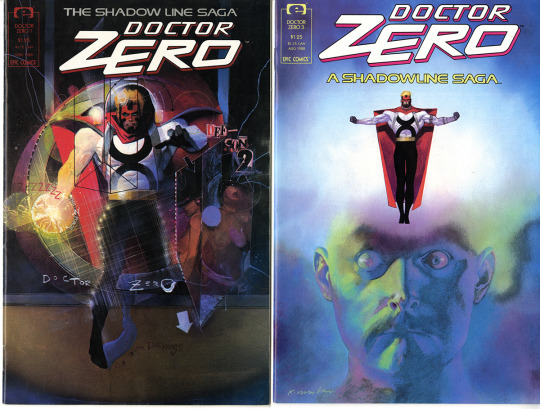
Doctor Zero 1-5 (1988)

By DG Chichester, Margaret Clark. Art by Denys Cowan & Bill Sienkiewicz. 

image
Art by Bill Sienkiewicz (left), Kevin Nowlan (right)

Manufacturing Superheroes

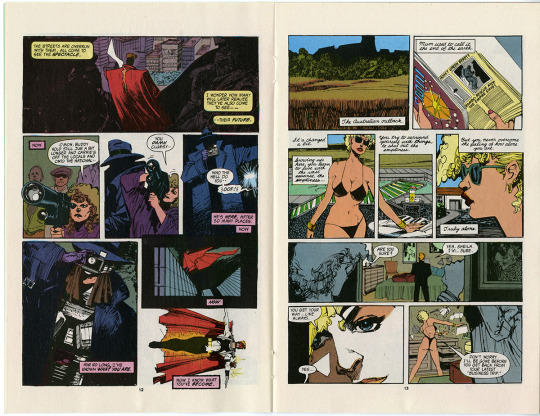
Doctor Zero [ 1 ] is just one series in an interlocked line of comics, called Shadowline. Itโ€™s a bit difficult to understand whatโ€™s going on in the first issue. The story follows several disparate events, a US bombing raid in Libya, nuclear terrorists on the Empire State Building, a missile attack on World Economic Forum in Davos. The common thread is Doctor Zero, who seems to be orchestrating the events from behind the scenes. He sets the wheels in motion, only to show upโ€”last minuteโ€”and save the day. In a way, this is the most obvious way to be a superhero in the world. The idea of โ€˜patrollingโ€™ the streets seems impossible. How do you patrol the streets of a city of millions? Even the police canโ€™t keep up! By manufacturing events in advance, Doctor Zero can easily โ€˜superheroโ€™ them. He knows whatโ€™s coming, and he prepares, not only for the event but the media frenzy that follows.

image

Mysterious Doctor

Heโ€™s got all the trappings of a superhero: costume and powers; but Doc Zero seems to have an agenda all his own. Being a superhero seems to be part of some kind of nefarious plan heโ€™s been concocting from the โ€˜shadows.โ€™ Apparently, he, and ones like him, have been living in the shadows for a long time. They appear to be a parallel race of humans that have a variety of powers; sort of like Marvel’s mutants or Inhumans. Anyway, as Doc Zero is engineering another superhero event in Africa, he is ambushed by St. Georgeโ€”another one of these shadow beings. Doc Zero kills St. George and appears to suck out her energy. Maybe heโ€™s an energy vampire? Hard to tell. Weโ€™ll have to find out in the next issue.

Divine Intervention

As the series continues, Doc Zero is revealed to be an immortal (or at least very ancient) roaming the planet since before humanity evolved. In fact, in one caption, he says he walked on Gondwana, which would make him several hundred million years old(!!!). Maybe โ€˜zeroโ€™ means heโ€™s the oldest of the Shadowline beings? Are his Machiavellian machinations some kind of god-like need to intervene in human affairs? Humans need saving, for they know not what we do. These kinds of ruminations are frequent with Doc Zero. He clearly has a god complex.

image

Occasionally there are hints of something else. For example, Doc Zero also swims with dolphins. He seems to be a good friend of dolphin-kind, who, according to him, โ€œflaunt their abilities openly.โ€ What does that mean? No explanation. Of the dolphins, he says, โ€œIโ€™ve reminded them of my offer to take them with me when I goโ€ฆโ€ Go where? Is Doc Zero, and by extension, all Shadowline characters, alien? Or is this just another way to play with his godhood? Itโ€™s never explained in the five issues I read.

Questions

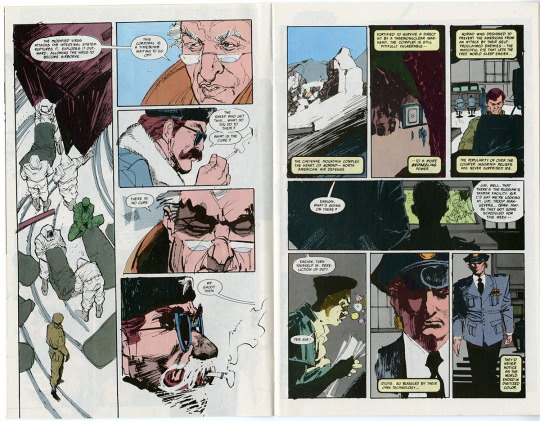
Art by Denys Cowan is awesome. These pages look a bit like his work in The Question, on which he was working at the same time. In fact, Doc Zero is a dead ringer for Vic Sage. The whole package seems to be lifted from DC Comics. DC had a number of titles packaged in a similar way: premium paper, painted covers by Bill Sienkiewicz, and mature content inside. The QuestionThe Shadow, etc. [ 2 ] In other words, The Shadowline books appear to be conceptualized around the successes DC was having with anti-heroes and โ€˜real-worldโ€™ superheroes. In a way, this is also a more mature-readers parallel to Marvel’s New Universe, which strived towards more “realistic” stories. New Universe was a conscious effort to start a “new” Marvel superhero universe, but with one extra constraint: everything that happened in New Universe became โ€˜real, and unchanging history.โ€™ It was a new Marvel universe, but with consistency and constrained by โ€˜realityโ€™ in a way that the main Marvel Universe never was. [ 3 ]

Dream Team

All issues (except #5) are drawn by Denys Cowan and inked by Bill Sienkiewicz. Each issue has a different cover artist. Apparently, Shadowline used the same cover artist across the line each month. It gave the titles a nice visual unity on the stands.

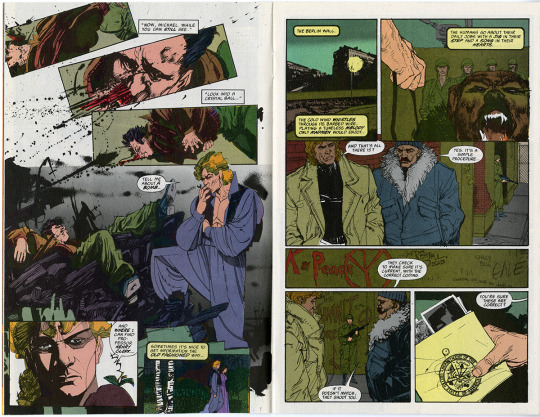
As mentioned above, Cowan and Sienkiewicz were also working together on The Question at the same time. Through this ongoing collaboration, they developed a strong rapport. The finishes on Cowanโ€™s art are really remarkable. Sienkiewicz zeroes in on the strongest parts of the image unerringly. His black spotting is key. Once the basic blacks are spotted, and composition is secure, the rest can be whatever flights of fancy he deems right for the moment. He just goes balls out using all kinds of tools and techniques with occasional odd choices. A messy perfection that never disrespects Cowan’s pencils.

image

Just look at that weird white-out mustache on the last panel of the left side of the spread!

NOTES:

[ 1 ] A version of this post originally appeared on the Ink Slingers Tumblr. It has been re-edited and slightly expanded.

[ 2 ] Eventually these various mature readers-oriented efforts would coalesce into DC’s Vertigo imprint in 1993.

[ 3 ] It’s not a coincidence that New Universe began during the time of narrative “crisis” in both Marvel & DC fictional Universes. The “white event” that instantiates the New Universe can be seen as an emanation from the Crisis of Infinite Earths or Secret Wars. It was a spark that reboots reality and sets a new consistent Universe consistent with rules first outlined in Omniverse magazine. Big event series like Crisis of Infinite Earths attempted to reboot the massive inconsistent superhero histories that accrued over decades. New Universe was doing the same thing but from scratch.


Frank Santoro on Beta Testing The Ongoing Apocalypse

This is a blast from the past. I was organizing some old links and this jumped out immediately! It’s an old ComicComics (who also misses ComicsComics?) post written by Frank Santoro. My comics at the time were appearing in the MOME anthology published by Fantagraphics. Frank’s take on my comics was an important and eye-opening moment for me. As I’m posting Adalbert Arcane’s notes to the new edition, it was fun to revisit this take. The post predates (by a few years) the first collected edition of Beta Testing the Apocalypse.

Frank has a fun no-nonsense writing style. A few snippets:

“This isnโ€™t a review or anything that attempts to cast a truly critical eye on the comics work of Tom Kaczynski. Itโ€™s more of an appreciation. For me, Tomโ€™s work is an oasis in the desert. And the desert is contemporary alternative comics. I find 80% of todayโ€™s alt-comics poorly constructed โ€” a veritable colony of lean-to shacks that could be blown over in a strong wind. In contrast, Tom K builds comics that could be likened to a brick house. These are solid comics. Is it any surprise that many of his stories have to do with architecture or that he went to architecture school?”

[…]

I feel firmly rooted in Tomโ€™s stories. I understand where the characters are, where I am as a reader. Never a bottle-necked area of the page or spread. Itโ€™s all very clear and airy, like walking through some Beaux-Arts 19th century library building. There are clear sight lines and strong centers on every page.

On 100,000 Miles:

The โ€œHighway Storyโ€ (100,000 miles) is interesting because it balances a certain sense of movement along with a realistic, believable sense of scale. Cars packed on a highway in slow motion, car crashes, cars lined up in a parking lot. Close-ups of the protagonist in his car and long shots of endless highway ribbons. Itโ€™s a short story, maybe only 8 or 9 pagesโ€”yet within the first couple pages a world is defined by the landscape itself.

On 976 sq ft:

The โ€œCondo Storyโ€ (976 sq ft) in contrast is less about balancing movement & scale as it is about scale itself. It opens with a couple on a rooftop looking down on to the street where a woman is walking a dog. So immediately here is the set-up: Seeing the world, or more specifically a neighborhood as a scale model. There is also a wonderful transition where the condo in real life fades into an architectural scale model of the same building.

Million Year Boom, p. 2 panels 5-6

On Million Year Boom:

The โ€œCorporation Storyโ€ (Million Year Boom). I can clearly see in my mind how perspectives & sightlines carry the reader across panels and the spreads of this story. There are very strong โ€œhorizontalsโ€ in this story (almost in counterpoint to the strong โ€œverticalsโ€ present in the โ€œcondo storyโ€). The corporate headquarters is low & wide, and the page compositions are tailored to convey the sense of open yet contained space. Thereโ€™s a great scene when the protagonist dives into a long rectangular pool that spans two panels.

On Influences:

I really enjoy his writing and drawing. He definitely owes a debt to the works of J.G. Ballard and Daniel Clowes. This is not a bad thing. Ballard was a surgeon with his words and the same could be said for Clowes with his drawing. Kaczynski has incorporated both mastersโ€™ approaches into his own work in a way that I find inspirational. He went through his influences and came out on the other side with something new, something his own. Like some hauntingly familiar โ€œhouse style,โ€ the approach fits the subject matter like a glove.


I can’t overemphasize how personally important this post was back when I was working on these stories for MOME. It’s rare when you find a reader that looks at your works this closely and just groks the vibe. Frank zeroes in on several sequences and moments that I agonized over. To have a reader unpack the structure of the comics with such precision was (and still is) personally very gratifying and gave me the oxygen to keep working on this material. I don’t know if I ever said thank you? Thank you, Frank!


Fantagraphics | Amazon.com | bn.com | Bookshop.org


36th Chamber of Commerce in A Batalha

I should’ve posted this ages ago. My 36th Chamber of Commerce story was translated into Portuguese and featured in the A Batalha newspaper. A Batalha is Portugal’s oldest anarchist newspaper (the original version was established in 1919) and a fitting place for the story. It was an honor to be included and very cool to see my work translated into Portuguese for the first time.

36th Chamber of Commerce originally ran as an 8-page story in World War III (B&W), and in Cartoon Dialectics #1 (with spot color). The A Batalha version had to be reformatted into a larger newspaper format and ended up with three oversized pages.

A Batalha was nicely put together. There were other comics in there and they had nice illustrations. You don’t know how much you miss illustrations from magazines and newspapers until you open one up with lots of them inside.

Here are some pics of 36ยช Cรขmara do Comรฉrcio in A Batalha. Special thanks to Chili Com Carne for making this possible!


Adalbert Arcane’s Notes and Theories: 100,000 MILES

Introduction

We begin a new series of guest posts from Adalbert Arcane, the writer of Notes & Theories section of the new edition of Beta Testing the Ongoing Apocalypse (BTTOA). The story covered is the first in the BTTOA cycle. This is the story that launched this project in the first place.

Who is Adalbert Arcane? Adalbert Arcane is a noted psychogeographer and the co-founder (with Tom Kaczynski) of Omniversity. He has an honorary fellow at OPA (Office for Psycho-Architecture).

Notes & Theories: 100,000 MILES

100,000 Miles by Tom Kaczynski page 1
100,000 Miles, page 1

AOL / TW

The author (Tom Kaczynski) claims personal events inspired this story. The details are sketchy, but some information can be pieced together from various infrequent interviews. The author did live in the Washington, DC area at the time of the creation of this story. He claims his commute to his job (when he was employed on a secret prototyping division of AOL/TimeWarner (AOL/TW) headquartered near the Dulles airport) was approximately 45 minutes each way. This is plausible as traffic in the DC/Virginia tech corridor is notorious.

The imagery of the comic resembles the freeway edgelands of the Herndon/Reston/Sterling suburban sprawl one would have to traverse to reach the AOL/TW HQ.

100,000 Miles, page 6, panel 1 by Tom Kaczynski
100,000 Miles, page 6, panel 1

Ballard

J.G. Ballardโ€™s car novels influenced 100,000 Miles [1]. The author makes this explicit on the page (see p. 14, panel 1). This author wears his influences on the sleeve.

Ballard’s Crash! and Concrete Island explore the psycho-sexual relationship between vehicles and drivers. Cars’ sleek chassis and leather barely conceal their latent deep pathology and violence. Drivers enter into a primitive hypnotic state as they begin to physically merge and identify with their vehicles. Violent collisions are moments of truth. The moment of the crash results in an erotic merger of steel, leather, and flesh [2]

In 100,000 Miles, the car is ubiquitous, commonplace, and tame. The Ballardian charge has already dissipated [3].

The protagonist drives aimlessly, trying to avoid work. The drive is a tedious and uneventful background that serves as a blank canvas for rumination and reverie. Is it a deliberate counterpoint to Debord’s Derivรฉ, where a flaneur traverses the city in rapid succession of ambiances? The car is a sensory deprivation chamberโ€”a theme that the author returns to repeatedly (see Hotel Silencio, Million Year Boom, and Music for Neanderthals)โ€”floating through a generic suburban wasteland. Occasionally the Real bursts through accidents and traffic jams. Like in Goddard’s Weekend, the traffic jam and the accident reveal the occulted meaning beneath the freeway concrete.

Break With the Past

This story distinctly breaks with the authorโ€™s other work (to be collected as Trans Terra, which attempts a sharp social critique in comics form) both formally and narratively. The Beta Testing The Apocalypse (BTTA) project seeds already appear here: obsession with numbered titles, easter eggs that connect each story, sly references to the source material, absurd fictional scenarios, etc.

100,000 Miles, page 7, panel 3 by Tom Kaczynski
100,000 Miles, page 7, panel 3

Traffic Jam / Hyperobject

At what point is the traffic jam real, a real object, an entity that has existential status? The author complicates the ontological status of the traffic jam. Sometimes we drive, and traffic seems to flow without delays, but another traffic jam is already forming somewhere ahead of us. Is each traffic jam a distinct entity? Or is the entirety of the automobile fleet simply in various states of the same continuous global traffic jam in various states of territorialization and deterritorialization?

These ideas parallel Timothy Mortonโ€™s work on hyperobjects and the contemporaneous work of the Object-Oriented Philosophical clique. OOP proposes novel metaphysics, reevaluates the ontological status of objects, and posits a positive flat ontology (more on this in notes on Million Year Boom).

The now-famous denouement of the infinite traffic jam sets the stage for the ongoing questioning of the ontological status of everyday reality throughout the book. This sequence is likely the genesis of the whole BTTA project.

[1] Originally appeared in Backwards City Review, 2006. First appearance in color: MOME 7, 2007.

[2] Though not explicitly based on Ballard, the Tetsuo, the Iron Man film best visualizes the flesh-machine hybrid.

[3] Ballard himself (as a writer at least) moved on to other libidinal-liminal zones, shopping malls, resorts, etc. 


Fantagraphics | Amazon.com | bn.com | Bookshop.org


Beta Testing the Ongoing Apocalypse Update

The dates keep moving on the release of Beta Testing the Ongoing Apocalypse. The release shifted from February to March 15th, 2022.

beta testing the ongoing apocalypse
beta testing the ongoing apocalypse cover by tom kaczynski

A few folks asked what will be different about the new edition. Besides being a hardcover, the new edition has a number of differences from the first edition:

  • A brand new cover (see above).
  • Three more stories. One previously unpublished.
  • An introduction by Christopher Brown.
  • Several pages of notes and theories by Adalbert Arcane.
  • Expanded Index.

You can order signed copies directly from me on this site:

or via Uncivilized Books here:

Order the book directly from Fantagraphics here:

Also available from Amazon, etc.

Amazon.com | bn.com | Bookshop.org


Uncivilized Territories

Gabrielle Bell and I started a podcast, Uncivilized Territories. Comics are the core subject, but we will often detour into broader cultural territories. This one is about comics, what comics can do for philosophy and the dangers of nostalgia. Future episodes will be on magick, domestication of dogs and humans, comics of Olivier Schrauwen, astral projection, and much more. Two cartoonists exploring uncivilized territories… episode one below.

Magical Devices Uncivilized Territories

Gabrielle and Tom K are enchanted by magic. The discussion begins with a reading ofย  S.S.O.T.B.M.E. by Ramsey Dukes. Through the alchemical power of conversation, the topic spawns a multifaceted hydra of detours and blind alleys. The theory of star seeds, magic vs. science vs. art, the internet police state, the magic of NFTs and Bitcoin. Comics are in there tooโ€ฆ and so much more! Gabrielle Bell's Patreon | Gabrielle's Books Tom's blog TransAtlantis I Tom's Books | Beta Testing the Ongoing Apocalypse Uncivilized Books.
  1. Magical Devices
  2. Olivier Schrauwen's Physiognomy
  3. The Abject Glamour of Comics
  4. Pet Theories
  5. The Psychogeography of Gabrielle Bell

Stay tuned for more episodes every two weeks!

Cartoon Dialectics 2: Apocalypse Is The Suburb Of Utopia

The new issue of Cartoon Dialectics is almost here! We were able to score a leftover batch of Pantone 804 fluorescent ink for the cover! It should be the perfect radioactive glow for the nihilistic content inside!

Table of contents:

  1. Cover
  2. Your Mind is a Vast Landscape by Adalbert Arcane. New spatial analysis of the mind and the comics medium. Co-presented by Omniversity. Illustrated Mind-Scape by Tom Kaczynski.
  3. Trans Terra Continues: The End of the World and the Typical Post Apocalyptic Scenario
  4. Eschatological Book Club with Ransom Strange
  5. Trans Terra Continues: The Ignoble End of Igloo City
  6. Extinction Level Events: We Are Elementals
  7. Trans Terra Continues: Continent Wrecked on a Mysterious Island
  8. Aesthetic Education: Man / God
  9. Indicia: Language as World
  10. Uncivilized Books Paid Advertising + Mechanics of Enjoyment
  11. Back Cover Motto: Apocalypse Is The Suburb of Utopia and A New Logos For The Anthropocene

The first 200 orders get a signed print. The first 50 get print + sticker!