Planeta Philosophorumโ€”Silver Surfer 4-5 (1987)

Silver Surfer and Mantis vs Ego The Living Planet

This post is part of an ongoing series looking at the Silver Surfer series (1987) written by Steve Englehart and drawn by Marshall Rogers. Previous installments: Part one. Part two. Itโ€™s also part of a larger project, Event Horizon, about comics from 1985 to 1987.
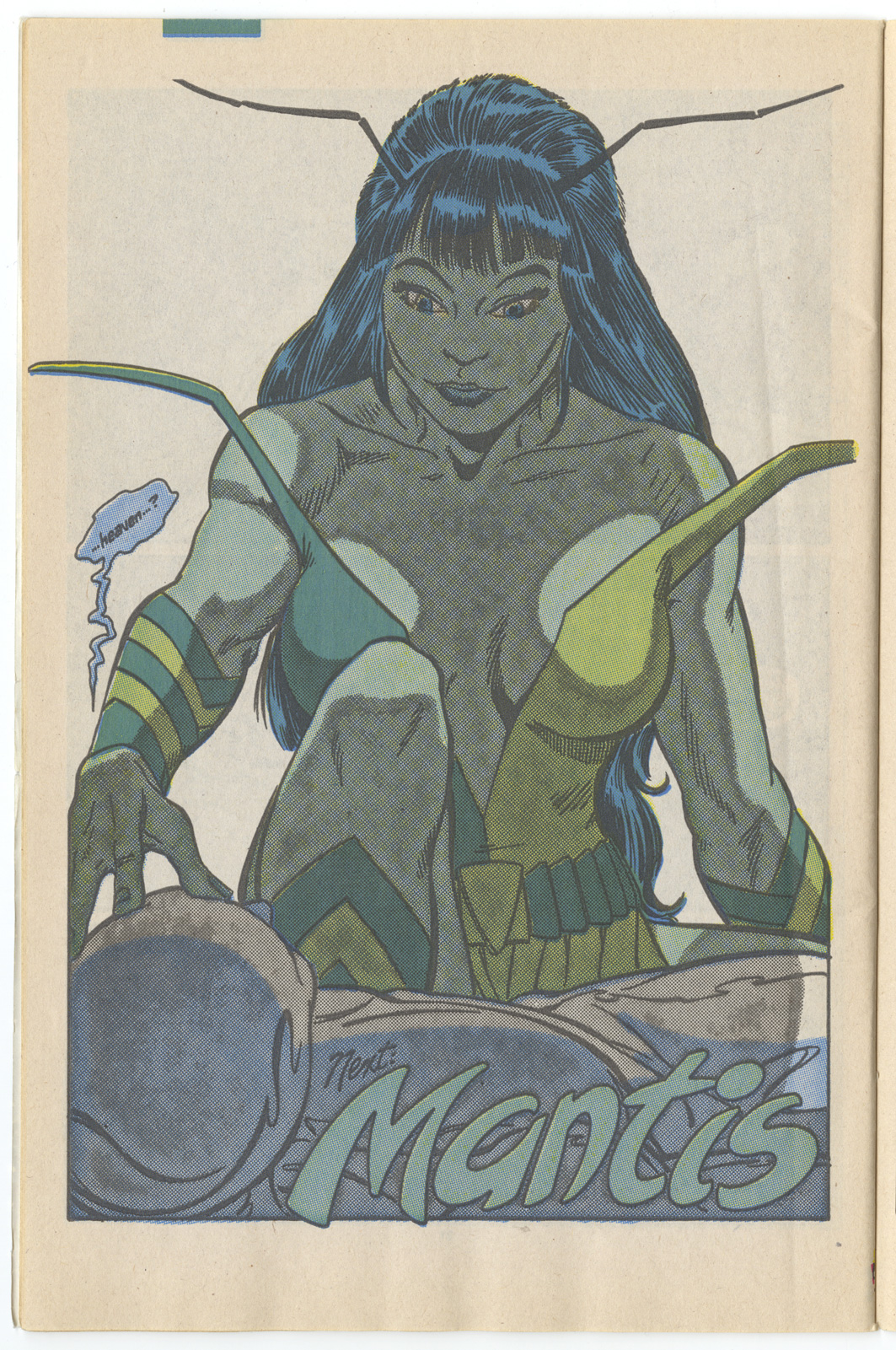
Mantis (issue 4)

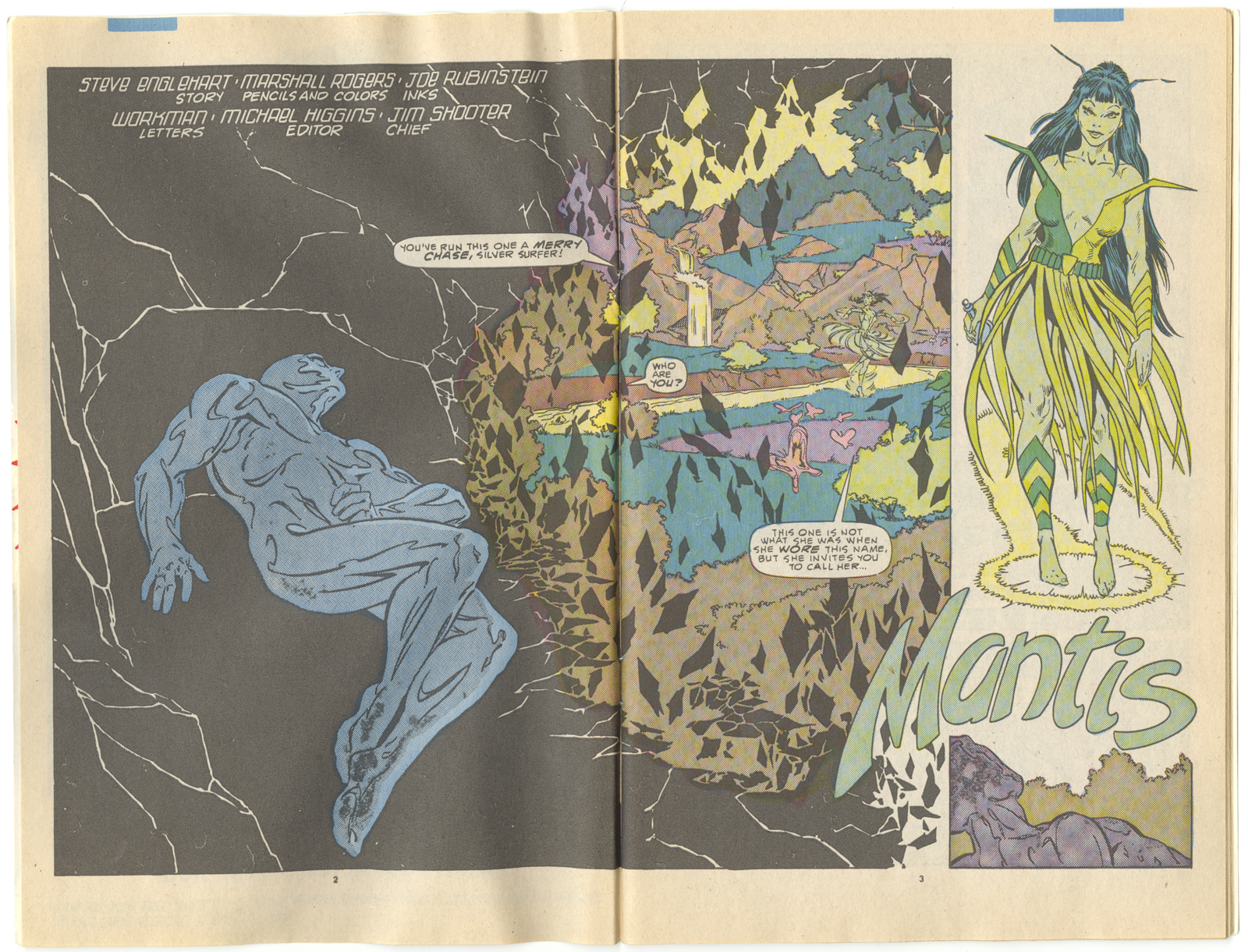
The Surfer, damaged and dying on a lifeless world (see previous issue), is saved by Mantis. Most of the fourth issue is dedicated to Mantis, the Celestial Madonna. Mantis is one of Steve Englehartโ€™s favorite Marvel characters. Heโ€™s been writing her for over a decade (her first appearance was in Avengers #112 in 1973), and sheโ€™s consequently amassed quite a long history.
Celestial Madonna

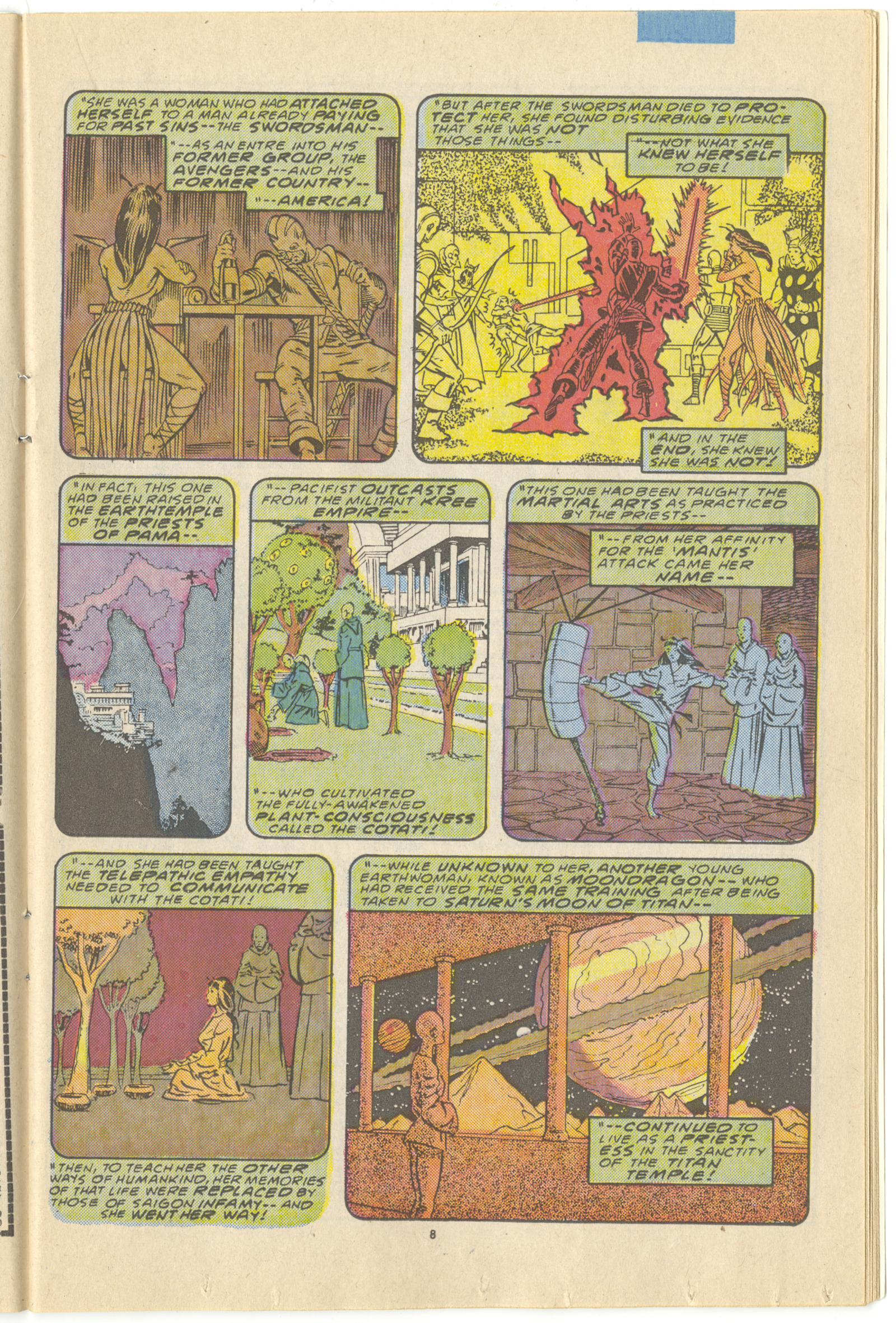
Mantis heals the Surferโ€™s skin and leads the Surfer to the hidden enclave of the Elders. On the way to the Elders, she recounts her story. Where the info dumps in previous issues were somewhat perfunctory, here, Mantisโ€™ story is lovingly retold over several pages. A full quarter of the issue recounts Mantisโ€™s back story! Itโ€™s too long to get into, so I advise the reader to either seek out the comics or check out her Wikipedia entry.

The most important part of her story is her cosmic wedding to the Cotati, a race of sentient plant life. Through this marriage, she entered symbiosis with plants, forming a union of flora and fauna. Itโ€™s another nod to the alchemical themes that begin to permeate the series. She became the Celestial Madonna, and a celestial child was born from this union. As we encounter her, Mantis travels the universe using her cosmic powers to transfer her consciousness from planet to planet.
The Info Dump

The info dump has a vital function in the Marvel Universe. As the various Marvel titles became more and more intertwined in the 80s, the โ€œinfo dumpโ€ became a more frequent feature. As a young reader, I used to love them. They showed me the vast history that remained out of reach. They also function as an essential storytelling device that smooths over gaps, lacunae, and inconsistencies.

Mantisโ€™ story is elegantly retold, edited, smoothed over, and historicized. A telos of Mantisโ€™ story emerges: to get her here, into this moment is Surferโ€™s life. Itโ€™s a mild retcon: this was always her purpose and calling. Itโ€™s as if this was always supposed to happen. All stories lead to Silver Surfer #4. Itโ€™s an effective technique when used well.

Elder Planet

Surfer and Mantis arrive at the Eldersโ€™ hideout. Here we finally meet the full roster: Grandmaster, Collector, Runner, Champion, Possessor, Gardener, Contemplator, Obliterator, Trader, Astronomer, andโ€ฆ Ego, the Living Planetโ€ฆ the very ground upon which the meeting is taking place!
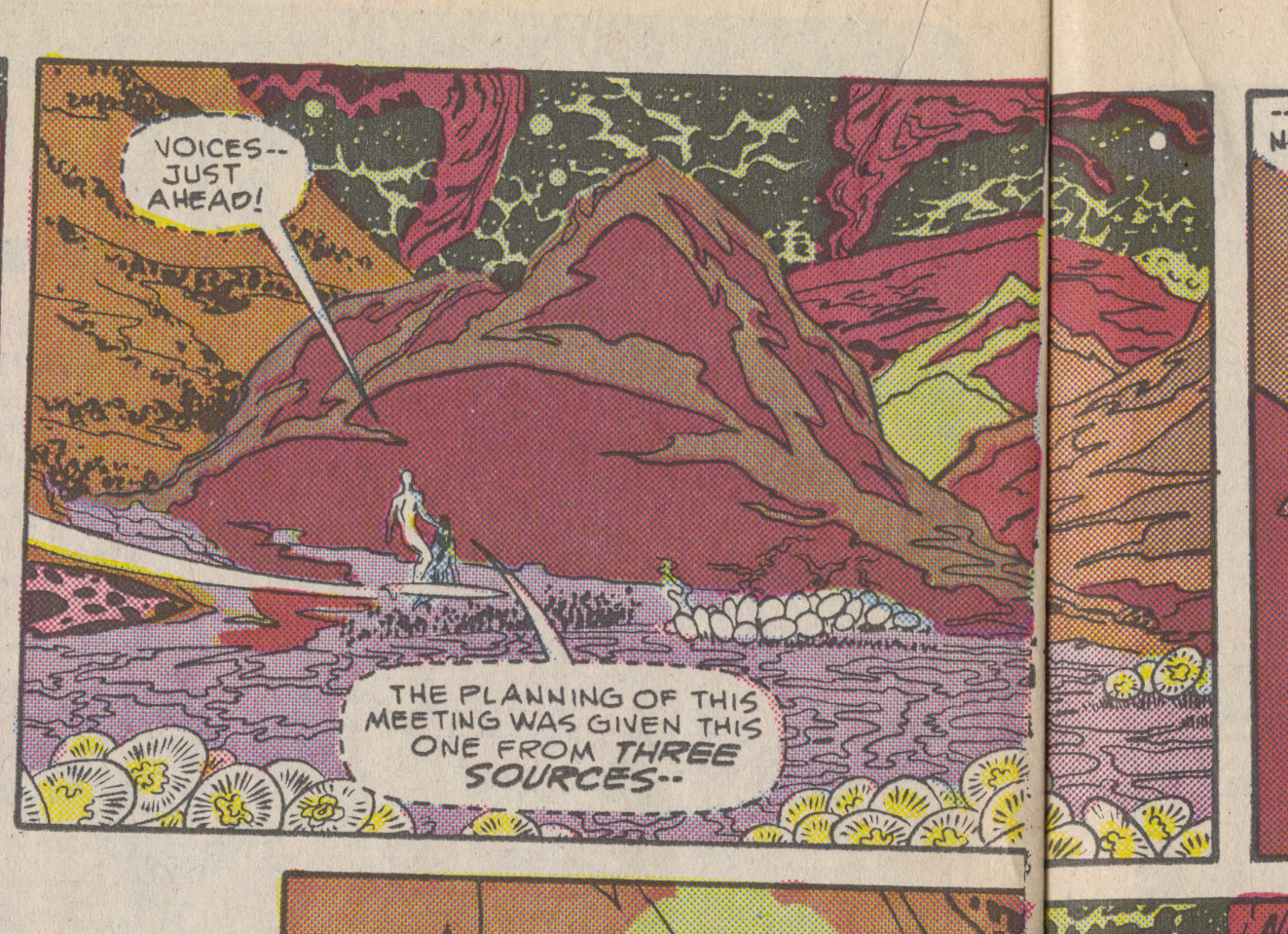
The face of the planet. Can you see it?

Incidentally, as the Silver Surfer and Mantis arrive at the planet, there’s a nice visual hint of Ego’s (as yet unknown) presence. The background landscape is arranged like a gigantic face. It’s a nice touch I never noticed before.

Lapis Philosophorum

The Elders are self-proclaimed โ€œoldest beings in the universe.โ€ Their immortality is another alchemical element often associated with the Philosopher’s Stone. Each one has a unique obsession that has fueled their near-eternal lives. The obsessions are pretty obvious based on the names of the characters. These obsessions are the key to their immortality. Each obsession is a unique Philosopher’s Stone, which drives them forward. They are a living will-to-power, or will-to-life, the conatus that drives them forward. Through it, they achieve literal immortalityโ€”eternal life.

Planeta Philosophorum

Ego, the living planet, is another alchemical character. Typically, we think of โ€œEarthโ€ as โ€œMother Earth.โ€ We perceive our planet as a nurturing feminine entity. Ego is the opposite. Heโ€™s a stern father commanding all his constituent elements with his iron will. A planet-sized philosopherโ€™s stoneโ€”he can transmute his constituent elements into others.  Heโ€™s immortal and has achieved the unity of opposites, a melding of base matter and life.

Eternal Envy

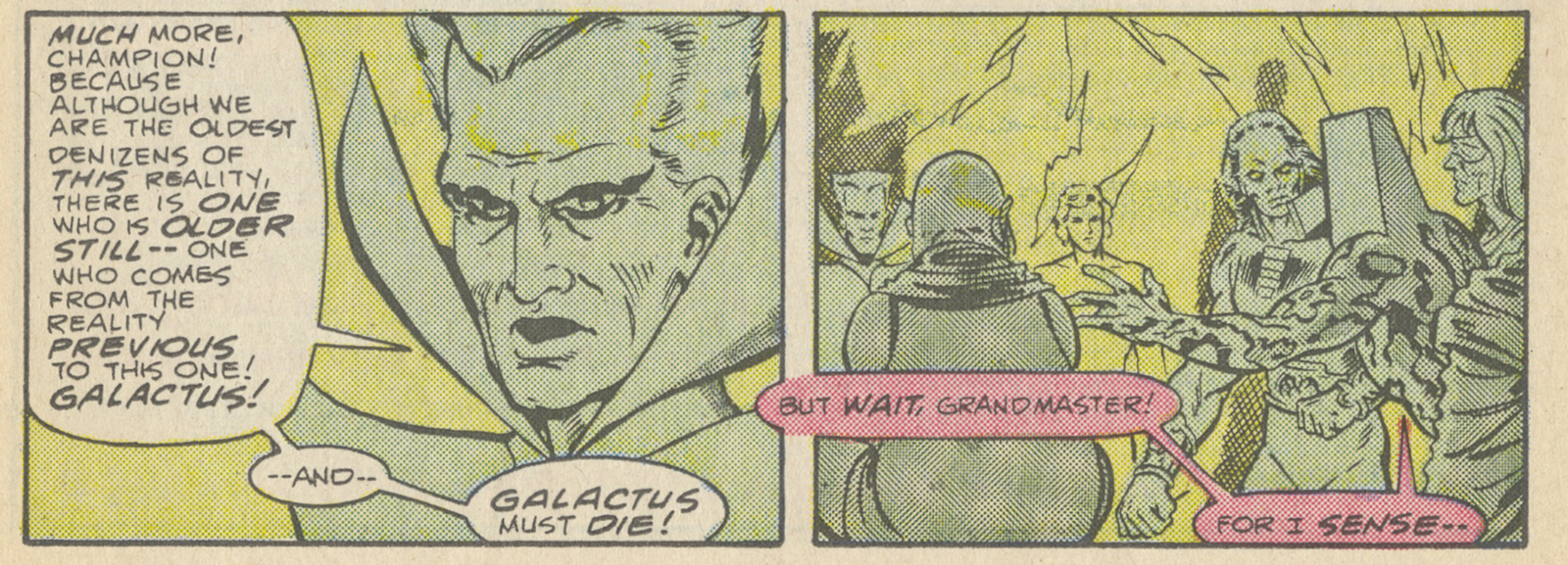
The Elders mostly recount recent backstory, but the Grandmaster drops a tantalizing hint of whatโ€™s to come. The Elders are the oldest beings in the universe, but thereโ€™s one older than all of them: Galactus! Therefore, โ€œGalactus must die!โ€

Escape

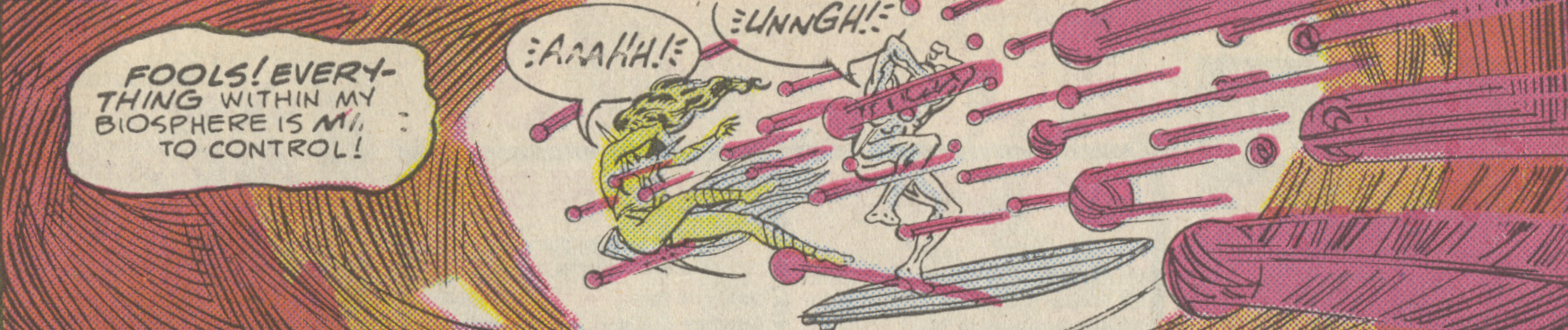
Before any more could be heard, Ego detects the presence of Mantis and the Surfer. A quick fight breaks out as the two escape off Ego into spaceโ€ฆ and share a brief kiss. โ€œWe two work so well together!โ€ says Mantis.

Meanwhile, we also get a quick update on the Kree-Skrull conflict in this issue. The Supreme Intelligence deduces that the Skrulls have lost their shape-shifting abilities! And a Celestial appears in the Skrull empire!

Obliteration! (Issue 5)

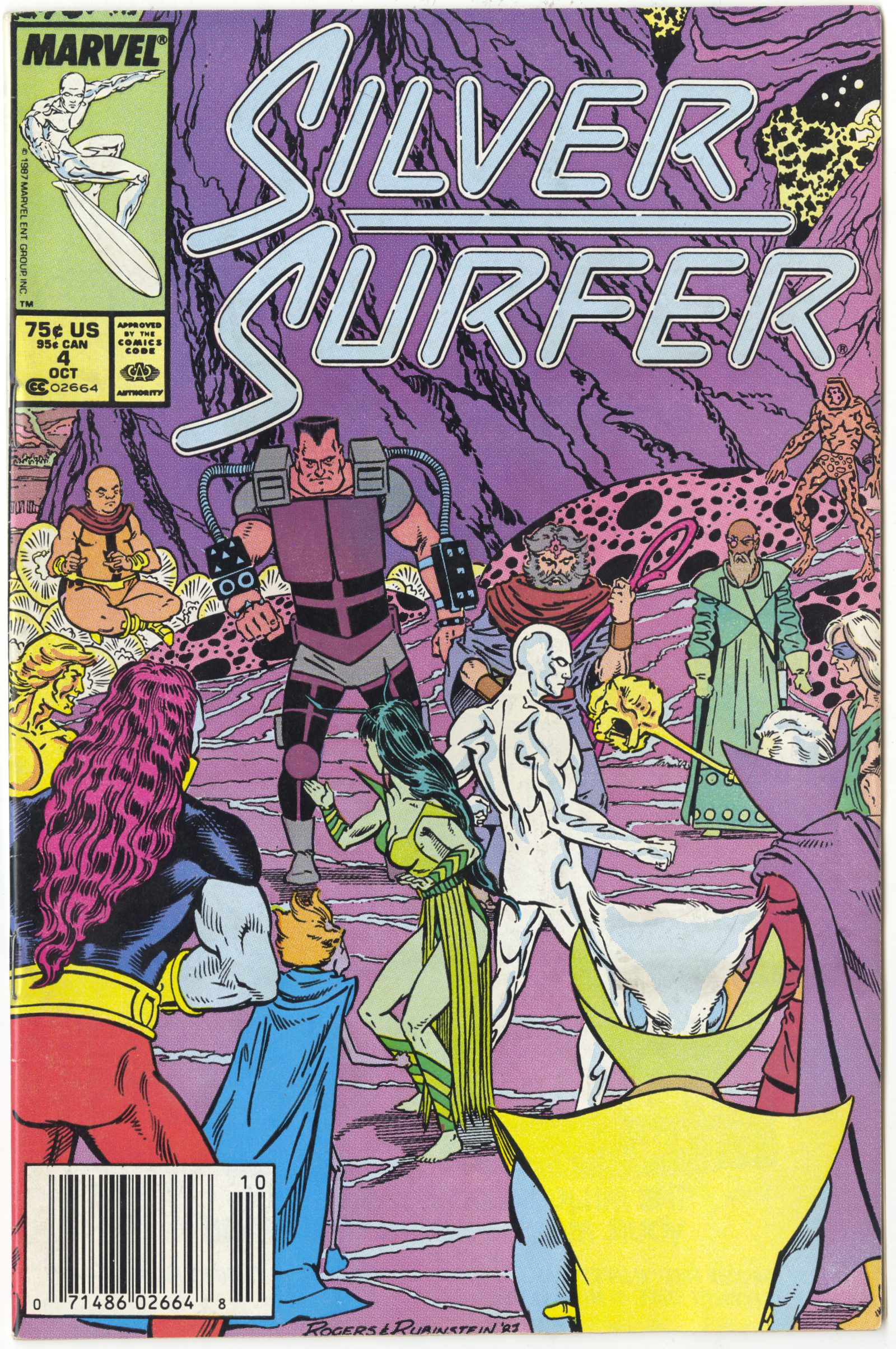
Look at that cover! Flat colors, color-hold, cartoon-eyed Obliteratorโ€ฆ just great.

The Obliterator catches up with Surfer and Mantis, and their fight consumes most of the issue. The Obliterator is like the Terminator; he keeps coming back! The Surfer and Mantis manage to ditch him several times, but he finds a way out and catches up with them again and again. Heโ€™s relentless!

The Obliterator is an interesting character. Rogers draws him almost in a cartoony style that is more familiar to indie comics. He has simple features. A pointy jarhead haircut, overbuilt torso, short legs, and blank Little-Orphan-Annie eyes under a heavy brow. Itโ€™s a startling design that feels somewhat out of place in the Marvel Universeโ€”more on him in the next issue.

Celestials

In the meantime, the Skrulls face off against Jamiah, one of the mysterious Celestials. It was the Celestial genetic experiments that eons ago created the Skrull species. Now, one of them returns. For what purpose? Usually, they are seen to stand in judgment of their creations. Jemiah is no different. Like a god, he towers over a Skrull capital. Kylor, one of the pretenders to the throne of the decaying Skrull empire, approaches the giant. The conversation is one-sided. Like a god, Jemiah is silent and inscrutable. The Skrulls attempt to nuke the colossus, but to no avail. โ€œEvents are collapsing upon us!โ€ Kylor laments.

Preying Mantis

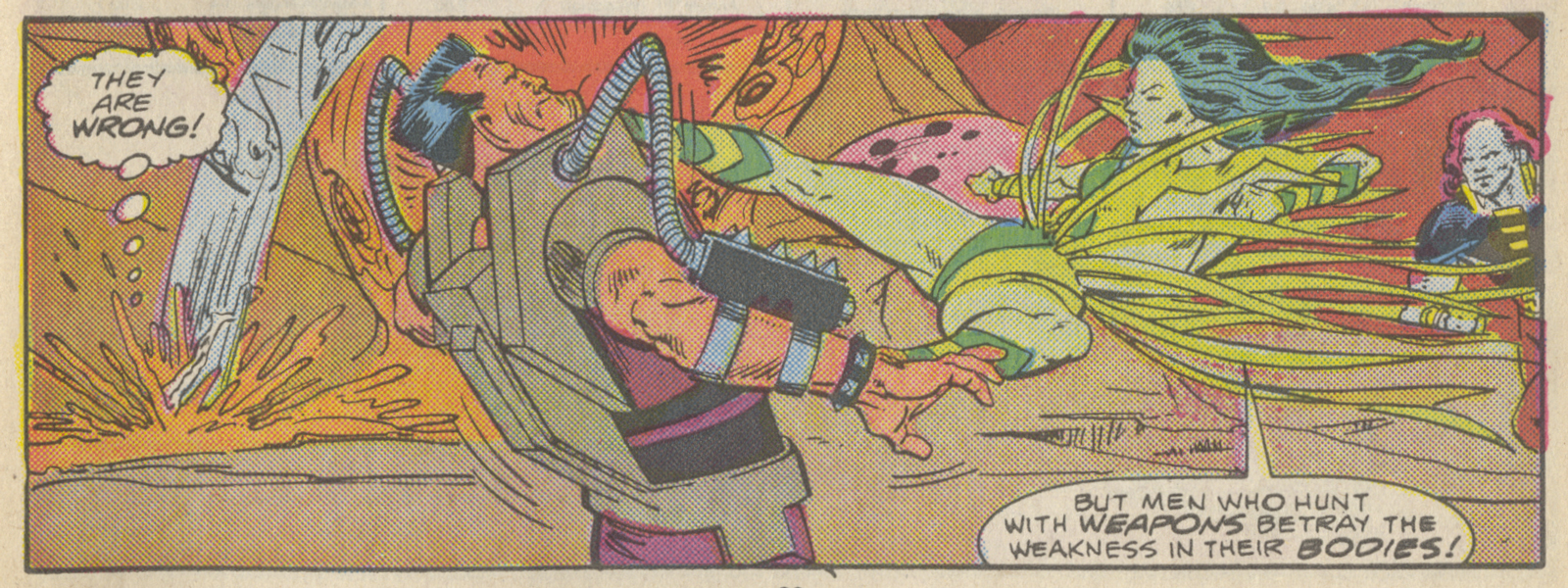
The Obliterator catches up with the Surfer and Mantis, and they have a final confrontation. Marshall Rogers’s art shines when he shows Mantisโ€™ martial arts abilities. She goes one-on-one against the Obliterator and almost gets the best of him. Look at the fantastic spread above. Minimal dialogue, paired with an arrangement that shows off Mantis’ agility. She traverses up, over, down, and forward directly into the camera. She is in constant movement; all the while, she’s delivering deadly blows. But he obliterates her!
Transubstantiation

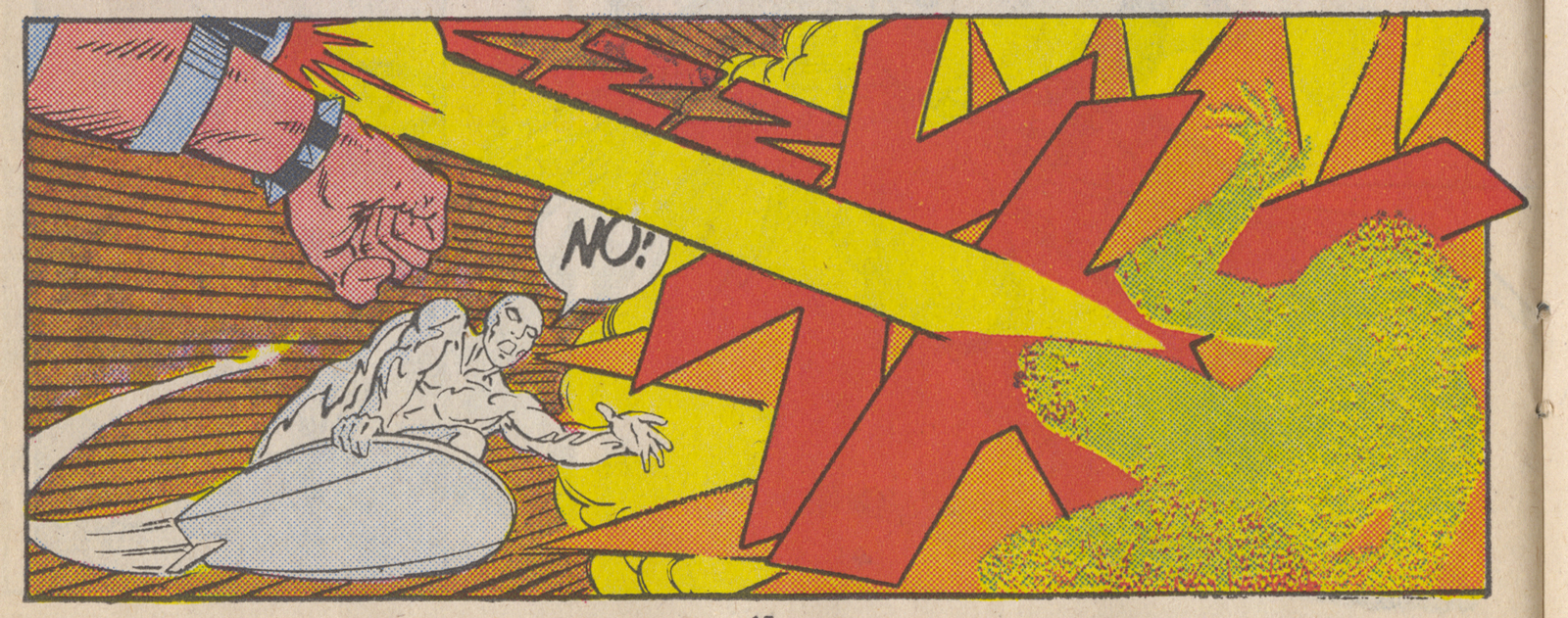
The Surfer, enraged, battles the hulking villain to a standstill and finally wins by disarming him through a power cosmic trick. He transubstantiates the Obliteratorโ€™s deadly weapons into harmless light emitters. The Surfer typically emits various rays of energy when engaged in combat. But Englehart likes to show an alchemical side of Surfer. He transmutes matter like a living Philosopher’s Stone. The Surfer is the perfect foil for the Eldersโ€”heโ€™s just like them.

Resurrection

It turns out Mantis survived her obliteration. A split second before disintegration, she transferred consciousness to local plants and re-grow a new bodyโ€”like a homunculus. The Surfer is overjoyed. The relationship between the two cosmic beings grows.


Love and Alchemy – Silver Surfer 2-3 (1987)

This post continues a look at the Silver Surfer series (1987) written by Steve Englehart and Marshall Rogers. For part one, look here. It’s also part of a larger project called Event Horizon, which is about comics from 1985 to 1987.

Silver Surfer #2. Surfer is returning home to Zenn-La.

Lond Distance Relationship (Issue 2)

In the second issue, the now-free Silver Surfer visits Zenn La to return to his love, Shalla Bal. Previously, the relationship of the two was presented as eternal, trans-universal, etc. In other words, it was idealized. The Surfer, a literal prisoner of Earth, had no choice but to keep a very long-distance idealized memory of Shalla Bal. 

While the Surfer was away, Shalla Bal created a new, independent life on Zenn La. Zenn La was devastated by Galactus (again, I’ll refrain from relating the Surfer’s long history; read it here). To help heal the planet, The Surfer gifted part of his “power cosmic” to Shalla Bal. With this power, she restored the planet’s biosphere and, as a result, became the “Empress” of Zenn La.ย 

Fictional Politics

As an aside, it’s always interesting to see what political systems are deployed in fictional worlds. Why did Zenn La become a monarchy? Was it one before? Is it constitutional? Absolute? The Skrulls are also an empire. In this series, the Skrull empire breaks into competing kingdoms, each ruled by a pretender to the imperial throne. The Kree are governed by the Supreme Intelligence, an AI composed of the minds of millions of Kree warriors. It’s a weird amalgam. It’s easy to imagine it as a Sparta-like warrior democracy that “progressed” to a pseudo-democratic technocratic rule by democracy as AI. More on this later.

 Love Will Tear Us Apart

Anyway, Shalla Bal and Surfer finally meet! But immediately, Surfer’s ideal love hits the unmoving force of reality. It becomes apparent that the two star-crossed lovers have different priorities. The love that bound them previously has ceased to exist. Shalla Bal becomes possessed by her duties as Empress.

The Empress has more important matters to attend to. The Skrulls sent an embassy to secure Zenn-La’s loyalty in the reigniting Kree-Skrull war. The Skrull designs must be checked, and the planet must be rebuilt. Romance is impossible under these circumstances. She rejects him romantically but insists that the Surfer remains a “protector” of Zenn La. 

And the Surfer isโ€ฆ a bit lost. His freedom shatters all his illusions about love, duties, and his very nature. He’s also angry in a way we’ve never seen him before. This isn’t the anger of facing an enemy. This is the anger of a noble soul, rejected by his eternal romantic love, who remains honor-bound to protect the realm as its shining knight. 

Knight-Errant

As he leaves Zenn La, he modifies a monument: “Here was born Norrin Radd, a son of Zenn-La,” to read “Here was born The Silver Surfer, a son of Zenn-La.”

He’s now a masterless knight in silver armor. His life as Herald over, he was ready to sacrifice for love. In the end, he realizes his love was “human.” It was Norrin Rad who loved Shalla Bal. The Surfer is now ready to discard his humanity and accept the Silver armor. The Silver Surfer flies alone. Or does he?

Silver Surfer #3. Cover. Gold vs. Silver.

The Content of Freedom (Issue 3)

In the third issue, the continuity gets wonky. This is not uncommon in the vast labyrinthine Marvel Universe. By the late 1980s, crossovers, events (see my piece on Crisis on Infinite Earths), etc., created an increasingly tightly interwoven narrative tower of Babel. Englehart wants to tell a relatively clean Surfer arc, but much of the back story is vast and pulls in threads from other Marvel titles. 

We already know the Elders of the universe are planning something. A big piece of this scheme is told elsewhere in two Avengers annuals. For the sake of brevity, I won’t get into it. Suffice it to say that the Surfer is now firmly set on a collision course with the Elders and intends to learn all he can about their nefarious plans.

Silver Surfer #3. Dense layouts and information density.

Holy Man

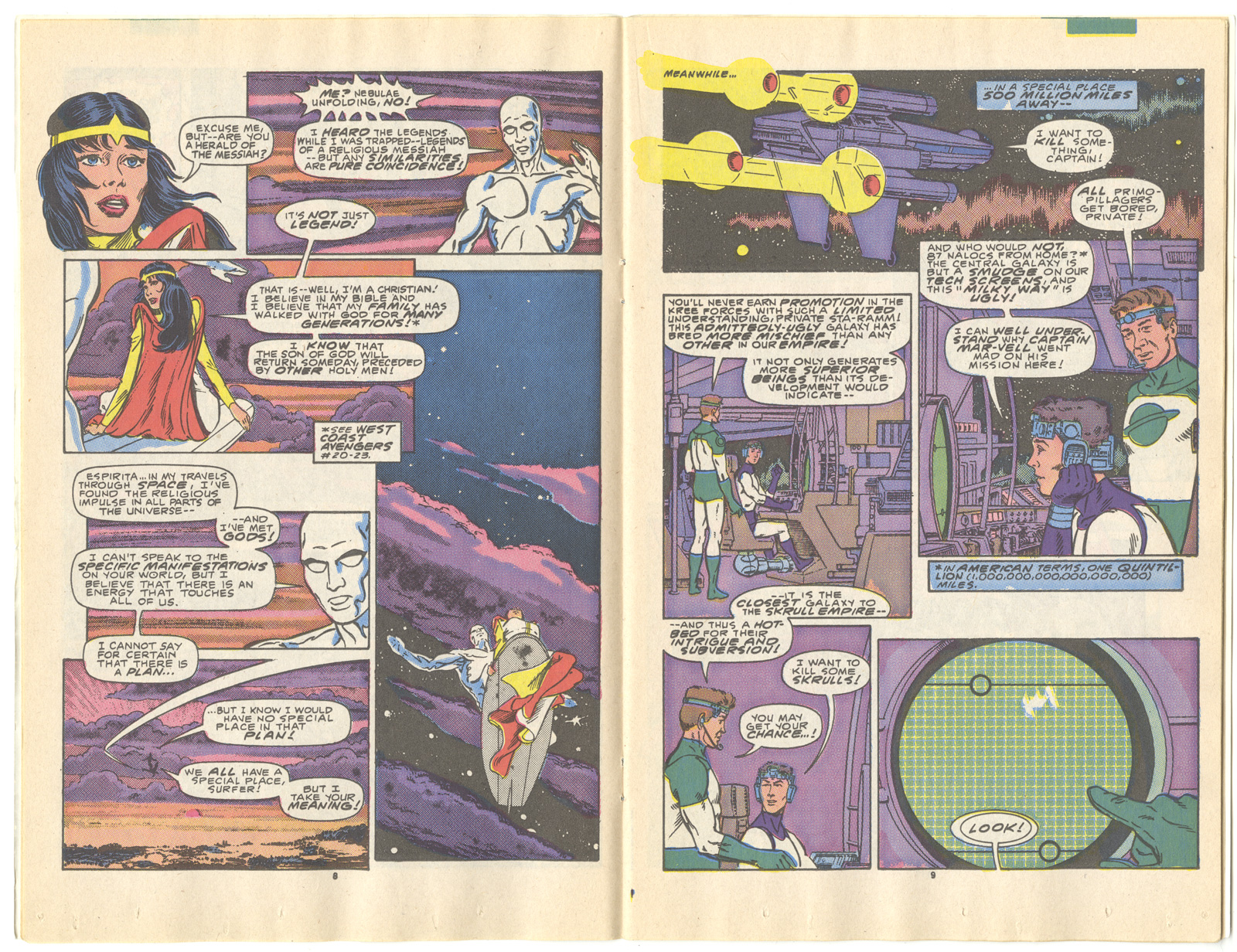
Two interesting moments occur in this issue. First, after a brief confrontation with the Collector, the Surfer escorts Espirita, a Christian superhero, back to Earth. The two have a short conversation. Espirita tells the Surfer that many people thought him to be a Herald of the Messiah during his imprisonment on Earth. The Surfer, startled, denies any religious affiliation. He believes the religious impulse is universal and that some energy touches us allโ€ฆ but there’s no plan. In any case, he wouldn’t have a special place in that plan. Espirita, a good Christian, retorts, “We all have a special place, Surfer!”

The moment nicely foreshadows the scale of the Elders’ plans, which will have cosmic repercussions. The Surfer here sees himself as insignificant in the universe, and his insignificance will haunt him for the rest of this arc.

Twins

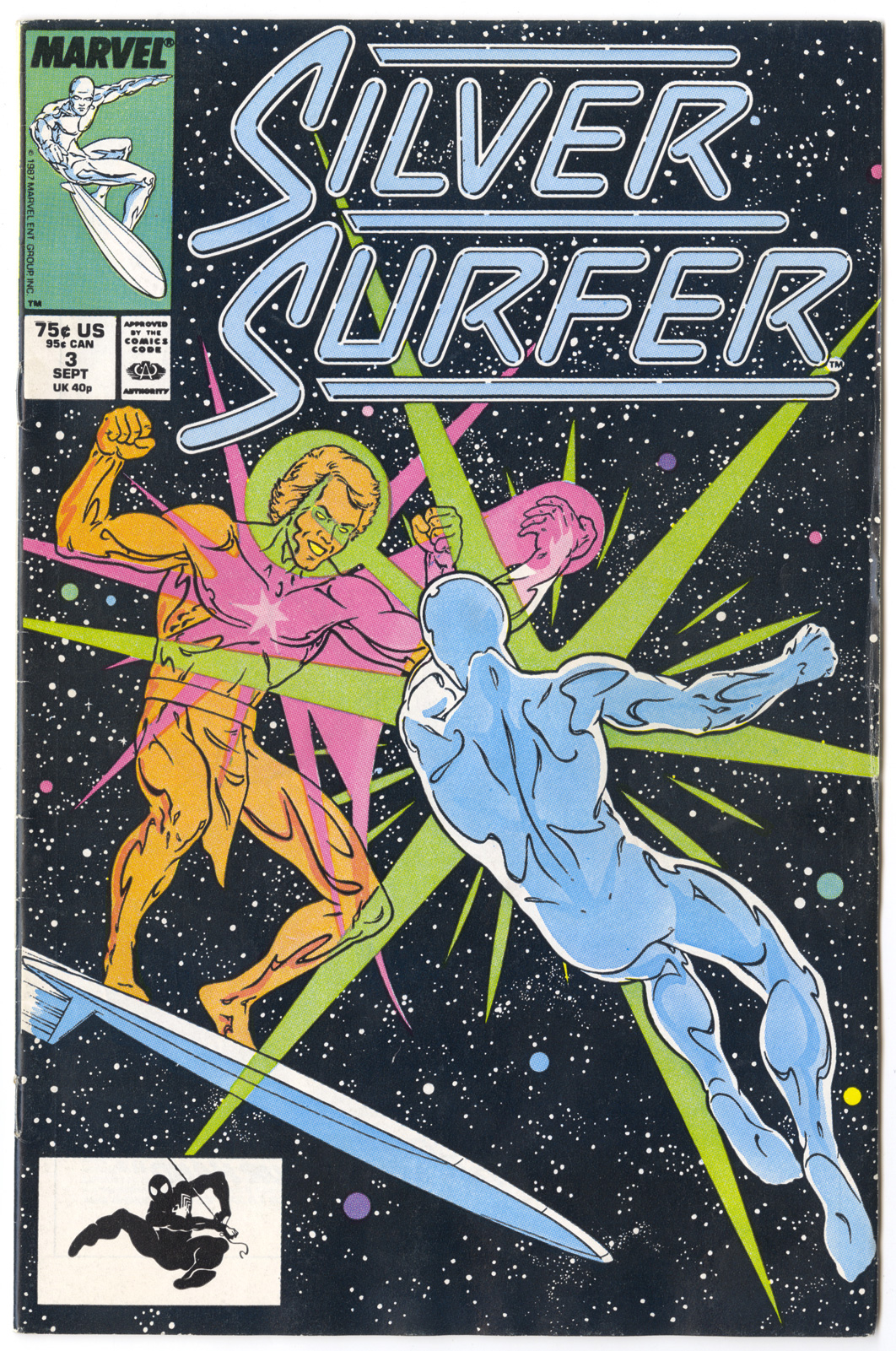
The other moment is the Surfer’s confrontation with the Elder known as the Runner. The Runner confronts the Surfer out of nowhere in the vast depth of space. Instead of silver, he is clad in gold. His appearance is that of a Greek god-like statue that comes to life. The Runner is a kind of twin of the Surfer. He says, “many sentients have spied my golden skin and thought us related.” Even though it is a physical contest, Surfer’s encounter with the Runner is also fraught with symbolic meaning.

Symbolically and archetypically, twins are often cast as moral opposites: good/evil, white/black, or civilization/barbarism. [ 1 ] Twins are locked in an everlasting struggle, whether on the physical plane or mental one. In Jungian terms:

“From this conflict, an irrational third arises the transcendent function, often in the form of a symbol. Logically, the opposites are always split and in conflict, but illogically, they coalesce in the unconscious psyche. The duality of archetypal content can be said to be integrated only when the full range of the spectrum has been made conscious.”

Source
Silver Surfer #3. Runner vs. Surfer.

Swept Away

There are interesting contrasts between the Surfer and the Runner. As the name suggests, the Surfer “surfs” on cosmic waves on his board. The symbolic implication is that he goes where the waves take him. Despite his vast power, he is swept up by events rather than affecting them directly.

The Runner, as the name suggests, “runs.” He is self-propelled and goes where he pleases. This goes well with his Elder-obsession. All Elders have an obsession (a Nietzschean will to power?) that has sustained and kept them alive for billions of years. We’ll get more in the weeds later, but the Runner’s obsession is to “see all there is to see, in all the universe!” Symbolically, he’s self-directed and possesses a goal and a destination (however vast it may be).

Alchemical Romance

The Surfer is silver, and the Runner is gold. Both are noble metals, but they have different symbolic meanings. 

SilverGold
moonsun
Artemis Apollo
purity prestige
strength luxury
clarity wisdom
silver age golden age
feminine masculine
youthdecadence

Slave, Meet The Master

The Surfer has always exhibited aspects of silver: purity, strength, clarity, and focus. Silver is associated with the moon and is also the color of Artemis. As such, it also contains feminine energy, which aligns well with his surfer nature and his general neurotic nature, full of self-doubt. He’s a human thrust onto a cosmic level; there’s a touch of impostor syndrome. He is the slave in Nietzsche’s master/slave dialectic.

The Runner exudes the ease and manner of an aristocrat, a golden child. He is confident and administers his brand of justice (kill the Surfer) without remorse. He also charismaticly affects the Surfer: “Something about him sweeps all caution from me!”  The Runner has no qualms about his quest for more power. If he can take it, he will. He embodies Nitschean master morality.

The Runner says, “I would’ve swiftly reached the end of my five billion years if I’d had to endure what you did [imprisonment on Earth]!” At first glance, it sounds like a compliment, but it’s also an insult. The Runner values freedom over everything. To be trapped anywhere would mean the Runner cannot fulfill his obsession; it’s the same as death. By implication, the Surfer allowed himself to be trapped and endured a lengthy imprisonment. Only slaves do that.

Free

The Runner says a tantalizing phrase to the Surfer: “[you are] too new to this freedom to understand how utterly it dwarfs individual concerns.” The Runner spells out the Surfer’s current predicament. Since sacrificing himself for Zenn-La by becoming the Herald of Galactus, this is the first time he has truly been free. 

The Runner proceeds to attack the Surfer. After brief combat, the Surfer is defeated and crashes into an uninhabited planet. In bad shape and dyingโ€ฆ he is met withโ€ฆ Mantis! 

Silver Surfer #3. Mantis!

Information, Art, Color, Letters

Both issues are still very informationally dense and heavy on backstory. One of the pleasures of reading stories set in the Marvel or DC universes is the back story, the obscure details, forgotten characters, missed connections, and esoteric lore. Steve Englehart is a master at this kind of pulp archaeology. He sifts through a mess of Marvel continuity and extracts a silver thread, which he uses to weave a complex narrative tapestry in The Silver Surfer. 

While these two issues don’t have the visual impact of the first issue, they demonstrate Marshall Rogers’ mastery of the form.ย His art and layout continue to impress even when he must accommodate some information-heavy layouts.

The lettering is credited to John Workman, one of the great comic book letterers. Typically, letterers also create the sound effects (SFX). But in Silver Surfer, the SFX appear to have been drawn by Rogers. They are integrated into the art and don’t resemble Workman’s usual SFX. It seems Rogers is doing the SFX uncredited. If anyone knows otherwise, let me know. Anyway, look at that!ย 

Silver Surfer #2. Sample SFX.

NOTES:

[ 1 ] “Twins appear frequently in folk cosmologies โ€“ usually cast in morally opposing roles. Anthony Stevens in his Guide to the Symbols of Mankind, Ariadne’s Clue, suggests that this archetype reflects the evolutionary ascent and involuntary descent of the sun: the good twin is represented as white, the bad one as black; one creates civilization, the other destroys it; Thus twins are locked in everlasting struggle (see, for example, the myths of Romulus and Remus, Cain and Abel, Jacob and Esau, Osiris and Set).

Stevens suggests that the symbolism has grown out of humanity’s primordial awareness that day is paired with night, light with darkness, summer with winter, and so on.

The archetype of twins is therefore to do with opposites, that together represent a whole.” โ€” source


Free – Silver Surfer #1 (1987)

silver surfer board POV marshall rogers

Space Is The Place

The 1987 Silver Surfer series is an under-appreciated high point in Marvel’s stable of comics during the tail end of the Event Horizon.

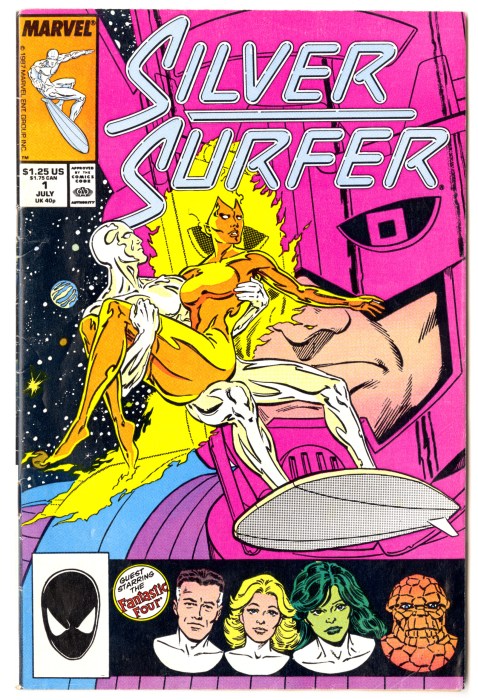
Fig. 1. Silver Surfer #1 (1987) Cover

The Silver Surfer has had a fraught career in the Marvel Universe. It’s an iconic character from the early golden Kirby/Lee age of the Fantastic Four. He became a popular guest star and a one-time member of the Defenders, but he never really came into his own as a character. (check The Silver Surfer’s convoluted back story here) Instantly recognizable, the Surfer was a compelling cosmic character. His imprisonment on Earth (by his former master, Galactus) created the impression of being a failure due to the Surfer’s “constant whining” about his predicament.

The 1987 series writer Steve Englehart (drawn (and colored) by Marshall Rogers and inked by Josef Rubenstein) consciously addressed the character’s shortcomings. In the first issue, the Silver Surfer is finally set free!

One thing to note is the density of the narrative. The Surfer runs into the Fantastic Four as they investigate the hole in the ozone layer in Antarctica. The team quickly solves the mystery when the Surfer admits to depleting the ozone in another futile attempt to break Galactus’ barrier. 

Out of the blue, Champion, one of the Elders of the Universe, attacks the Surfer. The Surfer wins and demands an explanation by right of victory. Champion launches into one of the several info dumps that convey massive amounts of information: 

  • A recap of the entirety of Silver Surfers’ Marvel history 
  • The Skrulls have lost their ability to shapeshift, and as a result, a new Kree-Skrull war is brewing
  • The vague contours of the Elders’ scheme behind it all begin to take shape

All of the above ties into a decades-long Marvel history, much of it written by Englehart. That’s all on top of the main narrative!

Once the Surfer dispatches Champion, Ben Grimm stumbles into an ingenious solution to the Surfer’s imprisonment. And, after a few pages, the Surfer is free! Instantly, the Surfer’s true nature is on full display as he surfs the cosmic spaceways. For the Surfer, space is the place.

Fig.2. The Surfer is free!

Master And Servant

But, before he can fully taste his new freedom, the Surfer must confront his jailer, his former master, Galactus. To remain free, Galactus must lift the punishment that bound the Surfer to Earth for so long. Silver Surfer proposes to free Nova (the current herald of Galactus) in exchange for a pardon. The two strike a bargain (Fig. 3).

Fig. 3. Nova rescue sequence pt. 1

The Skrulls hold Nova hostage on an “expandable” planet guarded by three million “expandable” fanatical Skrulls. The Skrulls, desperate to keep their secret: the loss of their species’ shapeshifting ability. They fear their eternal rivals, the Kree, would take advantage of their moment of weakness and invade. The Skrulls want to trade Nova’s life to force Galactus to consume the thousands of Kree planets! They want to turn the very forces of the cosmos against their rivals! Nova’s trap is specially designed to confound any effort by Galactus. The Surfer can succeed where Galactus would fail.

Fig. 4. Nova rescue sequence pt. 2

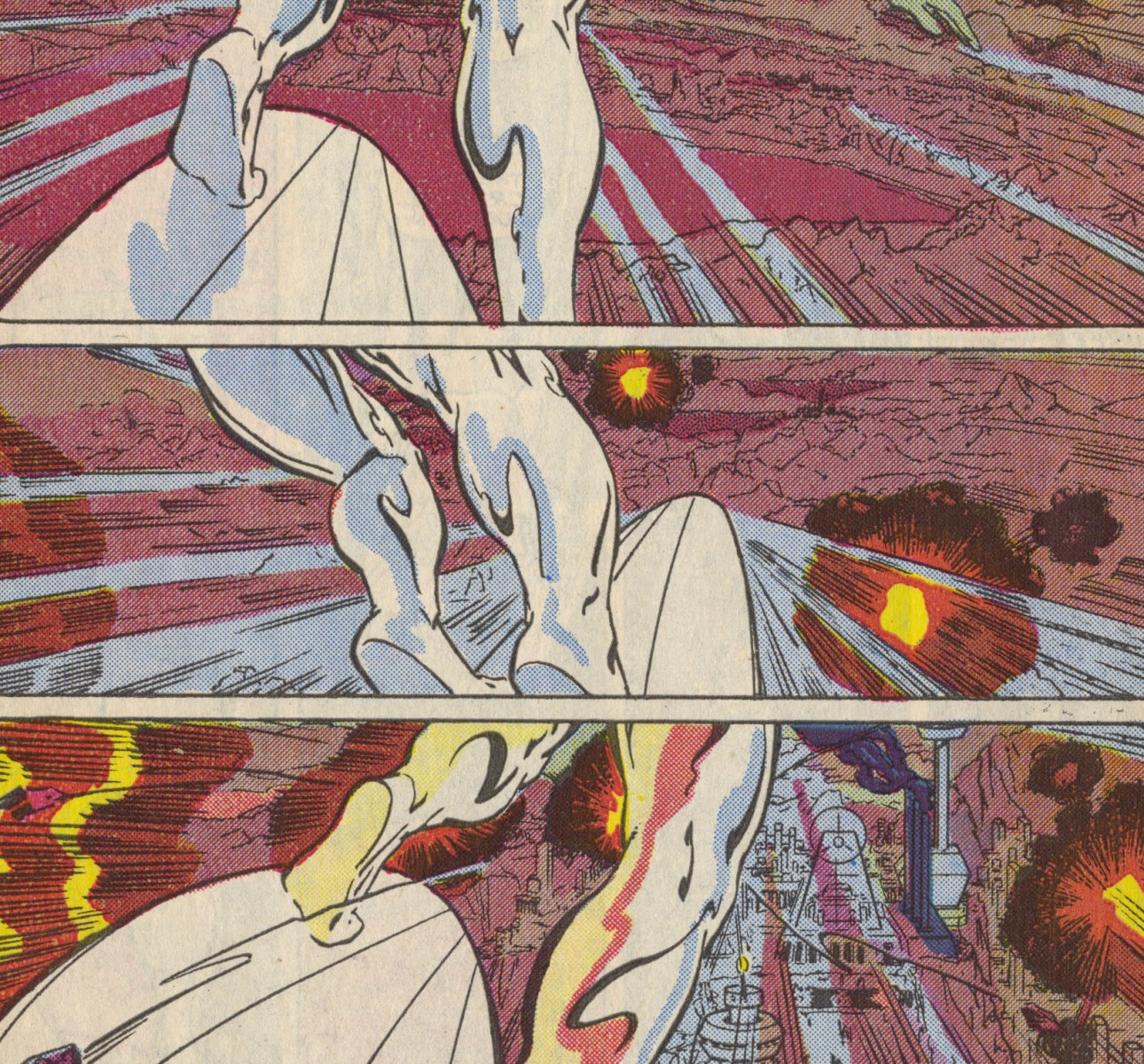
Marshall Rogers wonderfully visualizes the rescue sequence. First, the Surfer descends from space in a series of vertical panels emphasizing the distance traveled (Fig 2.). Then Rogers switches to horizontal panels as we see the changing ground below the Surfers board. The reader’s POV isย likeย sitting on the board behind the Surfer. Then, two full-page splash pages of the Surfer penetrating massive barriers surrounding the central device that holds the captured Nova (Fig. 4).

Fig. 5. Nova rescue sequence pt. 3

On the next page, the Surfer locates Nova in three vertical panels (Fig 5). On the subsequent page, three more vertical panels follow the Surfer, holding Nova, and escapes into space (Fig. 6). The denouement is another splash page of the Surfer holding the weakened Nova as they speed away from the Skrull planet (Fig. 7). It’s a masterful sequence that shows off the narrative and visual power of the medium.

Fig. 6. Nova rescue sequence pt. 4
Fig. 7. Nova rescue sequence pt. 5

It’s a great example of the push-pull between comics-specific realism and abstraction. Rogers reserves realism for characters and environments, while abstract visuals depict speed, energy, and superpowers. The old cartoon jokes (Fig. 8) about abstract art found their full narrative use in American superhero comics.ย The artist/cartoonist Keith Tilford had a few salient observations on this subject:

[George Pereze] understood abstraction via storytelling and had an incredibly strong design sense. I also thought immediately when Stephen Platt came onto the scene that there was a connection there. I still see it, and I am always interested in how these kinds of formal translations take place in comics.

Keith Tilford – TCJ Interview
Nancy by Ernie Bushmiller
Fig 8. Nancy panel by Ernie Bushmiller.

The art Avant-Garde “discovered” abstract visual expression. Still, comic books found the proper subject for the experiments: to visualize the intangible, unrealized, speculative, and hidden “cosmic” forces unleashed or uncovered by the technological revolution.

Moments like the above sequence and (elsewhere) show how integrated the Avant Garde experiments of the first half of the 20th century have become on the pages of American superhero comic books.

The Surfer returns Nova to Galactus and receives a pardon. The master/servant relationship no longer binds the two.

Fig. 9. Galactus pardons Silver Surfer.

It’s another great moment for the character. No longer confined to Earth, his conscience clear, The Silver Surfer surfs the cosmic spaceways!


Jim Starlin’s Dreadstar #1-2 (1982)

Dreadstarย #1ย (1982 โ€“ I read the newsstand edition of #1, re-published in 1985), Epic Comics

By Jim Starlin. Colors by Glynis Oliver

Intergalactic Refugee

Dreadstar #1 opens with a long, long, long ten-page recap. Vanth Dreadstar is a refugee from the Milky Way, destroyed by war. He settles on planet Nimbus in the Empirical Galaxy, where he tries to forget his old life and live in Peace. But, inevitably, war comes to Nimbus, anyway. A Monarchy starship lays waste to the planet leaving Dreadstar, Syzygy Darklock (a powerful magician), and Oediโ€”a cat-human hybrid and farmerโ€”as the only survivors. They vow to end this war and become the core of the rebellion against the war. They are joined by Willow, a blind cybernetic telepath who can see through the eyes of her pet space monkey, and later by Skeevo, a smuggler.

Church & State

The war is between the Monarchy and Instrumentality. The Monarchy is what it sounds like, a feudal dynastic monarchy ruling half the galaxy. The Instrumentality is a powerful religious order led by Lord High Papal. They have taken over the other half of the universe. Now the two powers struggle for supremacy over the Empirical galaxy. Starlin is playing around with classic themes of authoritarian dominance, whether monarchic or religious, doesnโ€™t matter. He sees both as two sides of the same coin. Both are wrong, and the struggle between them kills innocents. Dreadstar & crew need to free the Empirical Galaxy, both literally and figuratively.

High Polish

The first issue is a heist. The crew attacks an Instrumentality space station which is full of precious metals. Vanth wants the hoard of wealth to give them the funds to escalate their struggle against both sides.

Starlin draws the crap out of this issue. The environments are fully realized. The crew fights hundreds of robots, all rendered on the page without common visual shortcuts. Iโ€™ve always liked the way Stalin plays around with the grid. Heโ€™s unafraid to chop the grid into tiny slivers to add urgency to the action. He really wants visual density on a page. All the pages have either a lot of panels or are rendered with a lot of detail. He also doesnโ€™t skimp on text. He really wants to pack a lot of information into the comics. The result is a pretty satisfying read. Even if the intro info dump is a little much, you come away immersed into a huge story. It made me pretty excited for issue 2.

Star Wars

The whole thing is really reminiscent of Star Wars. It checks all the same boxes: 

  • Science-fantasy, check.
  • Mystical swords and powers, check.
  • Empires bent on galactic domination, check.ย 
  • A scrappy crew caught in the middle, check.ย 
  • A furry companion, check.ย 
  • You can keep going and keep finding more similarities.ย 

And it makes sense.ย Star Warsย made space opera fantasy really popular at that time. Many comics featured high adventure in space (Atari Force,ย Omega Men,ย Star Jammers,ย Alien Legion, among many others). But Starlin is an idiosyncratic creator, making it all his own. He injects his favorite themes: mysticism, religion, authoritarianism, and a sense of cosmic grandeur. A lot here is reminiscent ofย Warlockย &ย Captain Marvel, his 70โ€™s psychedelic cosmic comics for Marvel.ย Dreadstarย takes all these concepts, themes, character types and mashes them into a massive, sprawling space epic that is all his own.

Dreadstarย #2

After loading up on cash in the first issue, Dreadstar & gang continue their rebellion against the 200-year war between The Monarchy & The Instrumentality. The 2nd issue focuses on Willow, the blind telepath. She can read and affect the minds of humans and machines. We start out with Willow being a total badass as she effortlessly takes out a squad of military police that endangers their mission. We see how valuable she is to the Dreadstar crew. She quickly retreats into her private quarters and begins to ruminate on her life, which of course, means weโ€™re about to get Willowโ€™s origin story.

Willow

The Dreadstar crew rescue Willow in another operation (these events were apparently told in Epic Illustrated). She leaves her unhappy life and stowaways in Dreadstarโ€™s spaceship. When sheโ€™s discovered, she has a powerful psychic outburst. Vanth & Syzygy decide that having a telepath on board could be helpful, so they decide to keep her around. Syzygy trains Willow to use her mental powers, but she has some mental block that prevents her from reaching her full potential.

Ditkoesque

Most of this issue is an excuse for Starlin to go all Ditko on the art. Much of the training sequence with Syzygy and Willow takes place on various astral and mental planes, mystical dimensions, and other realms. Panels are full of cosmic psychedelia Steve Ditko pioneered in Doctor Strange and other books. Starlin has always been into this stuff. Warlock was full of Ditkoesque psychedelic touches. Weโ€™re treated to squiggly cosmic pathways, portals to unknown dimensions, and blinding white energy emanations that are the โ€˜force that dwells within all of us.โ€™ Starlin’s psychedelia here is more abstract, with thin lines holding large overlapping color fields. This approach gives the ‘astral plane’ a less solid, etherial vibe.

Soul Searching

Syzygy manages to identify Willowโ€™s block: She was sexually abused by her father (this proved to be very controversial in future letters columns). To overcome her trauma, she entersโ€”against Syzygyโ€™s warningโ€”the white energy of her soul only to be permanently blinded. But she triumphs over her traumatic blocks and becomes a powerful telepath. She accepts the trade-off: blindness for power. Dreadstar gifts her a space monkey, and now, by seeing through the eyes of the animal, sheโ€™s not so blind either. The white light stays with her, and she can call upon it in times of need.


This article is part of the Event Horizon series on comics. Click here to see others in the series.


Universal Crisis

After weeks of teasing, my Event Horizon column on Crisis on Infinite Earths has finally seen the light of day! Itโ€™s pretty big, which is appropriate given the subject matter. I follow the history of the comic book crossover and how it eventually led to the emergence of shared universes. The article also explores superhero metaphysics, the role of fandom in all these developments, and traces Crisisโ€™ cultural influence. Here are the first couple of paragraphs:

Crisis on Infinite Earths (COIE), published April 1985 to March 1986 was one of the quintessential and most influential comic book series of the Event (What is the Event? Read the introduction here.). It is overshadowed by comics like Watchmen or The Dark Knight, but it is arguably more influential than both.

What is remarkable about COIE is not formal or narrative innovation, but an intensification and scope of the endeavor of super-hero comic books. It is more appropriate to speak of COIE as an endeavor rather than as a specific comic book, though it is that as well. It is more important and influential AS an endeavor than as a comic book narrative.

Check it out, itโ€™s up now on The Comics Journal. And when you’re done with that, check out all the related Event Horizon posts here:

Explore more posts related to my Event Horizon column about the comics from 1985-87.

The Omniversal Method

omniverse

I will continue teasing my upcoming Crisis on Infinite Earths (COIE) article (part of my Event Horizon column) by dropping another interesting bit of comics history that had to be mostly left on the cutting room floor. Hereโ€™s the story of Omniverse magazine, a 70s fanzine founded by Mark Gruenwald. Gruenwald, for those who donโ€™t know, was a Marvel editor and writer best remembered for creating the Official Handbook of the Marvel Universe (1982), his long run on Captain America (1985 to 1995), the Squadron Supreme mini-series (Sep 1985 โ€“ Aug 1986), and Quasar (1989โ€“1994). But, what many donโ€™t know, is Gruenwaldโ€™s interest in fictional continuity — especially in the Marvel and DC superhero universes — indeed he can be considered one of the foremost theoreticians of the concept. The story of Omniverse magazine is largely also Mark Gruenwaldโ€™s story.

A Universe Emerges

By the mid โ€™70s, a new generation of authors and cartoonists entered the comics bullpens. They had grown up reading superheroes. As fans, they brought with them a new level of understanding of the superhero universe. They understood the value of the comic book crossover as fans, as readers, and now as writers. What was once valuable in terms of sales (crossovers often produced temporary sales bumps, especially when lower selling titles featured a popular character as guests), now became valuable on a narrative and mythological level. To this new generation, the value did not reside in each character, it resided in the world of characters. Crossovers became more frequent and created valuable narrative connections between comics and characters. Fans were encouraged to read more titles, as not to miss out on what happened in other corners of the universe. The story they were reading in Fantastic Four might have origins in another one in The Avengers. Heroes and villains could help each other out in different books. A shared narrative universe emerged out of a series of loosely related titles.

The Journal of Fictional Reality

The Fan press understood this as well. One of the most interesting fan publications of that era is Omniverse: The Journal of Fictional Reality, edited by Mark Gruenwald. The first issue, from fall 1977, is a masterpiece of theoretical world building. In the editorial, Gruenwald lays out the case for reading Marvel and DC comics as coherent universes. The entire magazine is devoted to explicating, explaining, and justifying the connections between the various inconsistent realities of the Marvel & DC universes. Itโ€™s grueling metaphysics, building the ontological maps for the weird-reality of the two universes. The seeds of the massive crossovers of the Event were sown here. Even some of the graphics prefigure the visual identity of COIE.

Gruenwald defines โ€œomniverseโ€ as โ€œthe continuum of all universes, the space/time matrix that comprises all alternative realms of reality.โ€ He also does not limit the omniverse to only comics, โ€œIn times to come, we hope to broaden our scope and place all forms of fiction under scrutiny. Til then, OMNIVERSE, will emphasize comic books over non-pictoral prose, due to the editorsโ€™ background in comicology.โ€

Reality Rating

One of the more fascinating items in Omniverse is its review column. Most fan press reviewed comics based on the quality of art or writing, but Omniverse had to be different. Its review column, โ€œCase Studiesโ€ (Omniverse #1, p.19-23), rates comics on their โ€˜Reality Ratingโ€™. The Reality Rating rates comics based on their overall depiction of reality. The ratings go from A to D:

  1. Enhances continuity or illuminates some new facet of reality.
  2. Despite some minor oversights, solid in its depiction of reality.
  3. Major problems in its depiction of reality, but still explainable.
  4. Detrimental to the readerโ€™s understanding of reality.

The ratings are not concerned with how well the comics conform to OUR reality (the one we live in), but how well they conform to the fictional reality they are part of. Special praise is heaped on comics that expand the scope of that fictional reality. For example, What If #3 gets an โ€˜Aโ€™ โ€œby virtue of its tighter terminology about parallel dimensions.โ€ (Omniverse #1, p. 23). On the other hand, Thor Annual 5 gets a โ€˜Cโ€™ because it introduces an inconsistency with the Norse & Olympian Gods within the Marvel Universe. The story depicts the gods as needing the โ€˜belief of mortal menโ€™ (p. 20) to exist, when in fact they have been previously depicted as independent other-dimensional beings without the need for โ€˜beliefโ€™ to sustain them.

The Reality of Reality

For much of their existence, comics stories for the most part existed in a kind of โ€˜situational comedyโ€™ vacuum. Sure, there was some continuity, but for the most part, when an adventure ended, the world โ€˜resetโ€™. The consequences of previous issues rarely had an impact on subsequent issues. Often, they introduced contradictions instead. For example, it might be written by someone less familiar with that particular characterโ€™s mythos, or simply because it was an interesting use of the character. Tight continuity, or consistent history of the character (the one exception being the origin story), had no value for a long time. The idea of a major character dying, and remain dead, for example, was still shocking at the time. It was a frequent trope to kill a character, only to resurrect them again later via some implausible deus-ex-machina plot device.

But once creators take continuity and โ€˜realityโ€™ of the fictional world seriously, itโ€™s a short distance to say, Watchmen (which imagines what our โ€˜realโ€™ world would be like once you add superheroes, with all the dark subtext and unintended consequences laid bare). Much of the innovation in comics of the 80s was simply creators taking fictional words seriously (however absurd they may be) and telling the stories that resulted from that seriousness.

Seeds of Crisis

Reading Omniverse, thereโ€™s a palpable sense of the theoretical case that Wolfman made for COIE. Omniverse is perhaps the most sophisticated explication of the various narrative complexities of the DC and Marvel universes. If this is what ended up in print, one can imagine the various theoretical constructions that circulated among the fandom in the years prior.

When writing about COIE, many of the concerns cited by Marv Wolfman as โ€˜problems to be solvedโ€™ in DCU continuity (multiple versions Atlantis, inconsistent futures, multiple Earths), are already present and explicated in Omniverse. For example:

  1. The various manifestations of Atlantis are discussed, and possible explanations for the inconsistencies are explored.
  2. The inconsistent future(s) inside of the DCU are enumerated. For example, Kamandiโ€™s nightmarish apocalyptic future does not match up with Legion of Superheroesโ€™ bright technological near-utopia of the 30th Century.
  3. There is a lengthy explication of the various multiversal, interdimensional, and time travels of The Flash. Many of these stories were key to COIE.

Omniverse shows these ideas and concerns were already advanced and present in the fandom, and among the writers who would eventually be given keys to the DC and Marvel universes.

Crisis Identity

Another eerie premonition of COIE is visual. It is the graphic for the Flash article (โ€œReality Spotlight on The Flashโ€ p. 24-28, art credited to Dennis Jensen, whose work I’ve never encountered elsewhere). The graphic depicts the Flash of two Worlds. The Flash from Earth-1 and Earth-2. Behind them there is a line-art graphic of four Earths, overlapping each other as if to suggest the multi-vibrational nature of the many Earths. This graphic treatment would become the logo for COIE. Perhaps thereโ€™s an earlier version of this graphical treatment? Maybe my readers know? Still, it is an interesting artifact that predates COIE by 8 years.

No Prize

DC & Marvel encouraged the fandom to make these kinds of investigations. The letters pages in most comic books were a hotbed of reader discussions on the many narrative โ€˜complexitiesโ€™ haunting both universes. Marvel made this into a virtue, by instituting the No Prize. Marvel editors awarded a No Prize to readers who came up with the best explanations for odd inconsistencies found in their stories. In effect, the letters pages blended with the fictional worlds, and some of the explanations could, and maybe should be considered canon.

Prophecy

In an interesting aside, Gruenwald quotes Paul Levitz article from Amazing Worlds of DC Comics #12 (August 1976 p.8):

โ€œThe pivotal time will be October 1986โ€ฆ and in that month, the future of the world will be decided. Either the path of the Great Disaster will be taken, and civilization will fall, or the path of sanity will prevail and the Legion of Super-Heroes will emerge triumphant a thousand years laterโ€ฆโ€

COIE series ended in April 1986. Did Paul Levitz miss the mark in his prophecy? Did DC miss an opportunity to build on this metafictional prediction? However, if we consider the omniversal nature of comic book fiction, we should turn to another event that happened in October 1986: Marvel launched the New Universeโ€ฆ The New Universe was a new fictional superhero universe that was exactly like our real-world until the โ€˜White Eventโ€™. The White Event was a point of divergence; a diversifal, in the parlance of omniversal theory. The White Event is the moment when the New Universe, began to diverge from ours, and superheroes become possibleโ€ฆ One of the main architects behind the new Marvel initiative was Mark Gruenwaldโ€ฆ โ€˜nuff said.

The premise and execution of Omniverse were a bit bonkers, but they also pointed to a way of looking at comics beyond simple, fannish enjoyment. Omniverse should be seen as an interesting and important moment in the development of comics criticism, which at that time was undergoing a renaissance.

Explore more posts related to my Event Horizon column about the comics from 1985-87.

Infinite Hyperobjects: Crisis on Infinite Earths

crisis on infinite earths crop

The upcoming Crisis on Infinite Earths (COIE) article that will appear in my TCJ column ended up with a lot of extra material that didnโ€™t make the cut. In the process of writing the article, I generated many concepts and ideas, and thousands of words that donโ€™t quite fit the article. A lot of this stuff is interesting on its own and deserves to be aired. I plan on following up on these ideas in the future. I already posted about Atari Force, the odd precursor to COIE. And a few days ago I wrote about George Perezโ€™s maximalist aesthetic.

Infinite Hyperobjects

One of the first frameworks I tried to use to think about COIE was the concept of hyperobject developed by philosopher Timothy Morton. The massive size of the narrative DC Universe (and the Marvel Universe (MU), which cannot be left out of the discussion) and its enormous influence and its emanations into general culture (via film, TV, toys, games, etc.) seemed tailor made for a concept like hyperobject.

In The Ecological Thought, Morton developed the concept of hyperobjects to describe objects that are so massively distributed in time and space as to transcend spatiotemporal specificity, such as global warming, styrofoam, and radioactive plutonium.[3] 

COIE was a massive event that grappled with the metaphysics of the even more massive DCU. The title alone evokes parallels to global warming. A planetary crisis but multiplied infinitely. Maybe looking at DCU through the lens of hyperobjects could be useful.

What is a Hyperobject?

Timothy Morton enumerates five characteristics of hyperobjects:

  1. Viscous: Hyperobjects adhere to any other object they touch, no matter how hard an object tries to resist. In this way, hyperobjects overrule ironic distance, meaning that the more an object tries to resist a hyperobject, the more glued to the hyperobject it becomes.[29]
  2. Molten: Hyperobjects are so massive that they refute the idea that spacetime is fixed, concrete, and consistent.[30]
  3. Nonlocal: Hyperobjects are massively distributed in time and space to the extent that their totality cannot be realized in any particular local manifestation. For example, global warming is a hyperobject that impacts meteorological conditions, such as tornado formation. According to Morton, though, objects don’t feel global warming, but instead, experience tornadoes as they cause damage in specific places. Thus, nonlocality describes the manner in which a hyperobject becomes more substantial than the local manifestations they produce.
  4. Phased: Hyperobjects occupy a higher-dimensional space than other entities can normally perceive. Thus, hyperobjects appear to come and go in three-dimensional space but would appear differently if an observer could have a higher multidimensional view.[32]
  5. Interobjective: Hyperobjects are formed by relations between more than one object. Consequently, objects are only able to perceive to the imprint, or “footprint,” of a hyperobject upon other objects, revealed as information. For example, global warming is formed by interactions between the Sun, fossil fuels, and carbon dioxide, among other objects. Yet, global warming is made apparent through emissions levels, temperature changes, and ocean levels, making it seem as if global warming is a product of scientific models, rather than an object that predated its own measurement. – from Wikipedia

Letโ€™s see if the Marvel or DC universe fit into Mortonโ€™s definition.

Viscosity

DC & Marvel have viscosity. Object stick to the DC / Marvel universe hyperobjects. For example, both companies have absorbed other companies and their respective โ€˜universes.โ€™ No matter how long they try to โ€˜keep them separated,โ€™ inevitably Charlton heroes, New Universe heroes, Fawcett heroes, etc. end up getting sucked into the voracious universes. Even more interestingly, in the โ€™70s and โ€™80s, there was a series of official and unofficial crossovers between these two universes. That means, that technically Superman exists in the same fictional universe as Spider-Man. Given enough time, itโ€™s possible to imagine a massive media conglomerate owning both universes, and bringing them together into one super-massive multiverse. Disneyโ€™s plan for 2050?

Another way DCU and MU demonstrate viscosity is in their effects on readers. The two universes are ever-expanding and sticky virtual worlds that can be inhabited by the fans to a disturbing degree.

Molten Lava

Both universes operate on a multidimensional level and consistently break and violate the contiguity of their fictional spacetime continuums. This may or may not be by design. But, the continual inconsistencies that creep into the universes need constant vigilance, reboots, etc. A good example of that is Ed Piskorโ€™s X-Men Grand Design. Piskor sutures decades of X-Men continuity — originally written and drawn by many different contributors — as if it was a single-story all along. The comic retelling functions like a history book, creating a unified narrative out of disparate historical events.

Both universes have lasted for decades and have produced an enormous amount of artifacts.

Nonlocality

Within their internal narrative logic, both universes are massively distributed in space and time. Both universes encompass universes (multi-verses even) and timelines stretch billions of years into the past and present. Reading a single Marvel or DC title never gets you even close to the totality of those universes. Beyond internal nonlocality, it is also nonlocal in the real world. The characters and concepts have spilled out into other media, books, TV, Film. Most recently Marvel Studios succeeded (before DC again) in porting the shared universe into film.

Picking up a single DCU or MU artifact, a neophyte is aware of a larger context, but the enormity of it eludes even the hardcore fans.

Phased

Both universes are phased and higher dimensional. They have this quality in both, their physical manifestation (as comic book made of paper) and in the fictional universe that emerges from their pages. We lack the perceptual apparatus to comprehend them in totality. We can only experience it one comic book, one TV show, or film at a time.

Additionally, we are largely unaware of the hidden forces behind the scenes, corporate decision, editorial mandates, moods of writers and artists, etc. all of which have effects on the universe we actually see.

Interobjective

This is maybe the clearest parallel. Each comic book, TV show, film, etc. is a footprint of something larger. Each one contains breadcrumbs in the narrative that can lead us to other corners. Crossover titles deliberately intensify narratives to reveal more of the universe. Seeing Wolverine appear in a Spider-Man title gives us a small glimpse of the massive X-Men comics continuity. Which itself is largely invisible, though interwoven with, the continuity of the Avengers, or The Punisher.

How to Manage a Universe?

COIE is perhaps the only comic book that attempted to map and manage a hyperobject as vast as the DCU. In fact, paradoxically, itโ€™s an attempt to manageโ€ฆ to de-hyperobject the DCU at the narrative levelโ€ฆ in order to expand the hyperobject on the commercial and cultural level.

If youโ€™re someone interested in comics as a medium either as a reader, or as a professional, the DCU and MU, were something that would confront you whether you wanted it or not. You may consciously avoid it, or just have no interest in it, but almost any conversation around comics would have to contend with DCU or MU. These two behemoths nearly consumed comics as a medium.

Infinite Terror

โ€œHyperobjects invoke a terror beyond the sublimeโ€ฆ A massive cathedral dome, the mystery of a stone circle, have nothing on the sheer existence of hyperobjects.โ€ Mortonโ€™s description evokes Lovecraftian cthuloid entities.

In an interview, Dan Clowes (Eightball, Ghost World, David Boring), recounted many moments of mounting horror when a stranger on an airplane asks him what he does. Once he’d answer that he made comic books, inevitably the immediate follow-up questions would be, “Which superhero do you draw?”

Ultimately, Iโ€™m not sure if DCU or MU qualify as hyperobjects, though they share some qualities. They may however be emanations of a much more vast hyperobjectโ€ฆ the massive industrial-entertainment complex that generates hyper-immersive fictional narratives inhabited by billions on this planet. It consumes massive resources and functions as an ideological safety valve for capital. These infinite worlds are multiplying rapidly around us as we hurtle through the yawning cold universe to our ultimate final crisis.

Explore more posts related to my Event Horizon column about the comics from 1985-87.

Notes on Comic Book Maximalism

crisis on infinite earths by george perez

Maximalist Aesthetics

Maximalism, in modern art, is usually seen as a reaction to minimalism (a post-WW II current in modern art). The art world tends to be very solipsistic and looks at its movements on a fairly narrow spectrum. I want to use the term a little more broadly. I want to think about maximalist aesthetics as a more general tendency in art, and specifically comics. There is a minimalist aesthetic as well, but thatโ€™s beyond this little post. Iโ€™ll develop that another time.

Iโ€™m in the process of writing about Crisis on Infinite Earths (COIE) for my Event Horizon column, and I wanted to classify George Pรฉrezโ€™s art in some way. He is famous for drawing comics stuffed to the gills with lots of characters and detail. He takes pride in this. According to Rob Clough, once on a comics panel, he said, โ€œwhy use three lines when you can use TEN!โ€

George Pรฉrez

His drawings are not what distinguishes his approach from others. Pรฉrez draws his figures and backgrounds squarely in line with comics realism, an approach, which, in the American context, is traceable back to Neal Adams. This style is more realistic (realism here is relative to older approaches like Wayne Boring, itโ€™s still a mannered realism) figure rendering, finer inking, focus on light and shadow, and how they add depth to the figure. One day Iโ€™ll have to unpack this more. In any case, Pรฉrezโ€™s basic style owes much to this approach.

Where Pรฉrez differs from the pack is in how he approaches the comic book page. He draws a large quantity of detail in each panel. But, he also has a tendency to layout the page in a very dense manner. In COIE especially, each page has a lot of panels. 10-12-15 panels per page are not uncommon, sometimes more. Overall, Pรฉrez approaches art and layout in a hyper-detailed and dense way. His layouts are complex, imaginative, and despite the density and enormous amount of detail, very clear. Heโ€™s is a maximalist in form and content.

Maximalism: A Definition

To summarize, here are some qualities of maximalism in comics:

  1. Quantity: large amount overwhelming detail: Geof Darrow, Hard Boiled.
  2. Depth: a lot of secondary details, jokes, etc. scattered in the panels that may or may not related to the main narrative: Will Elder, Mad Magazine.
  3. Density: of information or layout: George Pรฉrez on COIE.
  4. Scope: massive narrative length, scope, breadth of influences: Dave Sim, Cerebus (this definition developed by Tim Callahan). 

Many other examples exist out there. The maximalist tendency is present in comics from the beginning and can be traced from Windsor McCay, to Jack Kirby (especially his later work), to S. Clay Wilson, to Gary Panter, to contemporary practitioners like James Stokoe. The above should be seen as an exhaustive definition, rather as notes towards one. Let me know if you have ideas or suggestions on extending or improving this definition.

Oh and check out this Twitter thread on Maximalism for additional suggestions and ideas:

Explore more posts related to my Event Horizon column about the comics from 1985-87.

Atari Force 1-13

atari force 05

S-F Heroes

Atari Force is a title I admired from afar. I always loved the Jose Garcia Lopez art, and the fact that it was Science Fiction (S-F). With Gerry Conway writing, it always looked like itโ€™d be a solid title by two creators at the top of their game. I had a few random issues, but I never read any.

After acquiring issues 1-13 in a quarter bin not too long ago, I finally got around to reading them. Itโ€™s written by Gerry Conway (one of the great Bronze Age comics writers whose credits are too numerous to list), most of the art by Josรฉ Luis Garcia-Lopez, with a few fill-in issues drawn by Ross Andru (and inked by Lopez), and Eduardo Barretto. The lettering was done by Bob Lappanโ€”a delightful surpriseโ€”as he is one of my favorite letterers. Colors by Tom Ziuko.

I’m also currently re-reading and researching Crisis on Infinite Earths for another TCJ Event Horizon column (more on Even Horizon here). As I read through Atari Force, it became clear there were some interesting similarities to DC’s huge event series that came out only a few months later.

Art & Type

Lopezโ€™s art is crisp and light. He makes that classic bronze-era comic-book realism look so easy. His choreography of fights is always complicated but clear. Heโ€™s able to take difficult movements and postures and render them with a grounded lightness. He never skimps on environments either.

Josรฉ Luis Garcia-Lopez deep action. Fresh title type by Lappan!

Bob Lappan’s sound effects typography reaches sublime and absurd heights. Quirky, bizarre, odd, and awesome. Is there any other mainstream letterer that takes this much pleasure in rendering sound effects?

Stylized directional SFX in perspective
Imaginatively stylized SFX. Note the rivets in CLANK!

Star Wars

The narrative follows the Star Wars formula. A collection of โ€˜brokenโ€™ individuals has to come together as a team to defend the Multiverse against the Dark Destroyer, a Darth Vader-like menacing figure. A lot of Star Wars-like tropes abound. Alien planets, bounty hunters, an โ€˜forceโ€™ that seems to be undermining the lives of the heroes, etc.

The Dark Destroyer. Nice type on the bottom!

Multiverse Is the Place

One interesting aside is the use of the Multiverse as one of the driving engines of the story. In Atari Force, Humans have gained the ability to travel between universes, and one of the characters inherits the ability when exposed in the womb. Conway uses the idea as part of the universeโ€ฆ the multiverse increasingly became an important concept at both Marvel & DC. At DC it was at the core of the mythos since “Flash of Two Worlds” (Flash #123) established parallel Earth-2โ€ฆ and would become a key concept to revamp the DC line during the Crisis on Infinite Earths event.

There are other curious correspondences to Crisis on Infinite Earths. SPOILER WARNING: For example, it turns out that The Dark Destroyer is a double of the leader of Atari Force, Martin Champion. They are almost mirror images from disparate parts of the Multiverse. Destroyerโ€™s goal is to annihilate Martinโ€™s universe via an Anti-Matter bomb. These are obvious parallels to Monitor and Anti-Monitor and the matter vs. ant-matter struggle that propels the story of Crisis. Conway was one of the early architects of the multiverse concept that became increasingly deployed by both Marvel and DC throughout the 70โ€™s and 80โ€™s. As early as in 1972, Conway and writers Steve Englehart and Len Wein crafted an unofficial metafictional crossover spanning titles from both companies.

Gorgeous color and color hold art.

S-F Teams

The 80โ€™s were a good decade for โ€˜S-F hero teamโ€™ comics. They seemed to multiply everywhere. Besides Atari Force, there was also Omega Men and The Wanderers. I suppose the popularity of the S-F tinged Legion of Superheroes had something to do with it, as well as the popularity of Star Wars and S-F cinema. Marvel (via Epic) had Dreadstar and Alien Legion. Inside of the Marvel Universe were the Swashbucklers and Guardians of the Galaxy (though their heyday would come later). On the indie side there was Nexus and American Flagg! could be included, at least for its S-F nature, though it was much more ambitious thematically and artistically than most of the others. Iโ€™m sure Iโ€™m blanking on others.

Comics are for Kids

Atari is very much aimed at young readers, but in an interesting way. There are characters like Babe and Hukka which are very much aimed at very young readers. Babe is literally a big baby (albeit very powerful one) and speaks with a limited vocabulary. Babeโ€™s spotlight issue (#?) takes full advantage of this by limiting the words and action. Babe and Hukka riff off each other as they bumble and help revenge against (and genocide!!!) an invading force. Future issues feature Hukka back-up stories that use limited vocabulary, pantomime, onomatopoeia, and Bob Lappanโ€™s lettering mastery, to maximum effect.

Babe & Hukka antics

All this is paired with a more traditional comic book fare: heroic characters, adult situations โ€” but told from the POV of young adults, interesting S-F concepts like the Multiverse, villains with mysterious motivations, etc. The younger readers can come for the โ€˜babyโ€™ characters, but grow with the rest of the book as they master new skills and language. This is pretty rare in comics and books these days. This kind of formula is more often deployed in blockbuster movies, which are designed to appeal to the โ€˜familyโ€™ audience. Comics have become a much more niche product catering to specific demographics. Itโ€™s rare these days that the family would read comics together.

Atari logo incorporated into the physical environment… and more great type!

Branded to Oblivion

The story is only loosely based on the Atari Force video game (and accompanying comics). It takes the concepts into uncharted new territory. Visually, itโ€™s designed to capitalize on the Atari brand name. Itโ€™s jarring to see a comic book that was effectively a big Atari branding exercise. On every page some form of the Atari logo appears; as a patch, as a word, as a costume design flourish, etc.

Still, the creators don’t hold back. The characters are well rounded and interesting, the story is fun and propulsive, and the art is beautifully realized. Itโ€™s a pleasure to see top talent at the height of their powers. Itโ€™s a gorgeous comic book. It’s worth seeking this out in the original comic books… since it’ll probably never get reprinted due to licensing issues.

Ross Andru splash page

Explore more posts related to my Event Horizon column about the comics from 1985-87.

Pawn of the Demon: Batman and the Fractal Self-similarity of Superheroes

Batman_Fractal_crop

I’ve got a new entry in my Event Horizon column over at The Comics Journal. This on is about Batman: Son of the Demon (BSOTD) by Mike W. Barr and Jerry Bingham. I did a lot of writing around this episode, much of which didn’t make the final cut. Here’s a bit that got left on the cutting room floor. One thing I found myself struggling with is the large body of Batman literature. Much of this literature is very similar to itself, with small differences. The more I thought about it, the more it resembled a fractal structure. And when zooming out on this fractal, Batman and superheroes in general acquire a fractal self-similarity. But I get ahead of myself.

Ba(TM)an

How do you write about Batman? How do you write about a property like Batman? Specifically, how do you write about a single episode of one of the longest running comics properties in the world? How do you write about something like Batman: Son Of the Demon ?

After 80 years of continuous publication โ€” after countless issues, series, specials, graphic novels, novelizations, TV & film adaptions โ€” what is Batman? Which Batman do you write about? Batman the character or Ba(TM)an the franchise? When you write about BSOTD, which Batman do you compare him to? Is it possible to evaluate BSOTD on its own merits? How can you evaluate Batmanโ€™s behavior and story arc in this book? If you donโ€™t know the history between Raโ€™s al Ghul & Batman will this make any sense? If you know it only in-part, is that enough?

More Than You Can Read

If youโ€™re critical of a work like this, is it because you donโ€™t โ€˜get itโ€™? Is it because youโ€™re not a fan, and havenโ€™t taken the time to become more familiar with Batman mythos? Is it not for you? Or, is it possible to consider BSOTD out of the general Batman context and say something meaningful about it? This doesnโ€™t even begin to tackle Batman in the context of the broader DC Multiverse; all of his guest appearances, his relationships with Superman, Wonder Woman, The Justice League, and many of the other DC superheroes. Does any of that matter? Or, can you just write about BSOTD?

I have read many Batman comics, seen most of the ’66 TV show and all the Batman films since Tim Burton’s. Even with all this, I have not read more Batman, than I have read. This of course is true of just about anything. During our lifetime we will have not read more than we will have read.

One way is to just not worry about it too much. Each Batman incarnation fits the era in which it was created. Each Batman era owes as much to the general cultural context, as to the writer/artist/editor team that worked on the comics.

Batman Fractal
Batman Fractal

Fractal Self-Similarity of Superheroes

All that said, when you read a Batman comic, no matter how out of continuity, and how random, if you have read other Batman comics, and other superhero comics, most likely itโ€™ll have a quality similar to those other comics.

Thereโ€™s a self-similarity to superhero stories in general. A self-similar object โ€œis exactly or approximately similar to a part of itself (i.e. the whole has the same shape as one or more of the parts).โ€ [Wikipedia] Batman is like that. On transcendental level, Batman is a set of characteristics and story tropes. When looked at from a distance each part of the Batman canon is like another part. As you zoom in there are differences of course. But the differences circle around repetitions; like a fractal.

Pawn of the Demon

Anyway, back to the column. In this episode I start to zero-in on some of the general qualities of comics of the Event. (What is the Event? Read the introduction) This time I read Batman: Son of the Demon (BSOTD) by Mike W. Barr and Jerry Bingham. It’s a more traditional entry into the Event Horizon narrative.

I created a handy little chart that maps various Event titles onto art-narrative axes and with an experimental-to-traditional scale for each.

Event Horizon Fourfold Structure

Comics of the Event can be mapped onto a fourfold structure of two intersecting axes. On the horizontal axis, we have the โ€˜artโ€™ continuum, which ranges from experimental (or innovative) on one end, to traditional on the other. The vertical axis is โ€˜narrative,โ€™ which has a similar range.

Because comics are a unique melding of narrative and image, the intersections between these two continuums can result in unusual juxtapositions. Traditional narratives can be executed in experimental art styles, and experimental narratives might be assigned a traditional artist. These discrepancies were intensified during the Event, especially in commercial comics published by Marvel, DC, and other publishers where writer and artist are distinct figures.

At some point in the future I’ll probably come back to the fractal self-similarity of superheroes. But for now, read the new Even Horizon column here.

batman son of the demon cover back

Explore more posts related to my Event Horizon column about the comics from 1985-87.

Superheroes & Cities

superman vs building, superheroes and cities

If you’ve read my Comics Journal column on Ted McKeever’s Eddy Current (and the outtakes here), you probably saw a brief detour I took to discuss the relationship between superheroes and cities. I’ve expanded that topic a little more on my twitter account. Check out this thread:

Explore more posts related to my Event Horizon column about the comics from 1985-87.


Black & White Urban Noir On Ted McKeever's Eddy Current

My Comics Journal column about Ted McKeever’s Eddy Current is live! See how Eddy fits into the 1985-87 Event. Also, I couldn’t help myself, but I go into a fun tangent on the portrayal of cities in superhero comics. Here’s a taste:

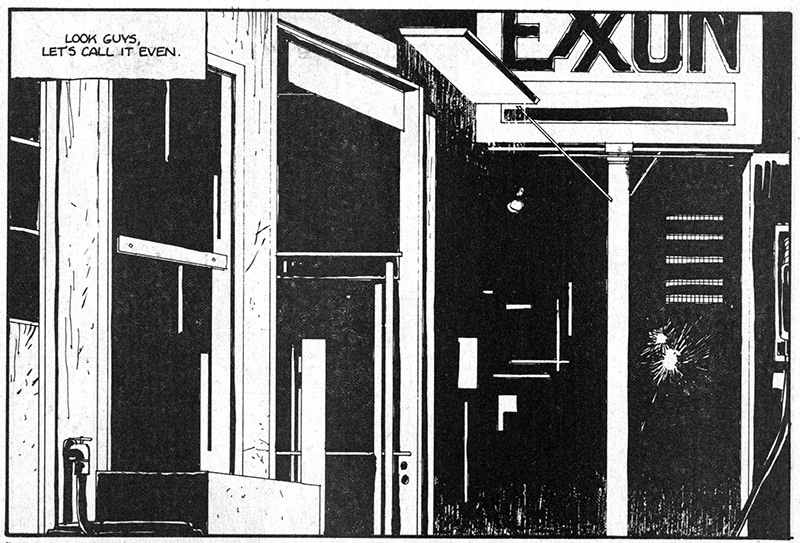
As required by superhero conventions, Eddy lives in a fictional city with a ridiculous name: Chad. The city resembles New York, especially the New York of the 80โ€™s: grimy, with underfunded infrastructure, populated by lowlives and criminals, and loomed-over by gleaming towers of the ultra wealthy ruling elites. Chad is Metropolis and Gotham in one. This is where McKeever really shines. His keen eye really brings the city to life. He finds moments of stillness and quiet beauty in studied depictions of abandoned warehouses, gas stations, desolate alleys, and diners. Clean lines, attention to detail, exquisite framing. These moments make Eddy stand out from other comics of the Event.

Read the whole column here. Oh and check out some Eddy Current art outtakes in my previous post.

Explore more posts related to my Event Horizon column about the comics from 1985-87.