Planeta Philosophorumโ€”Silver Surfer 4-5 (1987)

Silver Surfer and Mantis vs Ego The Living Planet

This post is part of an ongoing series looking at the Silver Surfer series (1987) written by Steve Englehart and drawn by Marshall Rogers. Previous installments: Part one. Part two. Itโ€™s also part of a larger project, Event Horizon, about comics from 1985 to 1987.
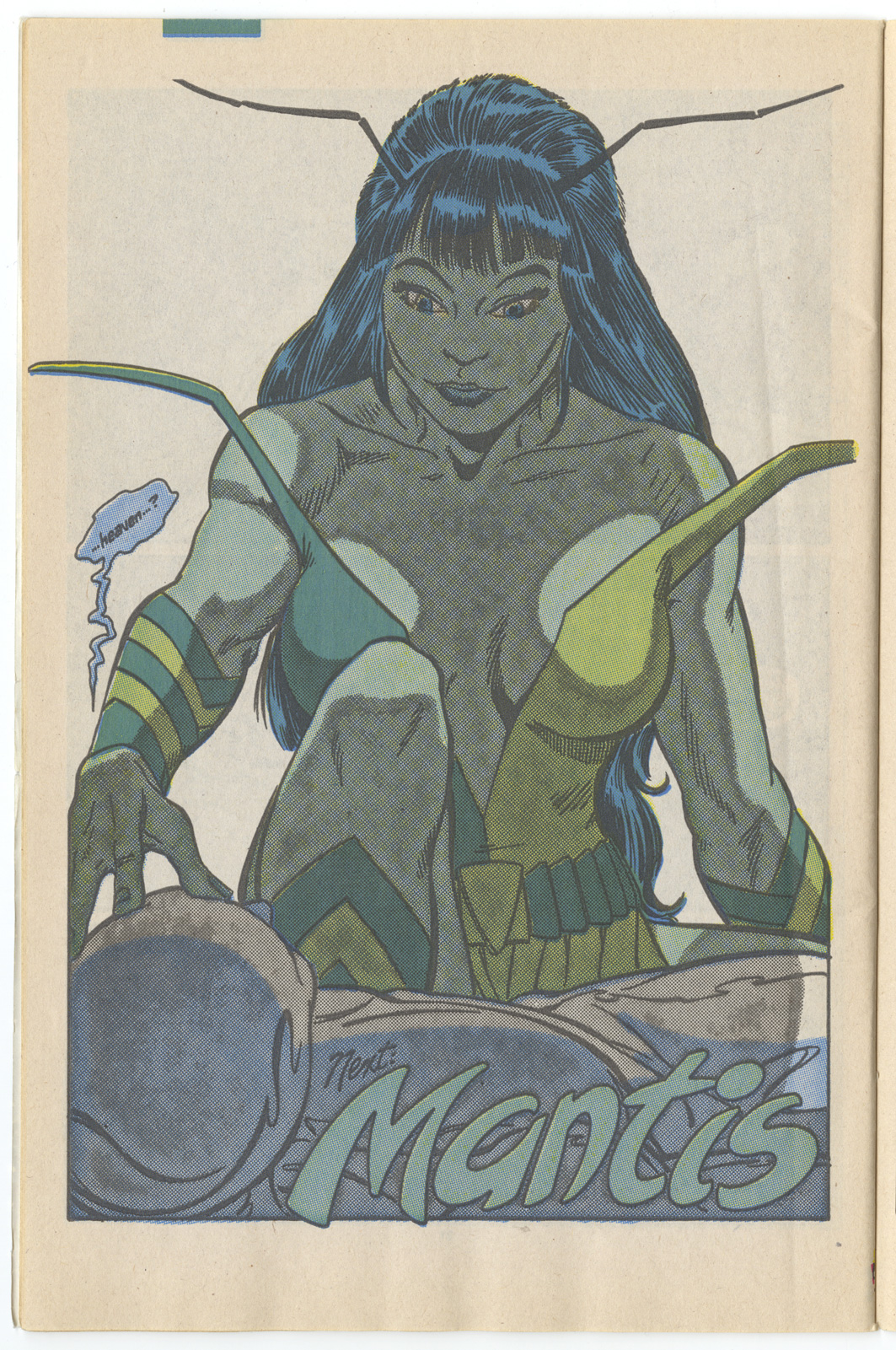
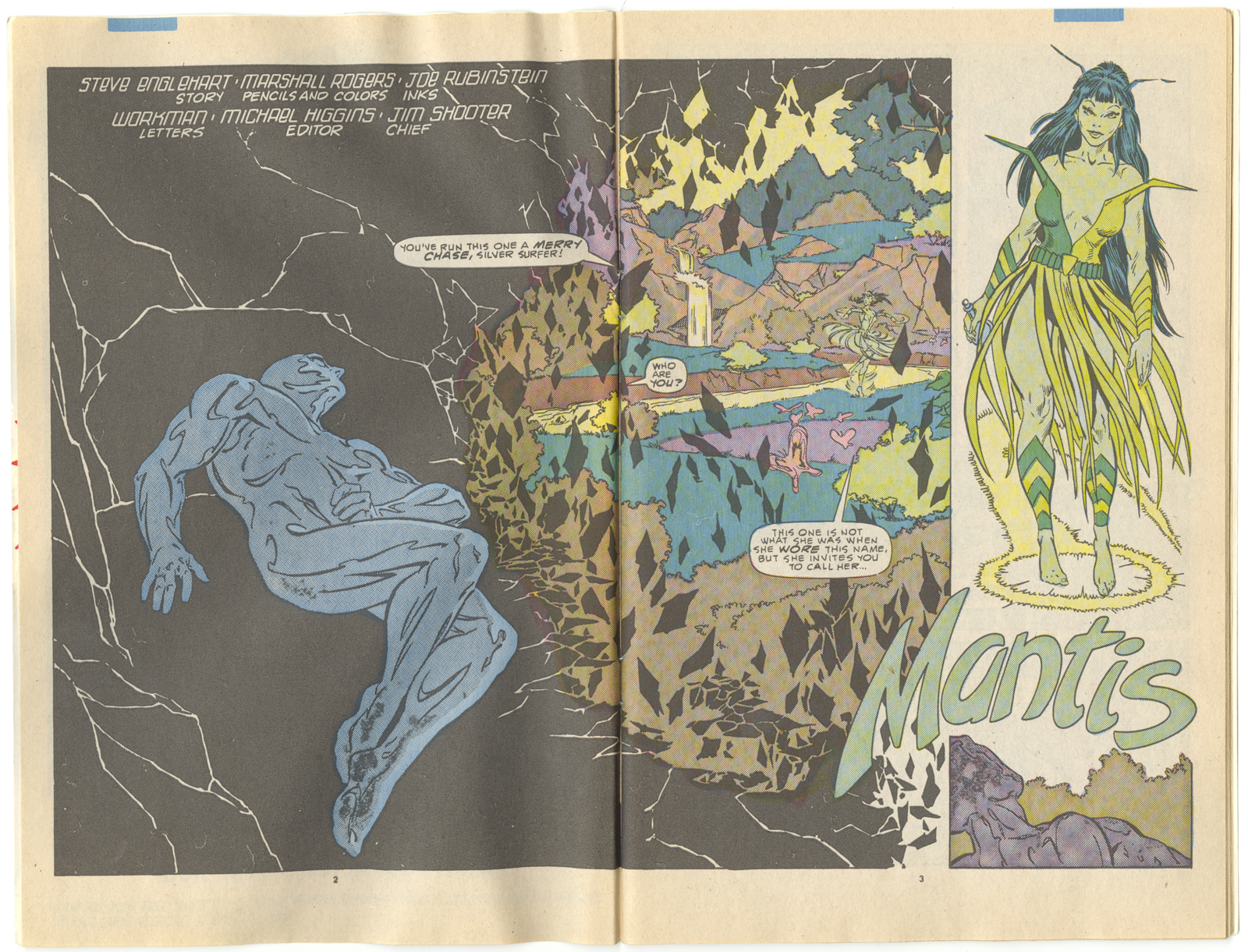
Mantis (issue 4)

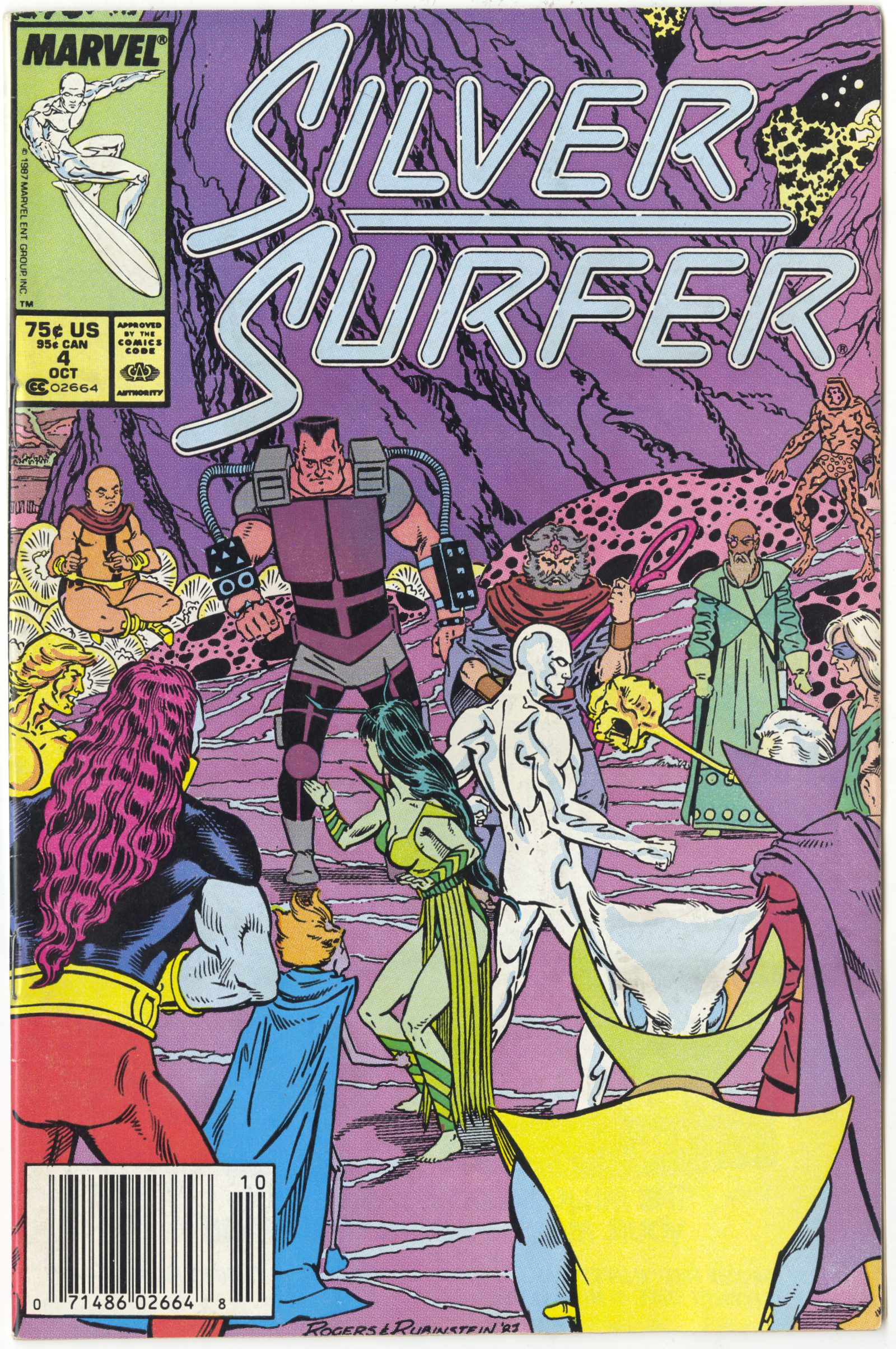
The Surfer, damaged and dying on a lifeless world (see previous issue), is saved by Mantis. Most of the fourth issue is dedicated to Mantis, the Celestial Madonna. Mantis is one of Steve Englehartโ€™s favorite Marvel characters. Heโ€™s been writing her for over a decade (her first appearance was in Avengers #112 in 1973), and sheโ€™s consequently amassed quite a long history.
Celestial Madonna

Mantis heals the Surferโ€™s skin and leads the Surfer to the hidden enclave of the Elders. On the way to the Elders, she recounts her story. Where the info dumps in previous issues were somewhat perfunctory, here, Mantisโ€™ story is lovingly retold over several pages. A full quarter of the issue recounts Mantisโ€™s back story! Itโ€™s too long to get into, so I advise the reader to either seek out the comics or check out her Wikipedia entry.

The most important part of her story is her cosmic wedding to the Cotati, a race of sentient plant life. Through this marriage, she entered symbiosis with plants, forming a union of flora and fauna. Itโ€™s another nod to the alchemical themes that begin to permeate the series. She became the Celestial Madonna, and a celestial child was born from this union. As we encounter her, Mantis travels the universe using her cosmic powers to transfer her consciousness from planet to planet.
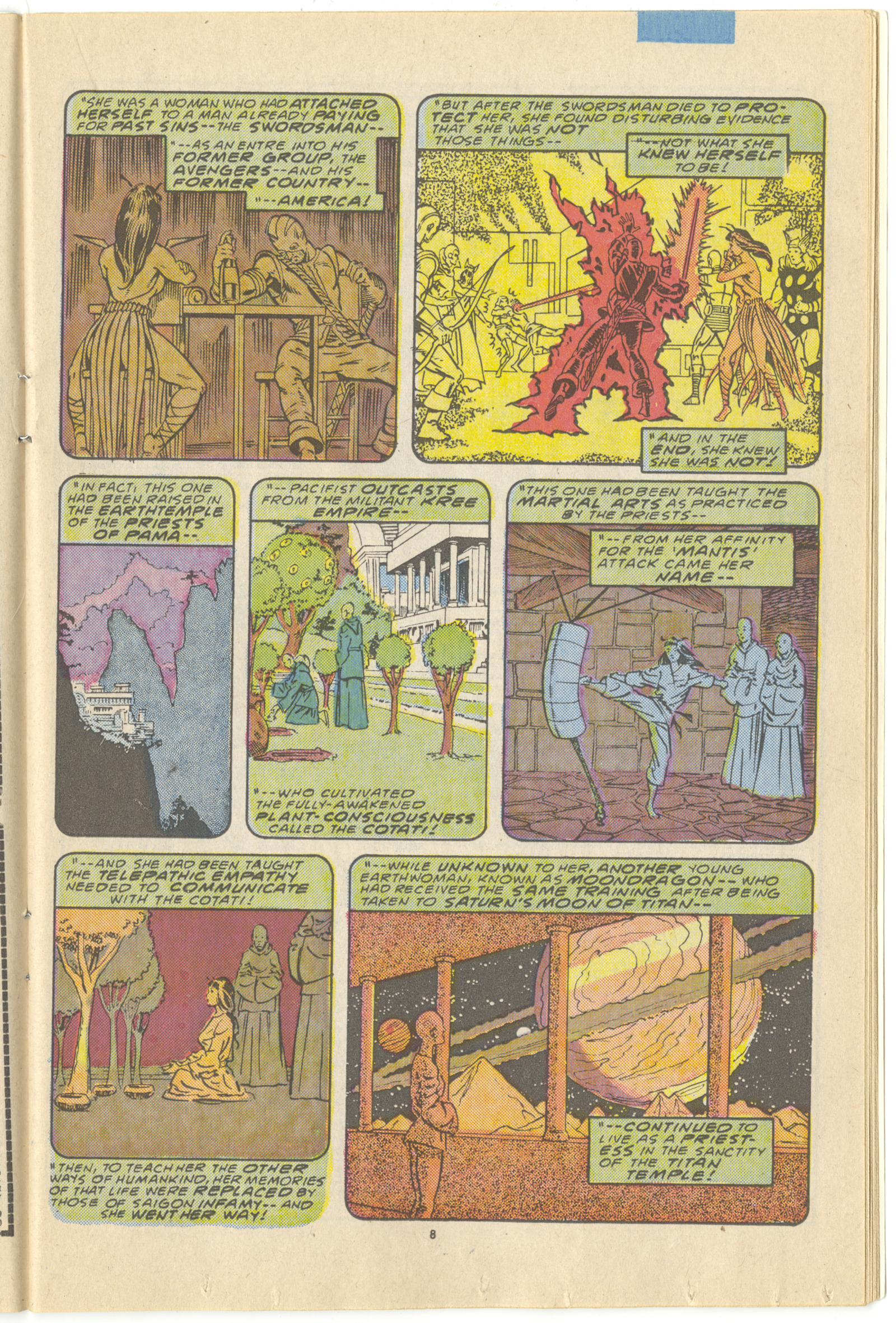
The Info Dump

The info dump has a vital function in the Marvel Universe. As the various Marvel titles became more and more intertwined in the 80s, the โ€œinfo dumpโ€ became a more frequent feature. As a young reader, I used to love them. They showed me the vast history that remained out of reach. They also function as an essential storytelling device that smooths over gaps, lacunae, and inconsistencies.

Mantisโ€™ story is elegantly retold, edited, smoothed over, and historicized. A telos of Mantisโ€™ story emerges: to get her here, into this moment is Surferโ€™s life. Itโ€™s a mild retcon: this was always her purpose and calling. Itโ€™s as if this was always supposed to happen. All stories lead to Silver Surfer #4. Itโ€™s an effective technique when used well.

Elder Planet

Surfer and Mantis arrive at the Eldersโ€™ hideout. Here we finally meet the full roster: Grandmaster, Collector, Runner, Champion, Possessor, Gardener, Contemplator, Obliterator, Trader, Astronomer, andโ€ฆ Ego, the Living Planetโ€ฆ the very ground upon which the meeting is taking place!
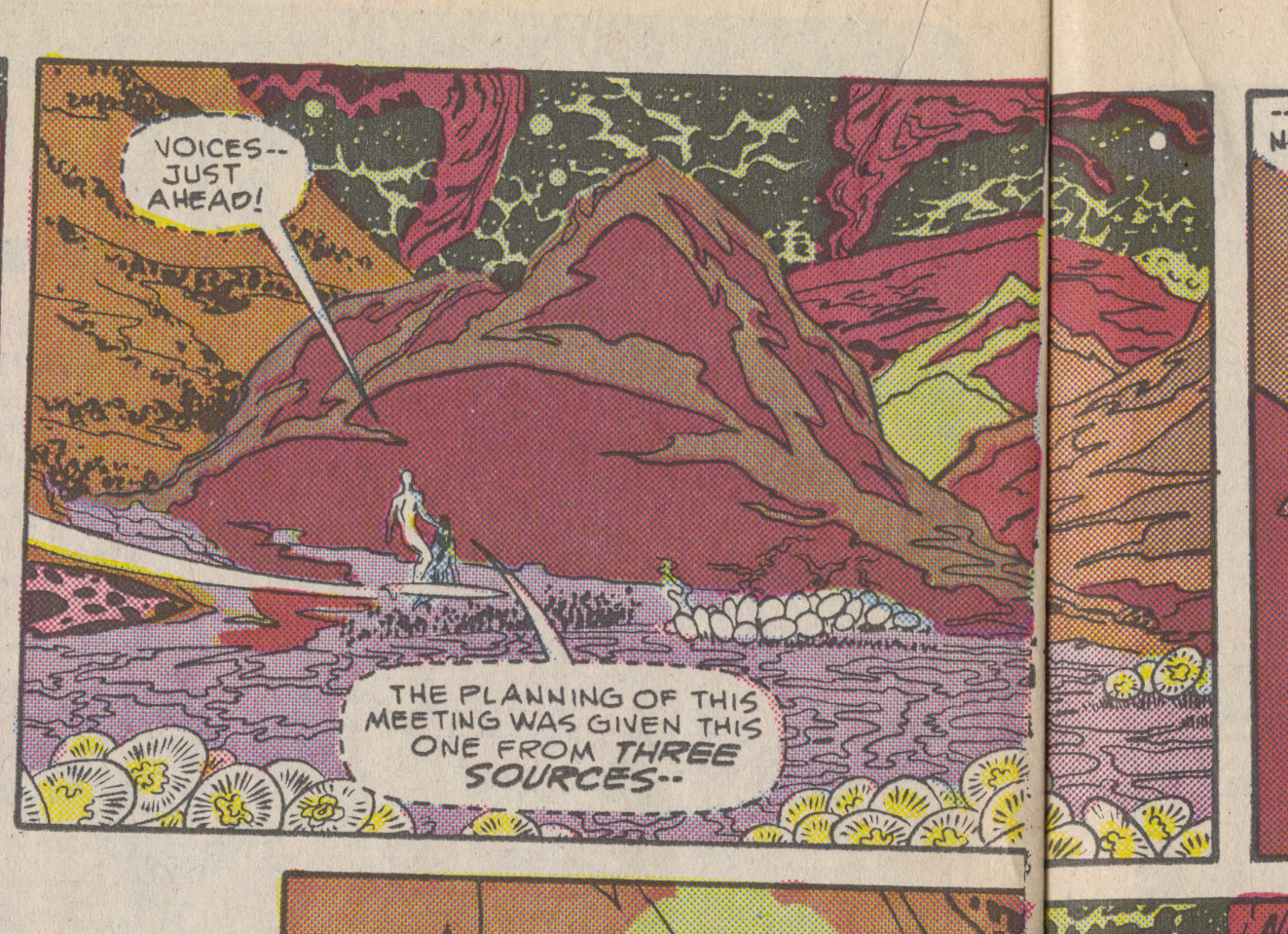
The face of the planet. Can you see it?

Incidentally, as the Silver Surfer and Mantis arrive at the planet, there’s a nice visual hint of Ego’s (as yet unknown) presence. The background landscape is arranged like a gigantic face. It’s a nice touch I never noticed before.

Lapis Philosophorum

The Elders are self-proclaimed โ€œoldest beings in the universe.โ€ Their immortality is another alchemical element often associated with the Philosopher’s Stone. Each one has a unique obsession that has fueled their near-eternal lives. The obsessions are pretty obvious based on the names of the characters. These obsessions are the key to their immortality. Each obsession is a unique Philosopher’s Stone, which drives them forward. They are a living will-to-power, or will-to-life, the conatus that drives them forward. Through it, they achieve literal immortalityโ€”eternal life.

Planeta Philosophorum

Ego, the living planet, is another alchemical character. Typically, we think of โ€œEarthโ€ as โ€œMother Earth.โ€ We perceive our planet as a nurturing feminine entity. Ego is the opposite. Heโ€™s a stern father commanding all his constituent elements with his iron will. A planet-sized philosopherโ€™s stoneโ€”he can transmute his constituent elements into others.  Heโ€™s immortal and has achieved the unity of opposites, a melding of base matter and life.

Eternal Envy

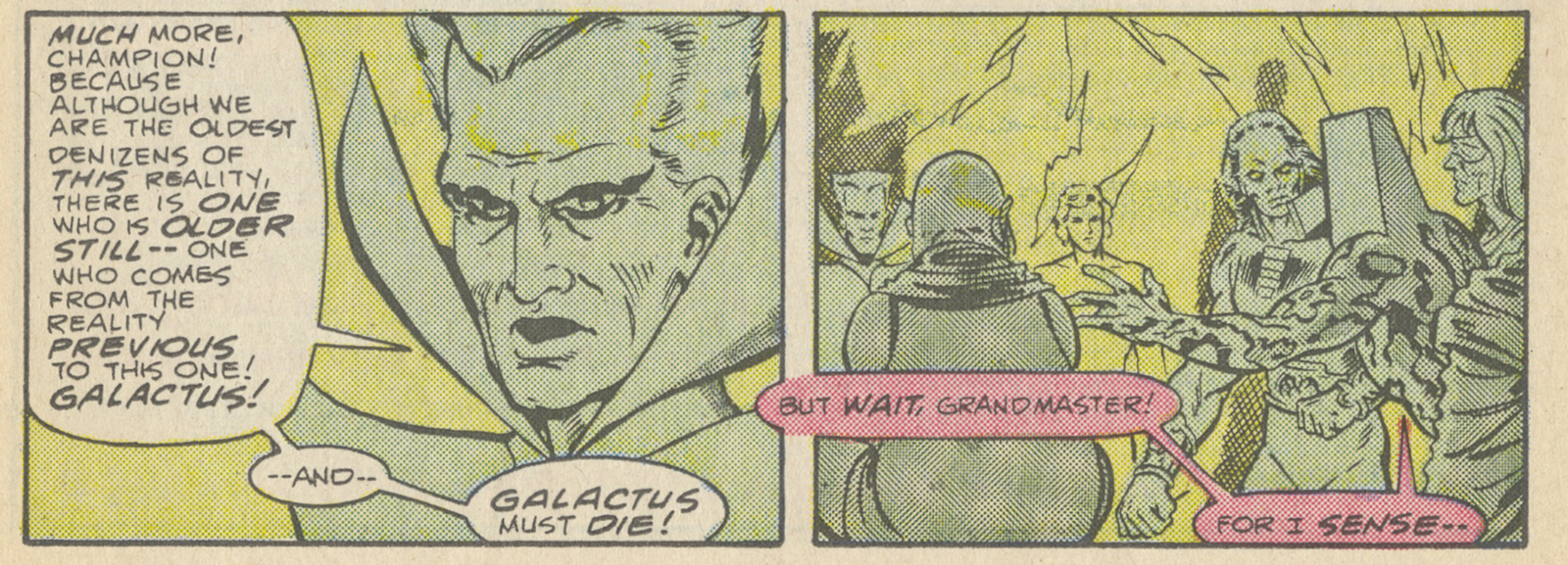
The Elders mostly recount recent backstory, but the Grandmaster drops a tantalizing hint of whatโ€™s to come. The Elders are the oldest beings in the universe, but thereโ€™s one older than all of them: Galactus! Therefore, โ€œGalactus must die!โ€

Escape

Before any more could be heard, Ego detects the presence of Mantis and the Surfer. A quick fight breaks out as the two escape off Ego into spaceโ€ฆ and share a brief kiss. โ€œWe two work so well together!โ€ says Mantis.

Meanwhile, we also get a quick update on the Kree-Skrull conflict in this issue. The Supreme Intelligence deduces that the Skrulls have lost their shape-shifting abilities! And a Celestial appears in the Skrull empire!

Obliteration! (Issue 5)

Look at that cover! Flat colors, color-hold, cartoon-eyed Obliteratorโ€ฆ just great.

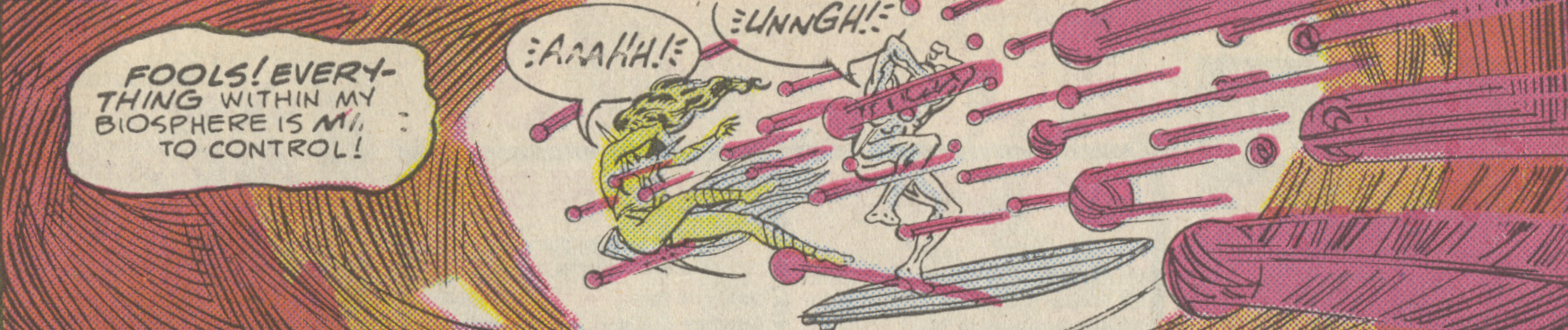
The Obliterator catches up with Surfer and Mantis, and their fight consumes most of the issue. The Obliterator is like the Terminator; he keeps coming back! The Surfer and Mantis manage to ditch him several times, but he finds a way out and catches up with them again and again. Heโ€™s relentless!

The Obliterator is an interesting character. Rogers draws him almost in a cartoony style that is more familiar to indie comics. He has simple features. A pointy jarhead haircut, overbuilt torso, short legs, and blank Little-Orphan-Annie eyes under a heavy brow. Itโ€™s a startling design that feels somewhat out of place in the Marvel Universeโ€”more on him in the next issue.

Celestials

In the meantime, the Skrulls face off against Jamiah, one of the mysterious Celestials. It was the Celestial genetic experiments that eons ago created the Skrull species. Now, one of them returns. For what purpose? Usually, they are seen to stand in judgment of their creations. Jemiah is no different. Like a god, he towers over a Skrull capital. Kylor, one of the pretenders to the throne of the decaying Skrull empire, approaches the giant. The conversation is one-sided. Like a god, Jemiah is silent and inscrutable. The Skrulls attempt to nuke the colossus, but to no avail. โ€œEvents are collapsing upon us!โ€ Kylor laments.

Preying Mantis

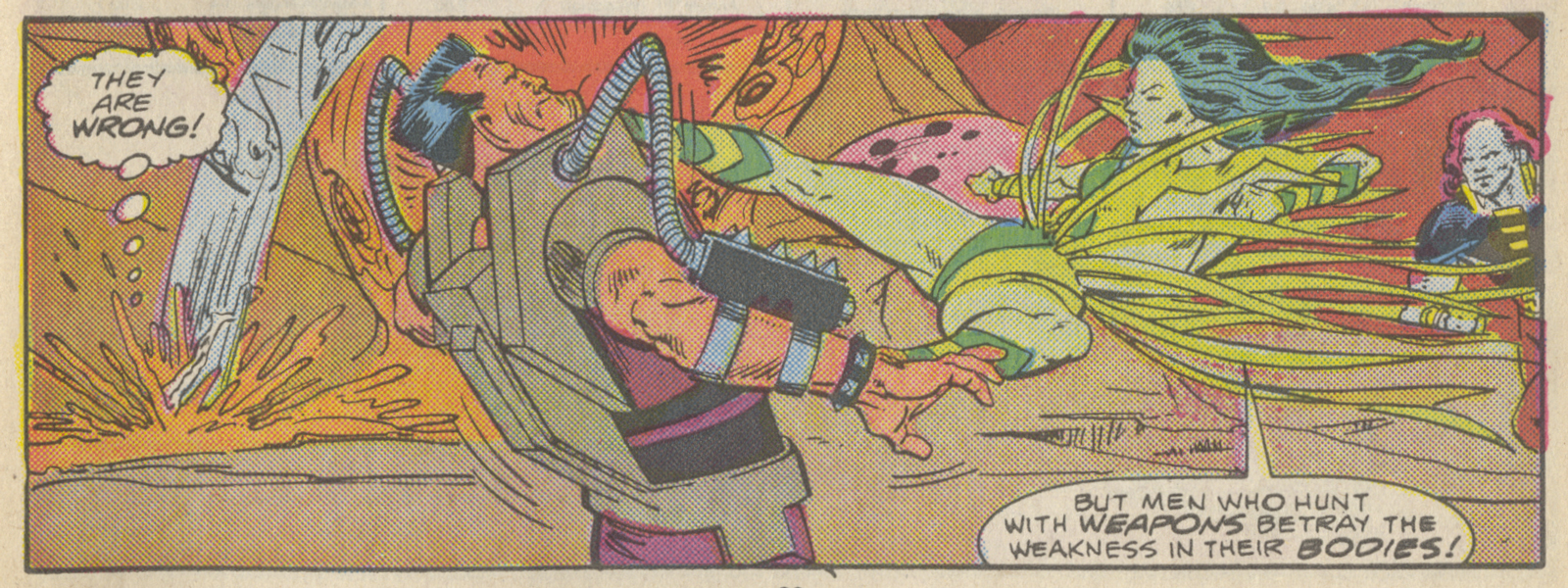
The Obliterator catches up with the Surfer and Mantis, and they have a final confrontation. Marshall Rogers’s art shines when he shows Mantisโ€™ martial arts abilities. She goes one-on-one against the Obliterator and almost gets the best of him. Look at the fantastic spread above. Minimal dialogue, paired with an arrangement that shows off Mantis’ agility. She traverses up, over, down, and forward directly into the camera. She is in constant movement; all the while, she’s delivering deadly blows. But he obliterates her!
Transubstantiation

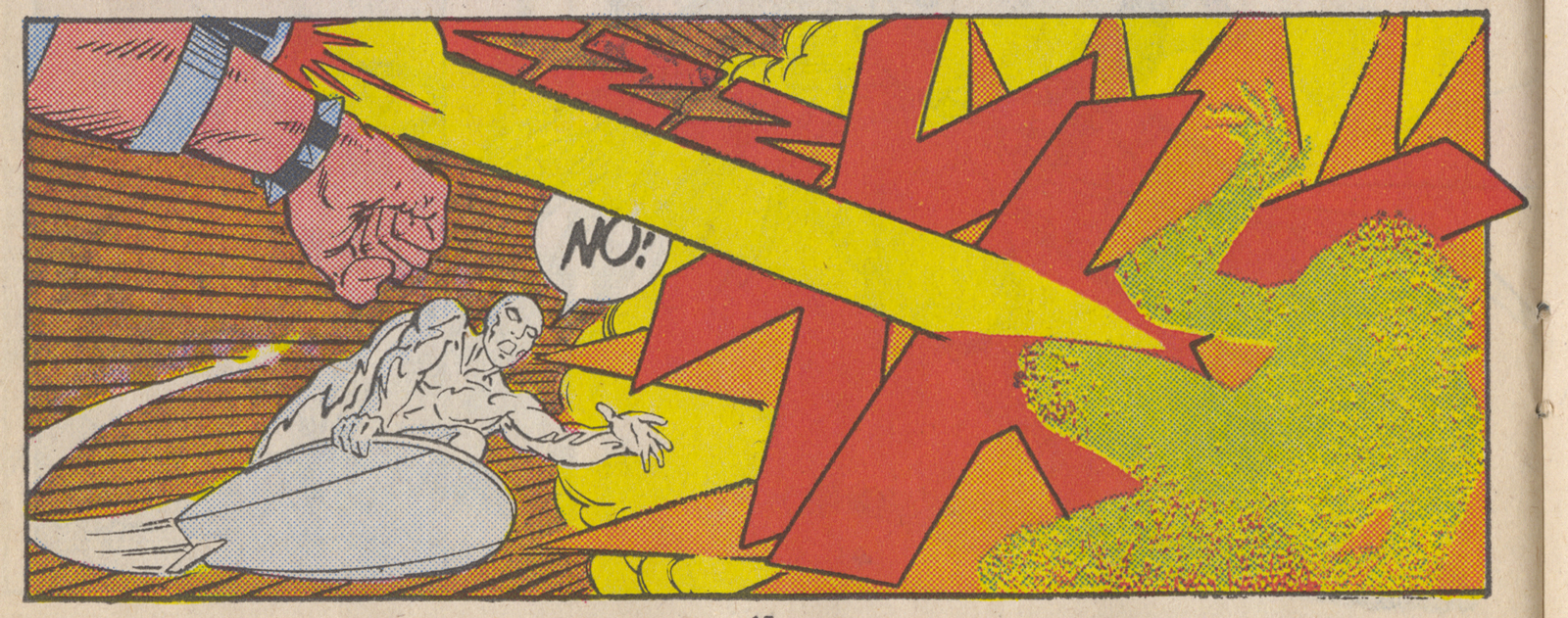
The Surfer, enraged, battles the hulking villain to a standstill and finally wins by disarming him through a power cosmic trick. He transubstantiates the Obliteratorโ€™s deadly weapons into harmless light emitters. The Surfer typically emits various rays of energy when engaged in combat. But Englehart likes to show an alchemical side of Surfer. He transmutes matter like a living Philosopher’s Stone. The Surfer is the perfect foil for the Eldersโ€”heโ€™s just like them.

Resurrection

It turns out Mantis survived her obliteration. A split second before disintegration, she transferred consciousness to local plants and re-grow a new bodyโ€”like a homunculus. The Surfer is overjoyed. The relationship between the two cosmic beings grows.


Love and Alchemy – Silver Surfer 2-3 (1987)

This post continues a look at the Silver Surfer series (1987) written by Steve Englehart and Marshall Rogers. For part one, look here. It’s also part of a larger project called Event Horizon, which is about comics from 1985 to 1987.

Silver Surfer #2. Surfer is returning home to Zenn-La.

Lond Distance Relationship (Issue 2)

In the second issue, the now-free Silver Surfer visits Zenn La to return to his love, Shalla Bal. Previously, the relationship of the two was presented as eternal, trans-universal, etc. In other words, it was idealized. The Surfer, a literal prisoner of Earth, had no choice but to keep a very long-distance idealized memory of Shalla Bal. 

While the Surfer was away, Shalla Bal created a new, independent life on Zenn La. Zenn La was devastated by Galactus (again, I’ll refrain from relating the Surfer’s long history; read it here). To help heal the planet, The Surfer gifted part of his “power cosmic” to Shalla Bal. With this power, she restored the planet’s biosphere and, as a result, became the “Empress” of Zenn La.ย 

Fictional Politics

As an aside, it’s always interesting to see what political systems are deployed in fictional worlds. Why did Zenn La become a monarchy? Was it one before? Is it constitutional? Absolute? The Skrulls are also an empire. In this series, the Skrull empire breaks into competing kingdoms, each ruled by a pretender to the imperial throne. The Kree are governed by the Supreme Intelligence, an AI composed of the minds of millions of Kree warriors. It’s a weird amalgam. It’s easy to imagine it as a Sparta-like warrior democracy that “progressed” to a pseudo-democratic technocratic rule by democracy as AI. More on this later.

 Love Will Tear Us Apart

Anyway, Shalla Bal and Surfer finally meet! But immediately, Surfer’s ideal love hits the unmoving force of reality. It becomes apparent that the two star-crossed lovers have different priorities. The love that bound them previously has ceased to exist. Shalla Bal becomes possessed by her duties as Empress.

The Empress has more important matters to attend to. The Skrulls sent an embassy to secure Zenn-La’s loyalty in the reigniting Kree-Skrull war. The Skrull designs must be checked, and the planet must be rebuilt. Romance is impossible under these circumstances. She rejects him romantically but insists that the Surfer remains a “protector” of Zenn La. 

And the Surfer isโ€ฆ a bit lost. His freedom shatters all his illusions about love, duties, and his very nature. He’s also angry in a way we’ve never seen him before. This isn’t the anger of facing an enemy. This is the anger of a noble soul, rejected by his eternal romantic love, who remains honor-bound to protect the realm as its shining knight. 

Knight-Errant

As he leaves Zenn La, he modifies a monument: “Here was born Norrin Radd, a son of Zenn-La,” to read “Here was born The Silver Surfer, a son of Zenn-La.”

He’s now a masterless knight in silver armor. His life as Herald over, he was ready to sacrifice for love. In the end, he realizes his love was “human.” It was Norrin Rad who loved Shalla Bal. The Surfer is now ready to discard his humanity and accept the Silver armor. The Silver Surfer flies alone. Or does he?

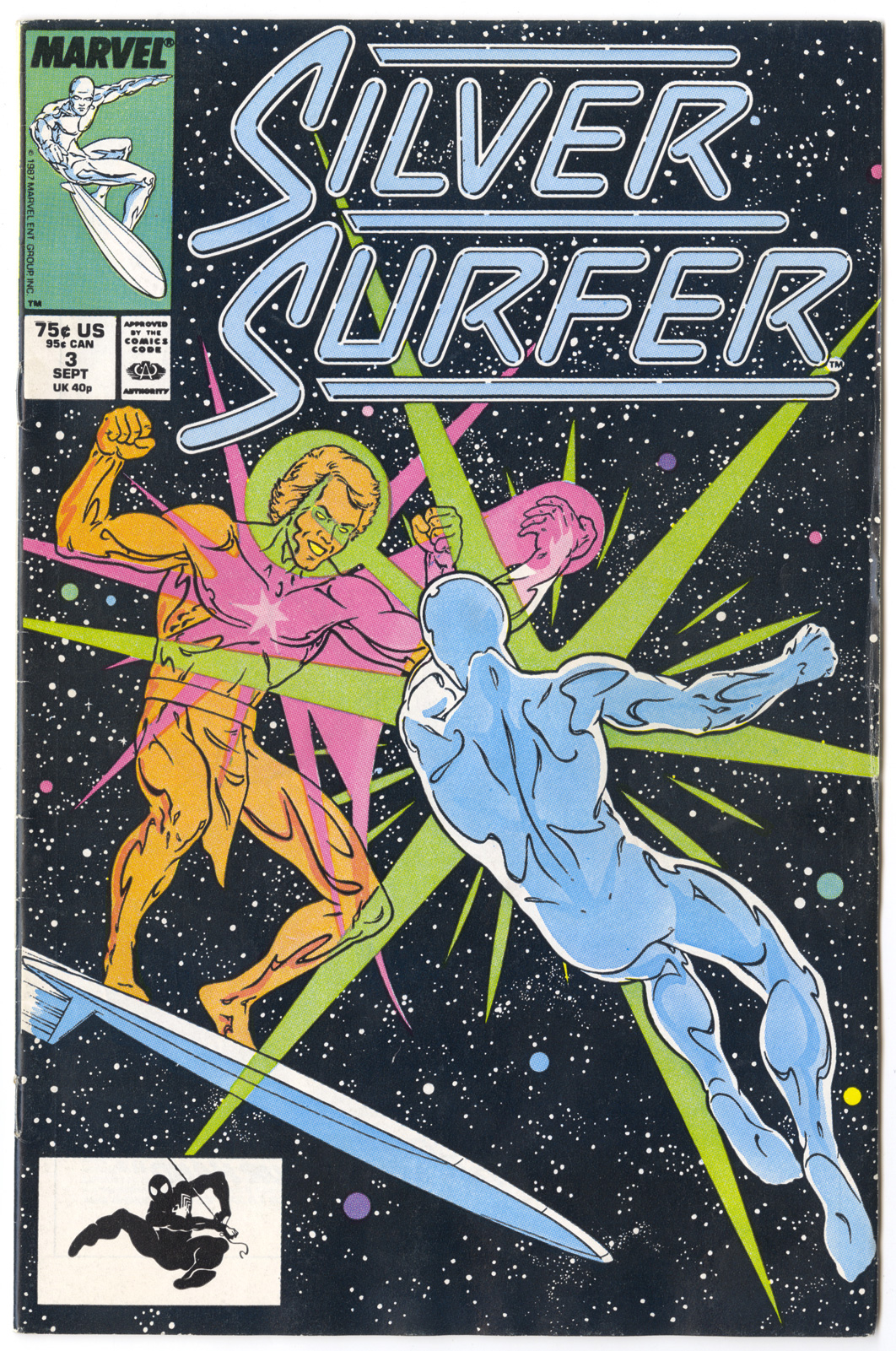
Silver Surfer #3. Cover. Gold vs. Silver.

The Content of Freedom (Issue 3)

In the third issue, the continuity gets wonky. This is not uncommon in the vast labyrinthine Marvel Universe. By the late 1980s, crossovers, events (see my piece on Crisis on Infinite Earths), etc., created an increasingly tightly interwoven narrative tower of Babel. Englehart wants to tell a relatively clean Surfer arc, but much of the back story is vast and pulls in threads from other Marvel titles. 

We already know the Elders of the universe are planning something. A big piece of this scheme is told elsewhere in two Avengers annuals. For the sake of brevity, I won’t get into it. Suffice it to say that the Surfer is now firmly set on a collision course with the Elders and intends to learn all he can about their nefarious plans.

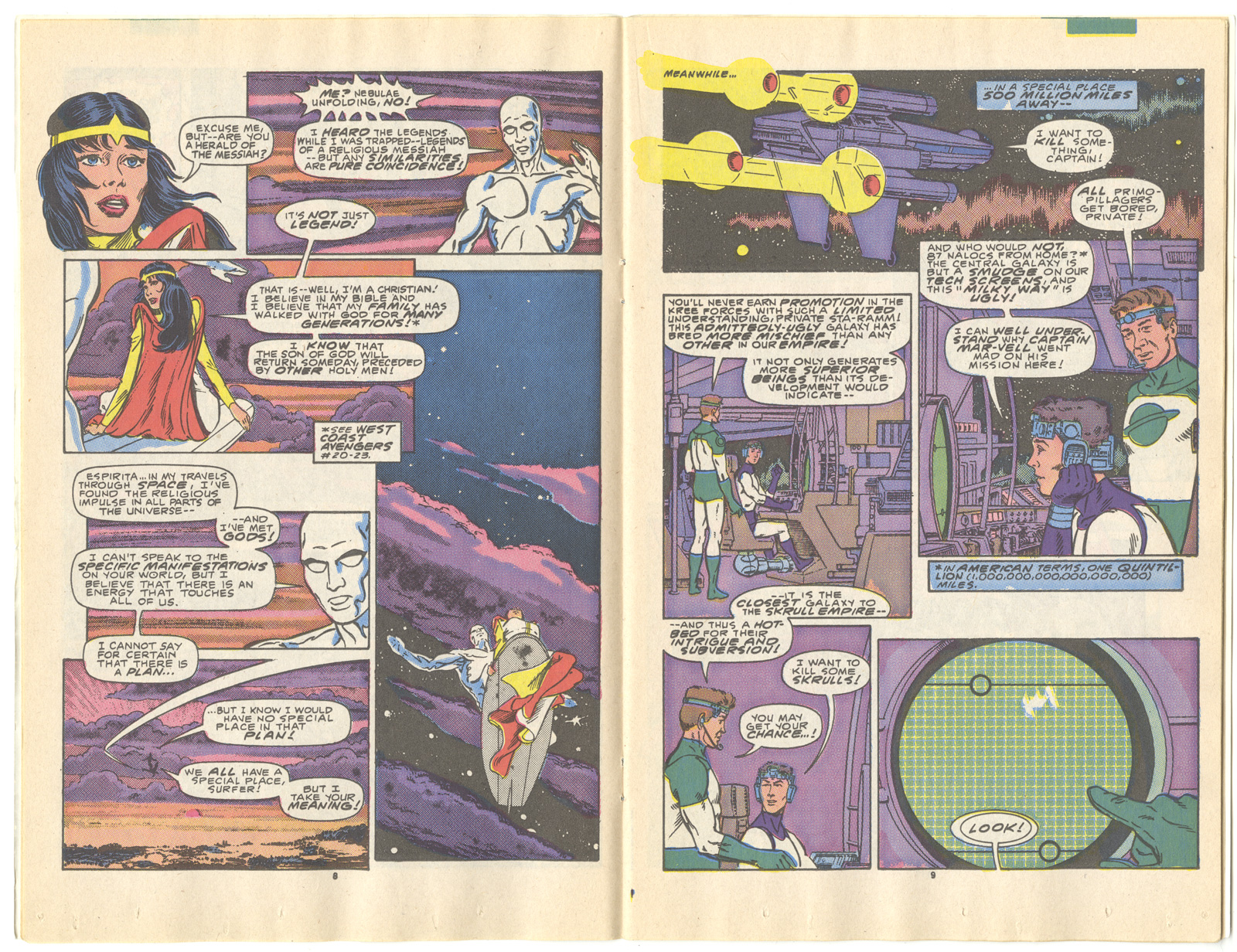
Silver Surfer #3. Dense layouts and information density.

Holy Man

Two interesting moments occur in this issue. First, after a brief confrontation with the Collector, the Surfer escorts Espirita, a Christian superhero, back to Earth. The two have a short conversation. Espirita tells the Surfer that many people thought him to be a Herald of the Messiah during his imprisonment on Earth. The Surfer, startled, denies any religious affiliation. He believes the religious impulse is universal and that some energy touches us allโ€ฆ but there’s no plan. In any case, he wouldn’t have a special place in that plan. Espirita, a good Christian, retorts, “We all have a special place, Surfer!”

The moment nicely foreshadows the scale of the Elders’ plans, which will have cosmic repercussions. The Surfer here sees himself as insignificant in the universe, and his insignificance will haunt him for the rest of this arc.

Twins

The other moment is the Surfer’s confrontation with the Elder known as the Runner. The Runner confronts the Surfer out of nowhere in the vast depth of space. Instead of silver, he is clad in gold. His appearance is that of a Greek god-like statue that comes to life. The Runner is a kind of twin of the Surfer. He says, “many sentients have spied my golden skin and thought us related.” Even though it is a physical contest, Surfer’s encounter with the Runner is also fraught with symbolic meaning.

Symbolically and archetypically, twins are often cast as moral opposites: good/evil, white/black, or civilization/barbarism. [ 1 ] Twins are locked in an everlasting struggle, whether on the physical plane or mental one. In Jungian terms:

“From this conflict, an irrational third arises the transcendent function, often in the form of a symbol. Logically, the opposites are always split and in conflict, but illogically, they coalesce in the unconscious psyche. The duality of archetypal content can be said to be integrated only when the full range of the spectrum has been made conscious.”

Source
Silver Surfer #3. Runner vs. Surfer.

Swept Away

There are interesting contrasts between the Surfer and the Runner. As the name suggests, the Surfer “surfs” on cosmic waves on his board. The symbolic implication is that he goes where the waves take him. Despite his vast power, he is swept up by events rather than affecting them directly.

The Runner, as the name suggests, “runs.” He is self-propelled and goes where he pleases. This goes well with his Elder-obsession. All Elders have an obsession (a Nietzschean will to power?) that has sustained and kept them alive for billions of years. We’ll get more in the weeds later, but the Runner’s obsession is to “see all there is to see, in all the universe!” Symbolically, he’s self-directed and possesses a goal and a destination (however vast it may be).

Alchemical Romance

The Surfer is silver, and the Runner is gold. Both are noble metals, but they have different symbolic meanings. 

SilverGold
moonsun
Artemis Apollo
purity prestige
strength luxury
clarity wisdom
silver age golden age
feminine masculine
youthdecadence

Slave, Meet The Master

The Surfer has always exhibited aspects of silver: purity, strength, clarity, and focus. Silver is associated with the moon and is also the color of Artemis. As such, it also contains feminine energy, which aligns well with his surfer nature and his general neurotic nature, full of self-doubt. He’s a human thrust onto a cosmic level; there’s a touch of impostor syndrome. He is the slave in Nietzsche’s master/slave dialectic.

The Runner exudes the ease and manner of an aristocrat, a golden child. He is confident and administers his brand of justice (kill the Surfer) without remorse. He also charismaticly affects the Surfer: “Something about him sweeps all caution from me!”  The Runner has no qualms about his quest for more power. If he can take it, he will. He embodies Nitschean master morality.

The Runner says, “I would’ve swiftly reached the end of my five billion years if I’d had to endure what you did [imprisonment on Earth]!” At first glance, it sounds like a compliment, but it’s also an insult. The Runner values freedom over everything. To be trapped anywhere would mean the Runner cannot fulfill his obsession; it’s the same as death. By implication, the Surfer allowed himself to be trapped and endured a lengthy imprisonment. Only slaves do that.

Free

The Runner says a tantalizing phrase to the Surfer: “[you are] too new to this freedom to understand how utterly it dwarfs individual concerns.” The Runner spells out the Surfer’s current predicament. Since sacrificing himself for Zenn-La by becoming the Herald of Galactus, this is the first time he has truly been free. 

The Runner proceeds to attack the Surfer. After brief combat, the Surfer is defeated and crashes into an uninhabited planet. In bad shape and dyingโ€ฆ he is met withโ€ฆ Mantis! 

Silver Surfer #3. Mantis!

Information, Art, Color, Letters

Both issues are still very informationally dense and heavy on backstory. One of the pleasures of reading stories set in the Marvel or DC universes is the back story, the obscure details, forgotten characters, missed connections, and esoteric lore. Steve Englehart is a master at this kind of pulp archaeology. He sifts through a mess of Marvel continuity and extracts a silver thread, which he uses to weave a complex narrative tapestry in The Silver Surfer. 

While these two issues don’t have the visual impact of the first issue, they demonstrate Marshall Rogers’ mastery of the form.ย His art and layout continue to impress even when he must accommodate some information-heavy layouts.

The lettering is credited to John Workman, one of the great comic book letterers. Typically, letterers also create the sound effects (SFX). But in Silver Surfer, the SFX appear to have been drawn by Rogers. They are integrated into the art and don’t resemble Workman’s usual SFX. It seems Rogers is doing the SFX uncredited. If anyone knows otherwise, let me know. Anyway, look at that!ย 

Silver Surfer #2. Sample SFX.

NOTES:

[ 1 ] “Twins appear frequently in folk cosmologies โ€“ usually cast in morally opposing roles. Anthony Stevens in his Guide to the Symbols of Mankind, Ariadne’s Clue, suggests that this archetype reflects the evolutionary ascent and involuntary descent of the sun: the good twin is represented as white, the bad one as black; one creates civilization, the other destroys it; Thus twins are locked in everlasting struggle (see, for example, the myths of Romulus and Remus, Cain and Abel, Jacob and Esau, Osiris and Set).

Stevens suggests that the symbolism has grown out of humanity’s primordial awareness that day is paired with night, light with darkness, summer with winter, and so on.

The archetype of twins is therefore to do with opposites, that together represent a whole.” โ€” source


Free – Silver Surfer #1 (1987)

silver surfer board POV marshall rogers

Space Is The Place

The 1987 Silver Surfer series is an under-appreciated high point in Marvel’s stable of comics during the tail end of the Event Horizon.

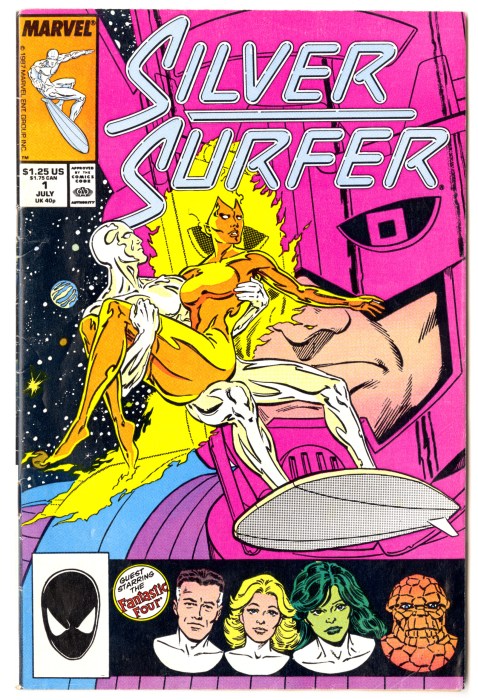
Fig. 1. Silver Surfer #1 (1987) Cover

The Silver Surfer has had a fraught career in the Marvel Universe. It’s an iconic character from the early golden Kirby/Lee age of the Fantastic Four. He became a popular guest star and a one-time member of the Defenders, but he never really came into his own as a character. (check The Silver Surfer’s convoluted back story here) Instantly recognizable, the Surfer was a compelling cosmic character. His imprisonment on Earth (by his former master, Galactus) created the impression of being a failure due to the Surfer’s “constant whining” about his predicament.

The 1987 series writer Steve Englehart (drawn (and colored) by Marshall Rogers and inked by Josef Rubenstein) consciously addressed the character’s shortcomings. In the first issue, the Silver Surfer is finally set free!

One thing to note is the density of the narrative. The Surfer runs into the Fantastic Four as they investigate the hole in the ozone layer in Antarctica. The team quickly solves the mystery when the Surfer admits to depleting the ozone in another futile attempt to break Galactus’ barrier. 

Out of the blue, Champion, one of the Elders of the Universe, attacks the Surfer. The Surfer wins and demands an explanation by right of victory. Champion launches into one of the several info dumps that convey massive amounts of information: 

  • A recap of the entirety of Silver Surfers’ Marvel history 
  • The Skrulls have lost their ability to shapeshift, and as a result, a new Kree-Skrull war is brewing
  • The vague contours of the Elders’ scheme behind it all begin to take shape

All of the above ties into a decades-long Marvel history, much of it written by Englehart. That’s all on top of the main narrative!

Once the Surfer dispatches Champion, Ben Grimm stumbles into an ingenious solution to the Surfer’s imprisonment. And, after a few pages, the Surfer is free! Instantly, the Surfer’s true nature is on full display as he surfs the cosmic spaceways. For the Surfer, space is the place.

Fig.2. The Surfer is free!

Master And Servant

But, before he can fully taste his new freedom, the Surfer must confront his jailer, his former master, Galactus. To remain free, Galactus must lift the punishment that bound the Surfer to Earth for so long. Silver Surfer proposes to free Nova (the current herald of Galactus) in exchange for a pardon. The two strike a bargain (Fig. 3).

Fig. 3. Nova rescue sequence pt. 1

The Skrulls hold Nova hostage on an “expandable” planet guarded by three million “expandable” fanatical Skrulls. The Skrulls, desperate to keep their secret: the loss of their species’ shapeshifting ability. They fear their eternal rivals, the Kree, would take advantage of their moment of weakness and invade. The Skrulls want to trade Nova’s life to force Galactus to consume the thousands of Kree planets! They want to turn the very forces of the cosmos against their rivals! Nova’s trap is specially designed to confound any effort by Galactus. The Surfer can succeed where Galactus would fail.

Fig. 4. Nova rescue sequence pt. 2

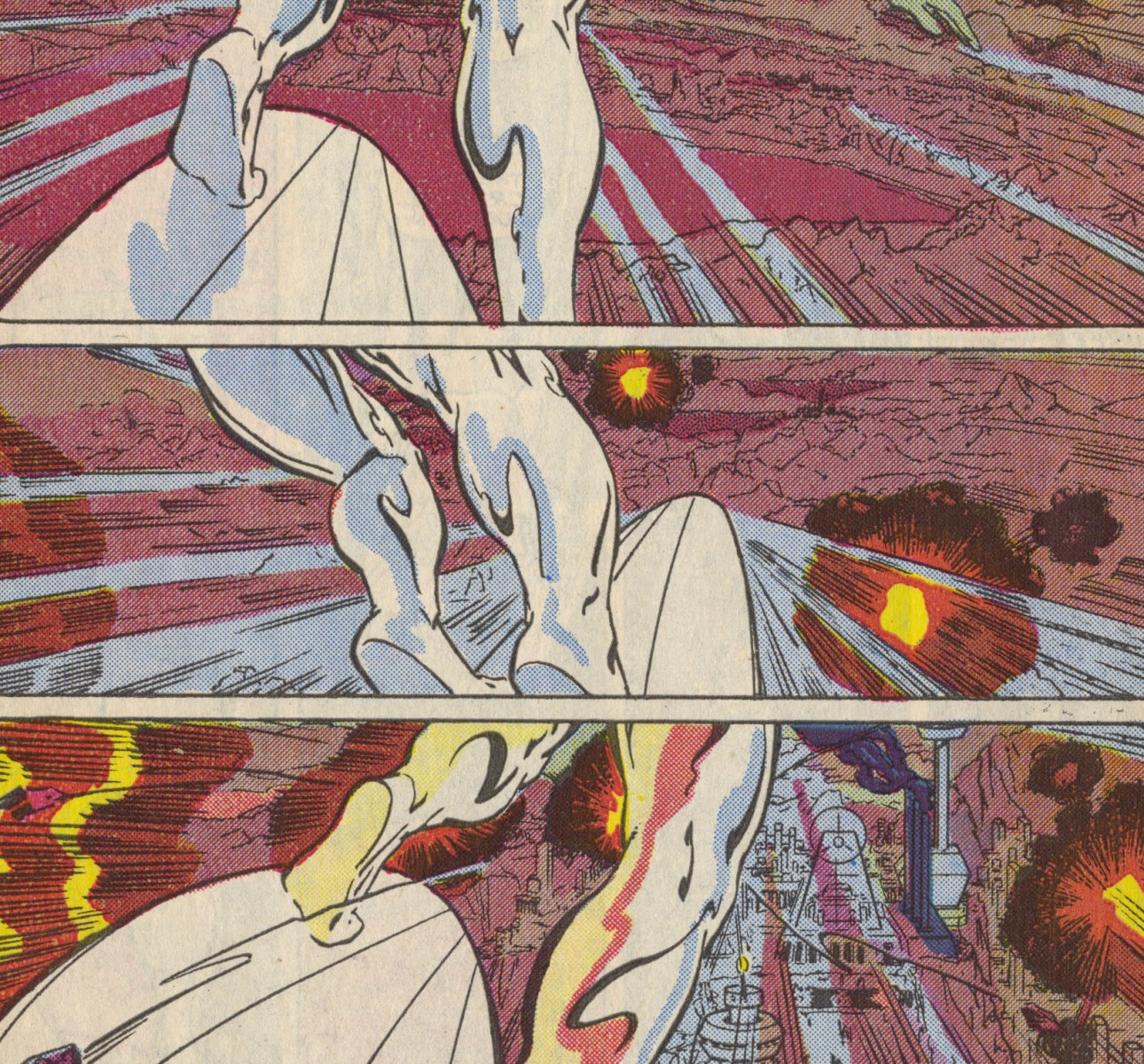
Marshall Rogers wonderfully visualizes the rescue sequence. First, the Surfer descends from space in a series of vertical panels emphasizing the distance traveled (Fig 2.). Then Rogers switches to horizontal panels as we see the changing ground below the Surfers board. The reader’s POV isย likeย sitting on the board behind the Surfer. Then, two full-page splash pages of the Surfer penetrating massive barriers surrounding the central device that holds the captured Nova (Fig. 4).

Fig. 5. Nova rescue sequence pt. 3

On the next page, the Surfer locates Nova in three vertical panels (Fig 5). On the subsequent page, three more vertical panels follow the Surfer, holding Nova, and escapes into space (Fig. 6). The denouement is another splash page of the Surfer holding the weakened Nova as they speed away from the Skrull planet (Fig. 7). It’s a masterful sequence that shows off the narrative and visual power of the medium.

Fig. 6. Nova rescue sequence pt. 4
Fig. 7. Nova rescue sequence pt. 5

It’s a great example of the push-pull between comics-specific realism and abstraction. Rogers reserves realism for characters and environments, while abstract visuals depict speed, energy, and superpowers. The old cartoon jokes (Fig. 8) about abstract art found their full narrative use in American superhero comics.ย The artist/cartoonist Keith Tilford had a few salient observations on this subject:

[George Pereze] understood abstraction via storytelling and had an incredibly strong design sense. I also thought immediately when Stephen Platt came onto the scene that there was a connection there. I still see it, and I am always interested in how these kinds of formal translations take place in comics.

Keith Tilford – TCJ Interview
Nancy by Ernie Bushmiller
Fig 8. Nancy panel by Ernie Bushmiller.

The art Avant-Garde “discovered” abstract visual expression. Still, comic books found the proper subject for the experiments: to visualize the intangible, unrealized, speculative, and hidden “cosmic” forces unleashed or uncovered by the technological revolution.

Moments like the above sequence and (elsewhere) show how integrated the Avant Garde experiments of the first half of the 20th century have become on the pages of American superhero comic books.

The Surfer returns Nova to Galactus and receives a pardon. The master/servant relationship no longer binds the two.

Fig. 9. Galactus pardons Silver Surfer.

It’s another great moment for the character. No longer confined to Earth, his conscience clear, The Silver Surfer surfs the cosmic spaceways!


Silver Surfer Black 1 | Review

silver surfer black 1

Over on Ink Logging, I’ve written a short review of the great looking new Silver Surfer Black series from Marvel. It’s drawn by Tradd Moore. Here’s a taste:

Thereโ€™s a barely restrained surrealist/trippy component to his drawings. The Silver Surfer series seems designed bring that element out in force. There are a lot of psychedelic flourishes, unusual angles, expressionistic renderings, complex layouts, etc. Moore seems to be really having fun here. Thereโ€™s a surreal fluidity to everything. Everything is flows, undulates, and bubbles likeโ€ฆ a lava lamp. Thereโ€™s not much to the storyโ€ฆ at least so farโ€ฆ

Read the entire post here.

silver surfer black by tradd moore