I was going to post this in time for the opening night of The Magic Show a group show at the Pony Club Gallery in Portland, OR. But I just realized that the opening was last night! Duh! I think I must have confused it with the opening night of the Off-Kilter Comics, which is IS tonight. I have a drawing (pictured above) at The Magik Show but not at the Off Kilter Comics show. Anyway, both shows feature a lot of great artists so if you’re in either Portland or Minneapolis, go see the one closest to you.
Since I wrote the Enigmatic Engineering post ‘Yuichi Yokoyama’ has consistently become one of the top 5 search strings (after communist, Wolverine, Karl Marx and zombies) that have brought readers to this blog. There have been a few responses to it across the internetosphere that I wanted to mention.
First, no less an authority than Tim Hodler at Comics Comics gave a nice shout-out to the article not once but twice. I look forward to the Comics Comics dissection of Paul Pope’s Heavy Liquid a comic that influenced me a lot when it came out. Although I voted for Marjane Satrapi’s Persepolis, which has gotten near unanimous high praise since it came out. It would have been interesting to see a more critical take on the book (which I liked very much). On the other hand, I don’t think I’ve ever seen a proper critical assessment of Heavy Liquid, so maybe it deserves the spotlight.
A couple of Noguchi Park to Yokoyma comparisons. Click to enlarge.
Tim Thornton e-mailed me a link to a PingMag post about Isamu Noguchi’s Moerenuma Park in Sapporo, Hokkaido. The park has many wonderful ‘Yokoyama’ touches, including an artificial mountain! Some of the other attractions are reminiscent of scenes from Yokoyama’s newest book The Garden. (Thanks for getting me a copy Mike!)
The amazing image on the inside of the dust jacket. Click to enlarge.
Both Tim and Jose Luis Olivares alerted me to the Yokoyama exhibition at Rappongi Crossing. I wish I had been able to see it. Fortunately Dan Nadel, a Comics Comics co-editor and Picturebox publisher, posted a few pictures of it. I hope that Picturebox will publish an english version of The Garden sometime in the near future. Since I don’t read Japanese I’m very anxious to see another meticulous translation of all the sound effects. There’s also a lot more dialogue in this book compared to New Engineering. Although, according to Luis, the dialogue is mostly descriptive of the various unusual sights the characters encounter.
Last, but not least, Simon Sellars has been kind enough to include Enigmatic Engineering among all things Ballardian. His site is the place online to watch the extensive influence of J.G. Ballard unfold… in (almost) real-time!
I’m still laboring on Part 2 of Enigmatic Engineering… but I have a good excuse. I was Momed.
The term ‘Momed’ was coined by Gabrielle Bell (if I remember correctly) and it refers to MOME contributing cartoonists who, in an effort to meet their deadlines, forgo normal social behavior and lock themselves up for extended periods of time in a desperate attempt to make comics at a highly depressing rate of speed… In short, I’ve been Momed over the last few weeks, which is why this blog has been very quiet lately. But my next MOME contribution is done and so this blog can resume it’s semi regular posting schedule.
panel from Mome 10
Speaking of MOME, the current issue (MOME Vol. 10, Winder/Spring 2008) is out now. This time I contributed a four page story called Phase Transition. It’s a kind of a prequel for the story I just finished. It wasn’t intended that way originally. As I worked on the MOME Vol. 11 story it slowly became clear that the main character from Phase Transition should play a role in it.
In addition to the story, I’m also the subject of an interview conducted by Gary Groth. I was very nervous before this interview because I’ve read so many of his interviews over the years and he’s definitely one of my favorite interviewers. It turned OK in the end and the conversation was pretty interesting even if I didn’t always give a good or coherent answer. Apparently Fantagraphics will be putting up all the MOME interviews online at some point, so look for it to appear there soon. I’m sure I’ll link it here when it goes up.
One of my favorite places in Minneapolis before I left for New York was Little Tijuana a little Tex-Mex place open until 3 am daily. The best part was always the paper table cloth and tons of crayons. A few months ago I decided to move back to Minneapolis. Now I can again experience the nearly forgotten pleasure of drunken crayon scribbling in the early hours of the morning. I know there are plenty other places out there that let diners doodle before a meal. For me, Little Tijuana is still the best.
A new stream of blog (that sounds vaguely obscene) has began to flow through the wilderness of the interweb. But it’s not a wild and chaotic brook, rather a finely chiseled flume. It meanders, certainly, but along a pleasing and picturesque path… er… … Blog Flume, is a new blog (what else?) launched recently ago by Alvin Buenaventura, Jonathan Bennett, Tim Hensley, Todd Hignite and Ken Parille. So far it’s been a great read. Some standouts: Tim Hensley presents a slideshow he delivered at a lecture at the Hammer Museum. It’s about Suiho Tagawa, the creator of Norakuro. It’s excellent despite using some of my amateurish photos from the Norakuro Museum in Tokyo. Jonathan Bennett looks at the work of Charley Harper and 1000 frames of Hitchcock. Ken Parille brief look at cartoonist Pete Morisi. There’s plenty more. Take a look.
I meant to post this sooner but the Yokoyama essay has been quite a distraction. Anyway, since the Daily Cross Hatch has deemed me a subject worthy of an interview, I suppose I should at least link to it: here’s Part 1 and Part 2. The interview was ably conducted by the intrepid Sarah Morean. Ok, this piece of shameless self-promotion done with, the blog can return to it’s semi-regular service…
The most interesting comic book of this year SPX was easily Yuichi Yokoyama’s New Engineering. I’ve been obsessing about Yokoyama’s work since I first saw random pages from his books posted online. Now that I actually got my hands on New Engineering I’ve been concocting all kinds of strategies for reading and understanding this work. I decided to string together a bunch of notes, observations, and theories I’ve accumulated over the last few weeks into this loose essay. Hopefully, this will make some sense to someone out there and they will find it useful in looking at Yuichi Yokoyama’s work.
By no means do I think any of this is the definitive way of looking at this work. Picturebox plans on publishing further volumes in the near future, and that work may contradict some of the things I say here. In any case, here are some correspondences between J.G. Ballard and Yuichi Yokoyama’s visionary architecture.
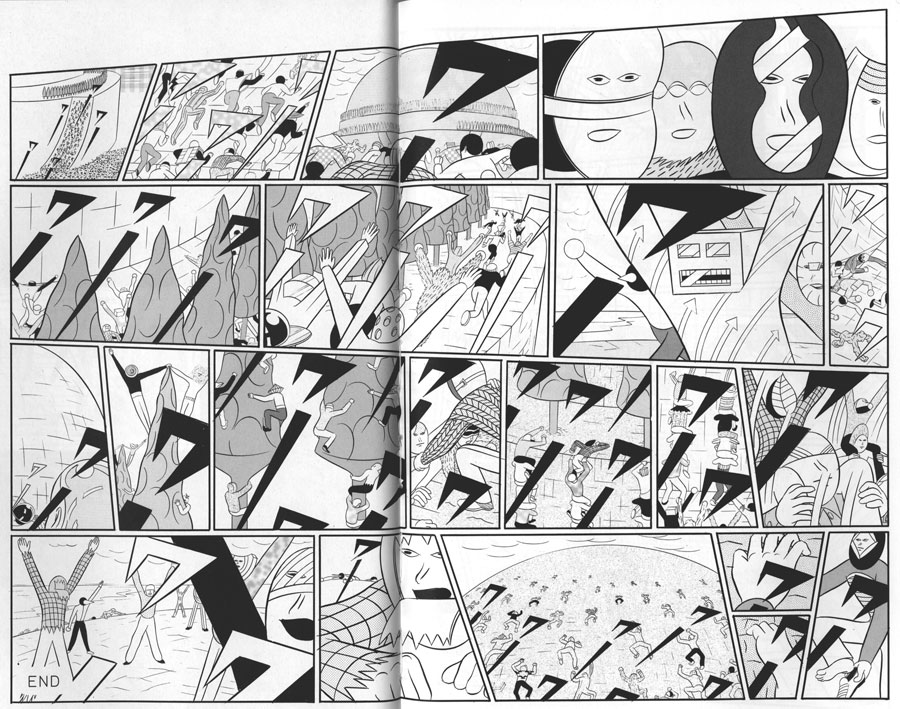
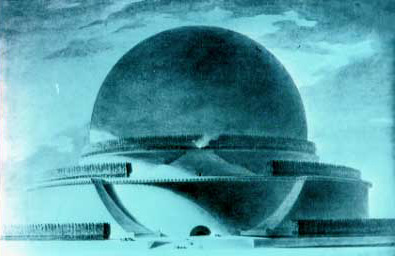
Spread from Memorial To Newton (read from right to left). Click to enlarge.
I. Enigmatic Engineering
I see the stories in New Engineering fall into two distinct, though interconnected, categories. First, there are the ‘engineering’ stories, where massive architectural projects are realized by gigantic machinery with some aid from the humans (are they human?). The second category contains everything else. These are stories of combat, athletics, warfare, fashion, etc. I’ll first talk about the separate categories. Later I’ll attempt to make some sort of unified statement on their relationship. First up is engineering.
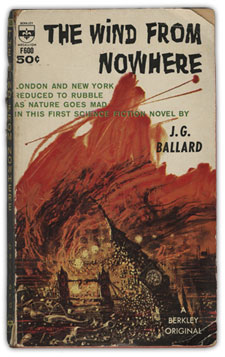
The Wind from Nowhere
The first thing that came to my mind when I saw pages from New Engineering (the story with that title also shared by the book) was J.G. Ballard’s first novel The Wind from Nowhere. In the book, the surface of the whole planet is rapidly destroyed by a powerful wind. The apocalyptic wind increases in force with deadly regularity. The wind sandblasts the planet into a cue ball. Civilization is on the brink of annihilation. Meanwhile, a mysterious structure is built – in secret – by a megalomaniacal millionaire Hardoon. The description of the building process has an uncanny resemblance to the way Yokoyama depicts the massive feats of engineering in his stories.
Here’s a taste:
“The hill had gone, obliterated beneath the gigantic jaws of fleets of bulldozers, its matrix scooped out like the pulp of a fruit and carried away on the endless lines of trucks.
Below the sweeping beams of powerful spotlights, their arcs cutting through the whirling dust, huge pylons were rooted into the black earth, then braced back by hundreds of steel hawsers. In the intervals between them vast steel sheets were erected, welded together to form a continuous windshield a hundred feet high.
Even before the first screen was complete the first graders were moving into the sheltered zone behind it, sinking their metal teeth into the bruised earth, leveling out a giant rectangle. Steel forms were shackled into place and scores of black-suited workers moved rapidly like frantic ants, pouring in thousands of gallons of concrete.
As each layer annealed, the forms were unshackles and replaced further up the sloping flanks of the structure. First ten feet, then 20 and 30 feet high, it rose steadily into the dark night.”
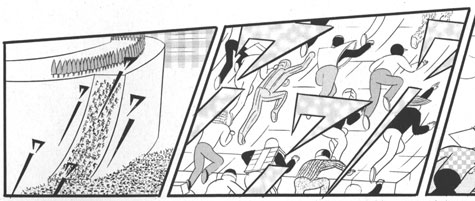
Detail from Memorial To Newton. “Like frantic ants…”
Like Frantic Ants…
This is only the first of several similar passages in the novel. Ballard totally dispenses with a human perspective. The construction is apprehended from a series of unnatural vantage points that allow us to experience the massive scale of the endeavor. Humans at this scale are “like frantic ants.” Since Ballard doesn’t have any visuals accompanying his prose, we have to imagine the scene. With Yokoyama, we are provided with vague glimpses. Chris Lanier has a great description:
“Yokoyama uses off-panel space with a droll brilliance — machines that cut rock or drill into the earth appear from the edges of the panels, needing no plausible leverage or further apparatus to do their work. The mysterious engine that runs these tools is the invisible will of the artist; the drill bits and jackhammers are really extensions of Yokoyama’s pen. The people in these stories have far less presence than the machines — they come at the end of the narratives to make the finishing touches and voice their approval.”
Without Psychology
New Engineering is different from The Wind from Nowhere. Ballard eventually tells us what is being built and why: a gigantic steel pyramid designed to withstand the force of the wind. Hardoon, the builder, hopes not only to survive the catastrophe but thrive in it as well. But his motives aren’t entirely clear and sometimes the reader is led to believe the pyramid exists solely so Hardoon can comfortably sit in his steel cage, watch the world turn to dust, and listen to the savage howl of the hurricane.
Hardoon is a typically Ballardian character who transforms and adapts as best he can to circumstances on the ground. A world catastrophe in this case and in Ballard’s early novels. In his later work modernity and technology are circumstances enough. We encounter these characters in what we recognize as ‘our’ world. But they already belong to another, hidden world, emerging in our midst like one of Italo Calvino’s Invisible Cities. And with the new world come new psycho(patho)logies. This is what’s missing from Yokoyama’s structures. The author consciously avoids depicting the psychology of his world. In the interview published in New Engineering Yokoyama says that he wants to create:
Characters without psychology — I am interested neither in the feelings of people nor in their emotions. I examine only what is to the eye. My characters do not work towards the satisfaction of a collective or individual interest, but to achieve a great goal, to achieve a great mission.
Great Missions
These “great goals” and “great missions” are opaque to us. They seem absurd, strange, and bizarre. Again Chris Lanier:
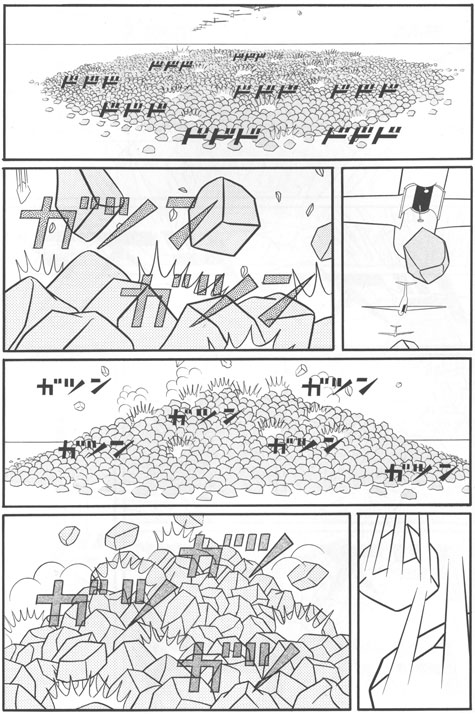
“ Its four stories show the construction of strange monuments and spaces. They describe huge mobilizations of resources for apparently useless ends. One “public work” is a fluorescent-lit room, set into a boulder, positioned in front of an absolutely straight (and also artificially constructed) canal. Another is a glass room, outfitted with chairs and a floor of Astroturf, set under the surface of a man-made lake. These constructions are not only absurd in themselves, the methods of construction are entirely impractical. The third “public work” is an artificial mountain, assembled from boulders that are dropped from airplanes, then coated with glue flowing from a single hose.”
From New Engineering. Click to Enlarge.
Memorial to Newton
If Yokoyama wants to banish psychology from his pages, we as readers want to put it right back. Because we lack direct knowledge of Yokoyama’s world we proceed archeologically and anthropologically. We compare our world or the artifacts of our world to the ones depicted in New Engineering in an attempt to excavate the smallest bits of meaning. Chris Lanier finds similarities between New Engineering and the kinetic architecture of superhero comics. James Benedict Brown can’t help but wonder about the ‘why,’ ‘how’ and ‘where’ of the New Engineering projects and compares their depiction to the sterility, purity, and disconnection of contemporary mainstream architectural photography.
Cenotaph for Sir Isaac Newton, by Boulle.
Indeed, Yokoyama’s world is close enough to the one we live in to make direct comparisons irresistible. In the “Memorial to Newton” sequence Yokoyama provides us with a clue as to the purpose or origin of these enigmatic works. The comic shows crowds of people irresistibly drawn to climb the immense Memorial to Newton structure. This is the only building that has any corresponding reality in our world. Perhaps it can serve as a key of sorts.
It refers to the unbuilt, and imaginary, Cenotaph for Sir Isaac Newton by the 18th Century visionary French architect Etienne Louis Boulle. It also brings to mind the endless specimens of visionary architecture that have been built and planned in the course of human history. Hanging Gardens of Babylon, Egyptian Pyramids, Roman Aqueducts and Temples, the great Gothic Cathedrals, the visionary paper architecture of the 18th, 19th and 20th centuries, The Crystal Palace, to the massive and often baffling projects of today’s starchitects that are going up all over the world. The list goes on.
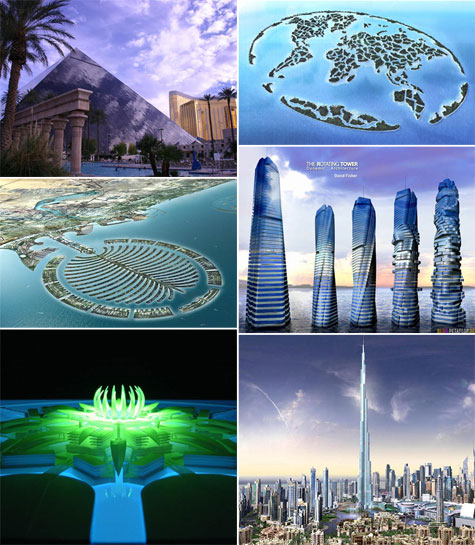
The Pyramids of Las Vegas and the wonders of Dubai.
Magnetism of Architecture
Many of these structures, especially the ancient ones, are as unfamiliar to us as Yokoymas. What do we make of the Great Pyramids? The Easter Island sculptures? After centuries of trying to ‘solve’ the riddle of the Great Pyramid, we’re really no closer to understanding the psychology of the builders.
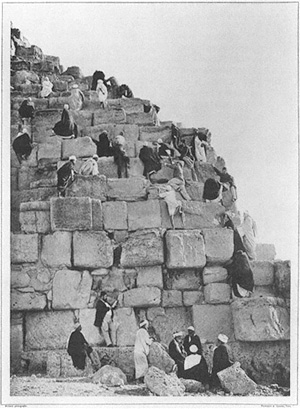
Like frantic ants… to the top!
The closest relatives of Yokoyama’s context-less plastic mega-structures are in Dubai or Las Vegas (and other alike places). Dubai is a veritable laboratory of modern architectural gigantism. Artificial islands, archipelagos in the shape of palm trees or the world itself, rotating skyscrapers, tallest towers in the world. These are just the tip of the proverbial iceberg.
Ostensibly we think we understand these structures. They are engines of economic growth, steel, and concrete representations of financial capital. Looked at in the larger context of globalization, global warming, war, and peak oil, they seem baffling and foreign. But they retain an irresistible and seductive pull. These structures— their sheer physicality, and what they represent —draw us in. In fact, climbing great monuments of civilization is one of the great past-times of today (and yesterday). People will travel thousands of miles for the privilege of climbing the Great Pyramids… and the pyramids of Las Vegas. What has been the initial impulse of the many people who first encounter the Great Pyramid of Egypt? Climb it!
Bath and The Flâneur, 2.5 x 3.75 inches, 2 color Gocco prints
I will be at the Minnesota Book Arts Festival this weekend. I’ll have all my mini-comics as well as two new micro-prints pictured above.


 I meant to post this sooner but the