My Comics Journal column about Ted McKeever’s Eddy Current is live! See how Eddy fits into the 1985-87 Event. Also, I couldn’t help myself, but I go into a fun tangent on the portrayal of cities in superhero comics. Here’s a taste:
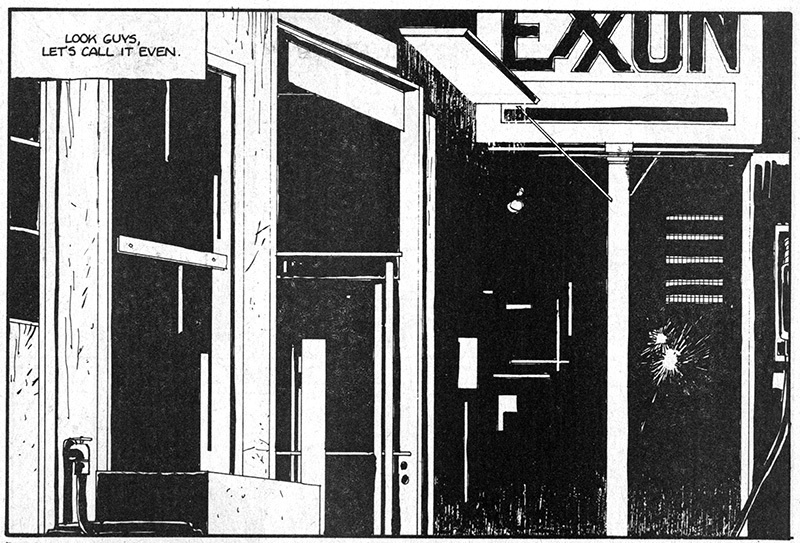
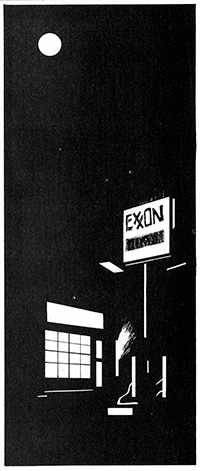
As required by superhero conventions, Eddy lives in a fictional city with a ridiculous name: Chad. The city resembles New York, especially the New York of the 80’s: grimy, with underfunded infrastructure, populated by lowlives and criminals, and loomed-over by gleaming towers of the ultra wealthy ruling elites. Chad is Metropolis and Gotham in one. This is where McKeever really shines. His keen eye really brings the city to life. He finds moments of stillness and quiet beauty in studied depictions of abandoned warehouses, gas stations, desolate alleys, and diners. Clean lines, attention to detail, exquisite framing. These moments make Eddy stand out from other comics of the Event.
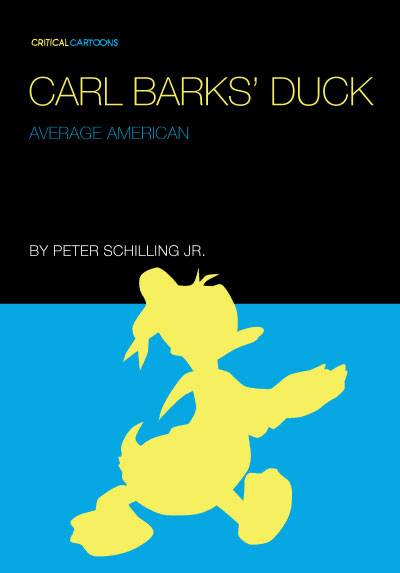
In last week’s post I mentioned I’d write more about Carl Barks’ Duck by Peter Schilling Jr. (out now from Uncivilized Books). Well, I ended up writing about the Critical Cartoons series as a whole.
Spectrum
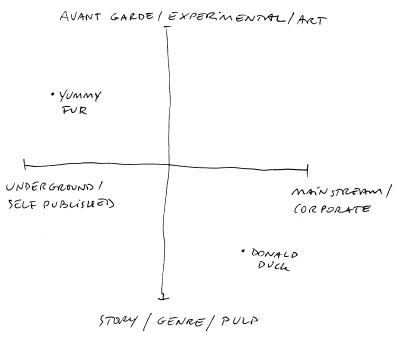
When I conceptualized the Critical Cartoons series for Uncivilized Books, I wanted to demonstrate the breadth of subjects that could be discussed in the series. The first two books should exemplify the opposite ends of a spectrum…
Yummy Fur
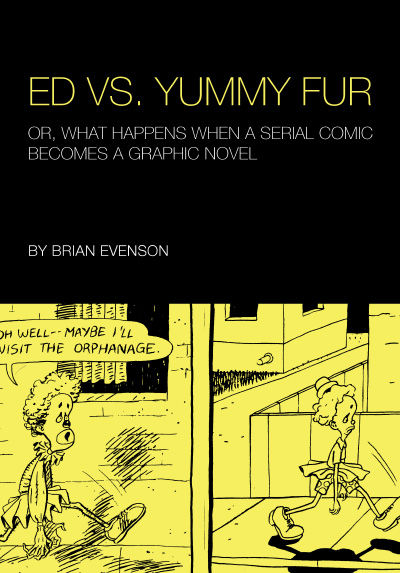
The first book (Ed vs. Yummy Fur: Or, What Happens When A Serial Comic Becomes a Graphic Novelby Brian Evenson) took on a key (and under appreciated) work from the comics underground: Yummy Fur by Chester Brown. Yummy Fur is scatological, sacrilegious and challenging. It was a way for Chester Brown to break down not only his inhibitions and beliefs, but also his approach to making comics. To date, Yummy Fur has not been reprinted.
The only part of Yummy Fur still in print is the collected (and heavily edited) Ed The Happy Clown. In other words, this a relatively obscure work that for all it’s influence, has been partially forgotten, and difficult to track down. Yummy Fur and comics like it represent one side of the spectrum of the comics continuum. The lost and forgotten self-published work, the minor masterpieces, hidden gems, significant early work (or ‘unusual’ late work) of great cartoonists… published by obscure small presses. I would be very happy if the Critical Cartoon series manages to bring some of them out into the light.
Duck Man
The second book, Carl Barks’ Duck, looks at Carl Barks’ Donald Duck stories. Barks’ Donald Duck could not be more different from Chester’s work. First, it’s a corporate product. Second, all the characters and situations are owned wholesale by the Disney corporation. Finally, it was a way for Disney to maintain copyright on Donald when his primary medium, the cartoon, had waned in popularity. And yet Barks’ created an amazing array of stories and characters within that system. His contribution to comics is difficult to measure. He is one of the greats. His work has been almost continuously published around the globe and has influenced comics and cartooning everywhere (for example, Osamu Tezuka was hugely influenced by Barks’ work).
Barks’ work represents the other side of the comics continuum: the corporate mainstream. Some, like Barks’ comics, are well documented, examined and easily available. Others were very popular in their time, but have become lost, or—if they are still currently published—changed beyond recognition (for example Captain Marvel / Shazam). Or, there are the occasional moments in time (1985-1987) where artistic experimentation, audience expectations, and corporate willingness to take chances, results in a deluge of interesting work in the mainstream.
Some of this work (Dark Knight or Watchmen) goes on to influence and create whole new movements. Other comics (The Shadow or The Question) languish in relative obscurity. This is where many comics readers start. When I was younger (I grew up in Europe), I immersed myself in Marvel and DC universes, or the fantasy / science-fictional worlds of Thorgal, Valerian and Funky Koval… Or, in the humor of Lucky Luke, Asterix and Kajko i Kokosz. Eventually I went on to discover (and create) comics closer to Yummy Fur in their sensibility. But this is where I started. There is a lot of interesting work at this end of the spectrum.
Barks Overload
For some reason I never got into the Disney comics, and consequently I didn’t encounter the work of Carl Barks until I was much older. Eventually, I became aware of his work, but it was always difficult to know where to start. Barks is such a ubiquitous cartoonist – so beloved and so prolific – that it’s difficult to know where to start… especially for new readers. Should I read the best works? What are the best works? Are they really the best works? Should I try to read from the beginning? I approached Peter Schilling Jr. about writing something for Critical Cartoons, I was selfishly delighted when he chose Barks’ Donald Duck comics. Peter went on to write the perfect introduction to the work… and with Fantagraphics’ recent push to reprint all of Barks’ Duck comics, now is a perfect time to examine his work again.
New Voices
Another goal for Critical Cartoons is to bring new voices to comics criticism. Both of the authors (Evenson & Schilling Jr.) are big fans of comics, but in their careers have never had the opportunity to write about them. If given an opportunity, something interesting might emerge.
Starting with tiny detail — a dash placed between ‘graphic’ and ‘novel’ to form ‘graphic-novel’ (read this excerpt on TCJ) which subtitled the recent Ed the Happy Clown re-issue, — Brian’s close reading of minutiae in Brown’s work was revelatory. More importantly, his unapologetic placement of Brown’s work in the continuum of sacrilegious and scatological works that goes back centuries, points to ways of reading comics that engage with broader culture.
Weird Panel
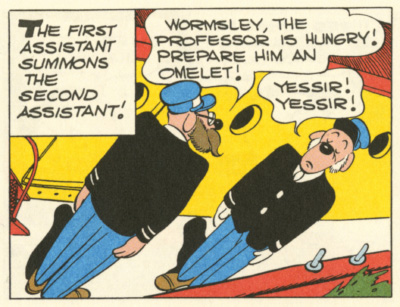
Peter’s comparison of Bark’s Donald Duck to the classic Hollywood system was revealing. Hollywood Stars, for example Cary Grant or Jimmy Stewart, took on a variety of roles, but often remained distinct recognizable characters themselves. Donald fits that bill too (sorry)! Finally, look at this flabbergasting ‘weird’ panel (see below) from Lost in the Andes. It’s such an usual angle and I certainly haven’t seen Barks use it again elsewhere (at least in my limited familiarity with his work). Did he try it out, decide it wasn’t working, and never used that angle again? Barks scholars… any insights?
Critical Cartoons
Now that the two inaugural volumes of Critical Cartoons are out, it’s time to look forward to next volumes. There are a few new Critical Cartoons project bubbling up. I’ll keep you posted as they develop. Thanks for reading!
Twitter
Finally, I have a new Twitter account: @BetaTestingTomK . Uncivilized Books started as a way to publish my own work. Until now I’ve conflated both identities… I was Uncivilized Books and vice versa. But the publishing house has evolved into something quite different and much larger than me. I don’t want to keep cluttering up the Uncivilized Books ( @unciv ) feed with weird thoughts, random ramblings, architectural drawings or strange theories (though you’ll probably get a bunch of that anyway). It’s time to have a new place for that stuff. Interested in the weird stuff? Follow @BetaTestingTomK or sign up for weekly updates on my new site (or both!)
Next week: Eel Mansions!
Soon: Progress report on Trans Terra: Towards a Cartoon Philosophy!
Over at the Tumblr parallel universe I’ve started a series of posts that excavates the source material of the architecture found in Beta Testing the Apocalypse. Follow that tumblr if you’re into that sort of thing. The first post was about Jan Maneval:
Graham Harman is one of my favorite living philosophers. I read his blog daily. So, it is with a very heavy heart that I must denounce this recent post: one of the most ridiculous polls ever conducted. I agree that the question polled, “Should a permanent shrine be erected in memory of Paul the Octopus?”, is ridiculous. It’s the off handed remark that mr. Harman makes after bringing attention to the poll that really chafes:
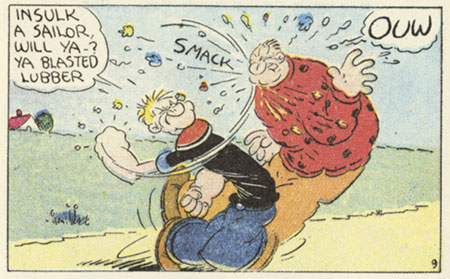
Should a “permanent shrine” be erected in honor of Popeye?
Why bring Popeye into it? Or, why not be more precise? Surely he doesn’t mean Popeye, star of Elzie Crisler Segar’s Thimble Theater, one of the finest American newspaper adventure comic-strips? Is it Popeye, the protagonist of the Fleisher Studio’s animated cartoons? Or, does he mean Popeye the character played by Robin William’s in Robert Altman’s film Popeye? It Popeye’s Chicken & Biscuits, the chain of fast food restaurants? Perhaps he means Jimmy “Popeye” Doyle the fictional detective from The French Connection?
Maybe he objects (no pun intended) to “permanent shrine” and not Popeye? Should it be a temporary shrine? Or maybe not a shrine at all but a monument? An obelisk? A pyramid? Which is it? I for one would endorse a “permanent shrine” to Popeye… especially if it were designed by Richard McGuire:
If you’re wondering, other posts on Comics Education are here: one, two, three, four, five.
Today I want to talk about comics in areas of study other than Art and specialized comics programs. English, Cultural Studies, and other programs have since the 90’s started to integrate the study of comics into the curriculum. When Art Spiegelman’s Maus was awarded the Pulitzer 1992 most rationales to ignore comics in the academy melted away. A year later Scott McCloud built on Eisner’s Comics and Sequential Art and released Understanding Comics. Whether you agree with McCloud’s thesis or not, the book quickly became a staple text for the academic world. It created a common language for talking and writing about comics. It was the perfect comics 101 text.
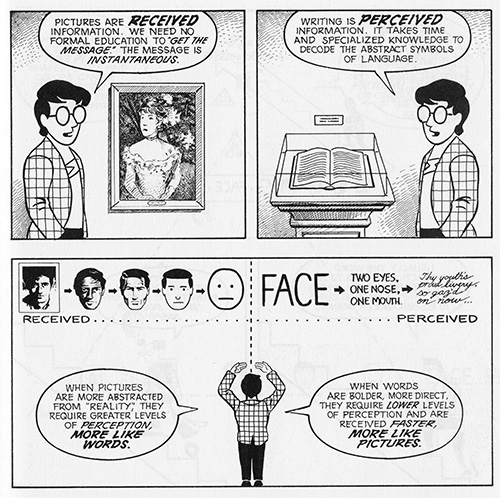
In my college experience (mid 90’s) I’ve taken many courses in the English and Cultural Studies departments. In both cases comics as object of study, or comics formatted assignments were welcomed with curiosity and open minds. My professors mostly didn’t have the critical apparatus to evaluate these projects, but at minimum they were interested in the medium. Almost all of them were at least somewhat familiar with Marshall McLuhan’s work. McLuhan famously included comic-books as an example of a ‘cool’ medium (meaning a low-definition medium requiring more conscious reader participation) in his pioneering book on media theory Understanding Media (1964).
Scott McCloud built on McLuhan’s media centric view, and introduced his own hot-to-cool continuum that was comics specific.
Of course, McCloud’s title Understanding Comics is a direct reference to McLuhan’s book. It’s an association that I’m sure helped open doors to the academy and cemented the book’s place as an essential text on comics.
Another potential reason for this relatively generous reception from literary academia resulted from the ‘comics as literature’ model that was dominant from the late 80’s to the present. The work of prominent cartoonists that emerged from that era: The Hernandez Brothers, Daniel Clowes, Adrian Tomine, Chris Ware, Seth, Chester Brown, Charles Burns and many others fits the literary approach (though, of course, not always and not entirely). This work was championed by The Comics Journal and it was this quality that was recognized by the Pulitzer Prize when it was awarded to Spiegelman’s Maus. While all of these creators are no slouches in the art department, they all create works that are story driven and deal with many traditional literary concerns.
I want to briefly focus on Adrian Tomine. Adrian earned a degree in English from the University of California in the 90’s. (I wonder if Clowes’ Art School Confidential was in any way part of his decision to not go the art school route?) I can’t locate my TCJ interview with Adrian, but if I remember correctly, at that time he was concerned with learning solid storytelling. He felt he could learn more from say, Raymond Carver, than the average comic-book on the stands. Comics to him were a storytelling medium. Art, though clearly important, was subordinate to storytelling. That attitude is understandable. At the time Adrian attended school, well written comics were a minority (and still are). I’d be curious to know if Adrian he ever brought comics into the classroom and created comics as assignments.
This ‘literary’ component of comics is something that is often overlooked in comics education. The vast majority of comic-books are still stories that people read. But most schools (that I’m aware of) that taught comics focused on the art side of the equation. Students were taught the grammar of comics, clarity of layout, transitions, or simply how to draw or use the correct tools. But the quality of storytelling that was told using these techniques was often an afterthought. Courses on comics as object of study (as literature) have also been proliferating, but courses on comics writing are still relatively rare. This has begun to change since the turn of the century and it’s something I’ll go over in my next couple of posts.
This is a small addendum to the last post. Jason Overby & J.T. Dockery (via comments) reminded me of another later interview where Dan Clowes recanted his Gary Panter comments. I dug around in my Comics Journals and found the relevant quote:
One guy whose work I once said flippant, dismissive things about in an interview which I absolutely deeply regret, is Gary Panter. I think he’s the greatest artist in the world. At the time I had only read a few things of his and really sort of lumped him in with other lesser artists of the style. – The Comics Journal, issue 233, May 2001
I hope that the article doesn’t read in any way as disrespectful to Clowes. I just wanted to point out the attitudes that existed at the time (late 80’s & early 90’s – though they persist until today) and that even the best of us held some of these views. I’m certainly not immune. In the past I’ve practiced all kinds of wrong-headed anti-art stances.
Also, it should be mentioned that both of the interviews the Blab! #4 interview I mentioned and MUCH more are is collected in a new volume edited by Kent Worcester Ken Parille and Isaac Cates: Daniel Clowes: Conversations.
This is a continuation of three previous posts on comics and education: one, two, three. Today, I continue with the ‘comics renaissance’ I started writing about in this post. Rough time period: late 70’s to late 90’s.
Here’s is an appropriate prelude for this post:
[Jack] Kirby enrolled at the Pratt Institute in Brooklyn, at what he said was age 14, leaving after a week. “I wasn’t the kind of student that Pratt was looking for. They wanted people who would work on something forever. I didn’t want to work on any project forever. I intended to get things done” (via)
Up until now I’ve written primarily about schools that focused specifically on comics. But there’s always been another way that aspiring cartoonists got educated: Art School. I want to look at two cartoonists who both went to art school (roughly during the same period) and who exemplified two basic attitudes about art in comics: Gary Panter and Dan Clowes. Art education was traditionally very much craft/technique oriented and focused on the core artistic pursuits: drawing, painting, sculpture. These were largely taught with a focus on representational image making. Life drawing, nature drawing, etc. By the time Panter & Clowes went to art school the focus had shifted dramatically. Most art schools still taught the basics of drawing, painting and sculpture, but these were supplemented (and in some cases supplanted) by non-traditional approaches culled from the countless art movements, avant-gardes and theories developed during the 20th century. By the late 70’s and early 80’s abstract expressionism, conceptual art installations, postmodernism, and others were well entrenched in the system.
Gary Panter studied painting at East Texas State University in the mid 70’s. In many ways his work embodies the comics as Art position. From the beginning his work never shied away from fine-art sensibility. His mind-bending, neo-cubist, cut & paste, future-caveman-punk Jimbo comics made a splash (slash?) in RAW magazine in the early 80’s. I’m not sure what Gary Panter’s school experience was like, but I don’t remember him ever speaking negatively about art school (I’ve read a lot of interviews with Panter, but I’m sure I missed a few, so if anyone knows otherwise let me know). In fact, if anything Gary’s gone out of his way to promote art to cartoonists. A recent example of that took place at the 2009 MoCCA art festival where Gary & Frank Santoro ran through a couple dozen artists that cartoonists should be aware of. In the middle of that Gary encouraged the attending crowd of comics artists and fans to “not be afraid of art.” Still, Panter was no ‘elitist arteest’ which is surely partly due to his embrace of the lowly comic-book. Panter form his 1980 Rozz Tox Manifesto:
Market saturation was reached in sixties – everyone knows that. Fine Elitist Art is of diminishing utility. There is not more reward for maintaining or joining an elite and sterile crew.
For some the artiness of Art Spiegelman’s and Françoise Mouly’s RAW (and Gary Panter’s Jimbo) was a breath of fresh air, but many cartoonists from that era caught a whiff of something else from the magazine. In an interview in Blab! #4 (1989) Dan Clowes was asked if he liked RAW:
Clowes: Not especially… I mean Spiegelman’s a very clever guy. I’m not sure if he planned it all this way or whether he just lucked into it, but he found a good way to package comics–as a magazine the Soho crowd is proud to have laying around at the foot of their loft beds, or whatever. He’s made RAW into a real big success, but I’m not sure whether it’s a great magazine. It’s certainly introduced us to some very good artists, Friedman and Burns specifically…and Muñoz and Sampayo.
Blab: Do you like Weirdo better?
Clowes: Much better. In fact, despite all the counter-culture cartoonist types I know, I can’t think anybody I’ve talked toin the last few years who really likes RAW–even people who’ve been printed in it.
In the same interview, Dan expounds further on art and artists when Blab! asks him what he thinks of Gary Panter:
Ummmm… I don’t care for it. I think he’s full of shit. There are little bits in it that I think are very amusing, but overall I think he’s pulling our collective leg. I really think that people that are into Gary Panter’s comics are, for the most part, pseudo artists or artsy fartsy types who think the’ve developed some real artistic sensibilities and can appreciate something the masses can’t appreciate. I can see what he’s doing but it doesn’t grab me. He’s certainly inventive and has a look all his own, but when it comes to drawing comics–which is what I’m talking about–why do I have to read it? It seems intentionally oblique for no reason. It’s going in a different direction than the stuff I’m interested in.
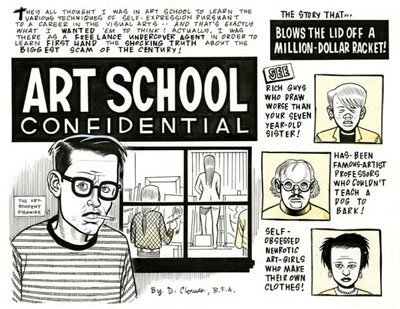
Now it’s not surprising to see the young Dan Clowes hold these views (I don’t know if he still holds them today). He is after all the author of Art School Confidential (the comic and the film). But he exemplifies the views of many other cartoonists at the time. Clowes attended the Pratt Institute in New York where he earned a BFA. By his account the school was drowning in the worst excesses of postmodernist conceptualism. The goal of the program seems to have been the creation of Art with a capital A, technique and craft were deemed secondary and determined by concept.
I don’t know if either of the cartoonists ever tried to present comics as art in any of their classes, and what the reaction might have been from the faculty or other students. But, having gone to art school myself I can at least speak to my own experience. I attended University of Minnesota in the early to mid-90’s and I graduated with a double major BFA in Art & Architecture. Cartoons and comic-books were generally seen as negatives in the art program. Several of my drawing teachers actively discouraged that kind of drawing. I assumed the print-making department would be more receptive to comics (as an art form where the end result is a printed object), but no. In my experience all printed work was created to be hung on the wall. When I at one point tried to present a comic-book that was done on a litho press, the professor insisted I matte and frame the work or I would not get credit for it. In other cases crazy performative pieces won general approval. In other words Clowes’ Art School Confidential resonated with my own experience… and that of many others:
As it turned out, every single one of my readers was either in art school or had some affiliation with it. They all responded overwhelmingly (and) were all certain I had gone to the same art school they had. The story took on a life of its own for a while.… People would Xerox it and put it up on the bulletin board at school. Somebody else would take it from there and Xerox it again. There were rumors that it had been Xeroxed so many times that nobody could discern the art style anymore. It became a kind of folk art. (via)
What art school lacked in the technique/craft area, was compensated by a kind of confident bravura that came with… well with being an Art School. Much of the art produced may have been bad or amateurish or whatever, but in almost all the cases there was a confidence in the importance of Art and it’s place in society. This was something sorely lacking in the comics world. But during this period the idea of comics as an Art form, with it’s unique qualities and effects was emerging and aggressively asserting itself. Gary Panter imported that attitude into comics from Art. Dan Clowes arrived at a similar place (with very different results) by having to actively resist the condenscending attitutes of the art world. In a weird way they followed a path described by Gary Panter. Again from Rozz Tox Manifesto:
Business 1. To create a pseudo-avant-garde that is cost effective. 2. To create merchandising platforms on popular communications and entertainment media. 3. To extensively mine our recent and ancient past for icons worth remembering and permutating: recombo archaeology.
Both artist mined the past of comic-books, newspaper strips, science-fiction and pulps, detective noir, monster & trash cinema and other detritus of past mass culture. Panter’s archaeology turned his work into a dayglo toxic feast for the eyes while Clowes’ work became a kind of high-pulp literature. Both artists found themselves at the head of a new comic-book avant-guard. The Dan Clowes literary approach to comics would win out over the next three decades, but Gary Panter’s influence is becoming increasingly visible in the new millenium.
Up next: I didn’t get to McCloud so I will try next time. Also, the English Department…
Timeline:
1980. RAW published by Françoise Mouly (edited by Art Spiegelman and Mouly)
Gary Panter writes the Rozz Tox Mainfesto.
1981. Weirdo published
The Hernandez Brothers publish Love And Rockets
1985. Will Eisner’s Comics and Sequential Art published
1986. Batman: The Dark Knight Returns by Frank Miller Watchmen by Alan Moore & Dave Gibbons
1989. Dan Clowes’ Eightball published
1992. Art Spiegelman’s Maus awarded the Pulitzer, the Eisner and the Harvey
1993. Scott McCloud’s Understanding Comics published
1996. Will Eisner’s Graphic Storytelling and Visual Narrative published
A few additions to my initial post before I forget them.
An anonymous reader pointed out (via comments) a couple of other institutions where cartoonists got training. Both Disney and Fleisher Brothers trained artists for animation. This type training followed the specialization model typical of the other schools I mentioned before. In this case the specialization was even more pronounced. These companies were growing very quickly at one point and had a huge demand for animation talent. The fact that they set up corporate schools to satisfy their own demand for animators, speaks to the fact that there weren’t many other places for this kind of education. Some of this training obviously could translate to comics and cartooning. At least one great comic-book artist, Jesse Marsh, came out of that system.
The other school (named by the same anonymous reader) was The John Buscema School. It was set up in the 1970’s by one of Marvel Comics’ most prolific artists, John Buscema. I know that Stan Lee lectured there, but I don’t know much else about it. The work that went into that school was the source material for the legendary How To Draw Comics the Marvel Way. I confess that I have created hundreds of pages of comics during my high-school days based on the exercises in that book. If the book is indicative of the curriculum of the Buscema School, then the school probably functioned in a way similar to the training done by the animation studios. It was a way to quickly train talent for a fast growing business.
Even though How To Draw Comics… contains a lot of work by Jack Kirby, it’s probably safe to assume he didn’t teach at the Buscema School. By 1971 he had left Marver for DC. Also, I think by then he had already moved to California(?). In an interesting side note, Kirby briefly worked for the Fleischer Studios as an inbetweener. But he hated the work:
From Fleischer I had to get out in a hurry because I couldn’t take that kind of thing,” describing it as “a factory in a sense, like my father’s factory. They were manufacturing pictures. (Via Wikipedia)
This is coming from a famously fast artist who was capable of turning in several issues of a standard comic-book per month. I wonder if this in any way could be a clue as to the conditions & pace present at the animation studio schools.
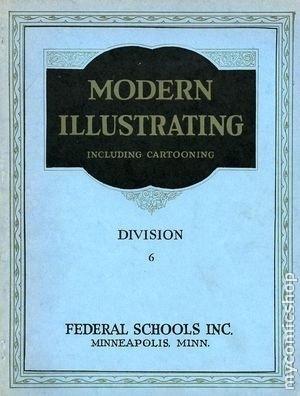
Modern Illustrating Including Cartooning (1935 edition) An interesting nugget about the state of comics education before the WWII can be found a the end of volume one the D&Q edition of Gasoline Alley (published as Walt & Skeezix). I just finished reading the volume and I can’t resist mentioning it. The book reprints seven pages from the fifth volume of Modern Illustrating and Cartooning. The book was published by Federal Schools, from Minneapolis, Minnesota. Federal Schools was the original name for the Art Instruction School which I already mentioned. Frank King wrote and illustrated the material reproduced. The piece is called “Lesson 3. Part 1. The Cartoon Page”. Here are a few subheaders to give you an idea of the material King’s writing about:
The Cartoon Page a Symposium on Timely Topics
Ideas
Arrangement
Making the Drawings
The content of the piece is a reminder why comics are called ‘comics’. Almost all of the advice is geared to creating humorous pieces on timely topics. King also encourage students to keep sketchbooks and to draw from life; sound advice for any era.
The material dates from 1931, but as Chris Ware notes in the explanatory text that accompanies the reprinted pages, most of the drawings that accompany King’s text dates to 1917 & 1918. Federal Schools was founded in 1914, so it’s certainly possible that earlier editions of the work exist.
Chris Ware also raises the tantalizing possibility “that [Charles] Schulz worked his way through King’s exercises as part of his correspondence training”. Schulz is the star alumni of the Art Instruction School, and had famously taught there as well. Incidentally the school is still around. A few of my friends were instructors there. It’s still a correspondence school, and the instructors still hand-correct (with red ink) sent in student drawings.