Category: Review

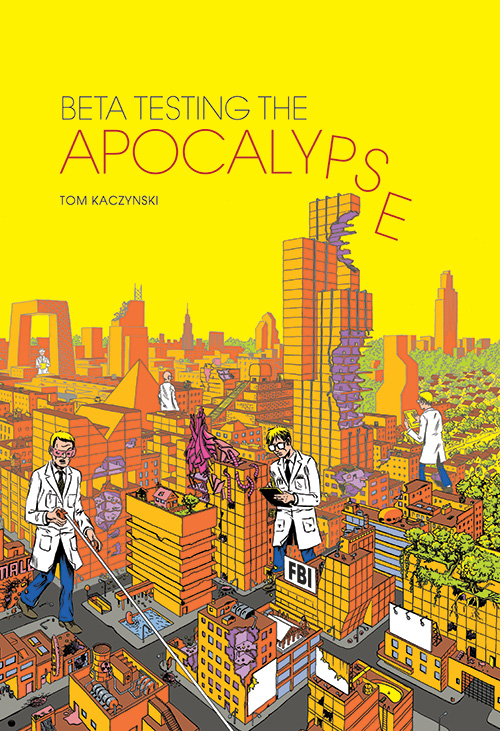
  • Beta Testing The Apocalypse Reviewed by Miami Herald

    This one is a short capsule review, so I’ll post the whole thing here:

    His functional and utilitarian art is often reminiscent of the insanely proper illustrations in Jack Chick’s religious tracts, but Kaczynski’s own wildly anarchic imagination fuels his insightful and unsettling narrative. He combines socioeconomic fact, fantasy and farce in this seriously paranoid criticism of modernity, and the result is a disturbing but hilarious tale of identity loss and consumerism run amok.

    See the Beta Testing The Apocalypse Review on Miami Herald.
  • Beta Testing Reviewed by The Comics Journal

    A new review of Beta Testing the Apocalypse, this time by The Comics Journal! As a reader of The Comics Journal since issue 148 (Charles Burns Interview. I miss the paper issues!), I’m pleased as punch. Here’s an excerpt:

    […] One of the pleasures of reading Beta Testing, as in other watershed collections like Caricature,Curses, or Everything Together, lies in watching a cartoonist become less mindful of his precursors, less rote in his treatment of subject matter, both freer and more assured. As the book progresses, Kaczynski sloughs off influence, just as his characters slip away from civilization. A breakthrough story like 2008’s “Million Year Boom” nearly brings the book to a halt halfway through with its impressive and authentic weirdness, yet still retains the stamp of millenarian systems novelists, still partakes of the old dead-eyed Clowesian aloofness. By the time we reach the concluding story, “The New”—at once an ode to modernist architecture and an allegory literalizing the decline of the west, created uniquely for this volume—Kaczynski’s layouts have exploded into space, cities and buildings splayed out on the page in startling and diagrammatic splashes.

    Also, the review delves into the index, which is personally very satisfying. I’m always curious how people will react to it:

    To his credit, Kaczynski acknowledges as much, duly footnoting his book’s debt to J.G. Ballard’s drowned worlds and concrete islands in an index that records other oblique references to Jane Jacobs and Slavoj Žižek—though entries for “Gibson, William,” or “DeLillo, Don” remain curiously absent. Kaczynski’s looming dread and sub/urban automata owe at least as much to White Noise as his vision of mechanized, entropic modernity does to The Atrocity Exhibition, not to mention his pontifications on gleaming consumerism: “Consider the modern bathroom. … How did this antiseptic room where excrement magically disappears come to be?” In such revelations of the science-fictional in the everyday—Kaczynski also invokes grain silos and utilitarian office buildings as totems of some alien race—the cartoonist conducts a kind of archaeology of the future from among our commonplace existence, in much the same way the Godard of Alphaville or the Tarkovsky of Stalkercalled forth the otherworldly moonscapes that have always been dormant in what our culture has erected or let fall into ruin.

    William Gibson should’ve been there, but Don DeLillo I’ve never read. Here’s hoping there’s a second edition so I can tinker with the index some more!

    The rest of the review is here.
  • Beta Testing Reviewed at Comics Bulletin

    beta-testing-the-apocalypse-by-tom-kaczynski

    Another review of Beta Testing The Apocalypse surfaced a little while ago. This one was fun to read:

    Kaczynski’s new collection Beta Testing the Apocalypse is weird as all fuck and funny as all shit, a Singles Going Steady for the art comix crowd that merges Burroughs’ cut-up commentary with Ballard’s keen tech consumer insight and siliconic wit. Working in a style that is a perplexing mix of dot matrix detailing, architectural blue print exactness and razor blade xeroxing looseness, Kaczynski uses Beta Testing the Apocalypse as a platform for his interest in the anxieties of the ever shifting expansiveness of 21st century life, a life Kaczynski obviously inhabits, too, but somehow does so with a verve and clarity the rest of us lack.

    See the the rest here.

  • Utopia Adrift: The Drifting Classroom

    the drifting classroom kazuo umezu
    Poisoned paradise

    I should have posted this earlier. I wrote a review of Kazuo Umezu‘s The Drifting Classroom for Rain Taxi. The review is not online, but the magazine is available for free in most independent book stores around the country. You can also get a copy by ordering direct from Rain Taxi. Here’s an excerpt:

    The distance between the present and utopia is measured in centuries. We locate utopian societies in the future, and prefigure them with premonitions of apocalypse; the dysfunctional order of the present must be swept aside by some vaguely grasped apocalyptic event to allow a new and better world to emerge. Every generation faces their own unique brand of the end of the world: religious rapture, nuclear annihilation, natural disasters, clash of civilizations, Malthusian overpopulation, and so on. Ecological collapse caused by industrial pollution fuels the horror in Kazuo Umezu’s inventive, eleven-volume manga horror epic, The Drifting Classroom.


    The titular classroom is actually Yamato Elementary School, which due to unknown circumstances finds itself ripped out of time and flung into a devastated future. The school, housing 863 students and teachers, becomes an ark adrift on the sea of toxic sand that covers the remains of Tokyo and the rest of the world. The school’s temporal realignment brings the kids and adults face to face with the deadly consequences of Japan’s famed ‚ “economic miracle.” They become the last remnants of civilization and, at the same time, the last hope for humanity’s survival.
    It’s clear that Umezu perceives adults as part of the problem, for he dispenses with the teachers early on. One by one the grown-ups succumb to madness and die off quickly. They can’t process what is happening to them‚ “the idea that the school might be in the future is utterly impossible,” and unable to imagine the impossible they have to die off, like dinosaurs. The children, not yet saddled with dogmas of adulthood, are able to imagine the possibility of time travel and thus grasp the reality of their predicament. Their capacity to imagine the impossible becomes their salvation, but also the source of the horrors to come.