How’s your 2020 going so far? Pandemic, unexpected relocation, pinched nerve, Minneapolis Riots, RIP Ruby, Pneumonia… what else you got 2020?
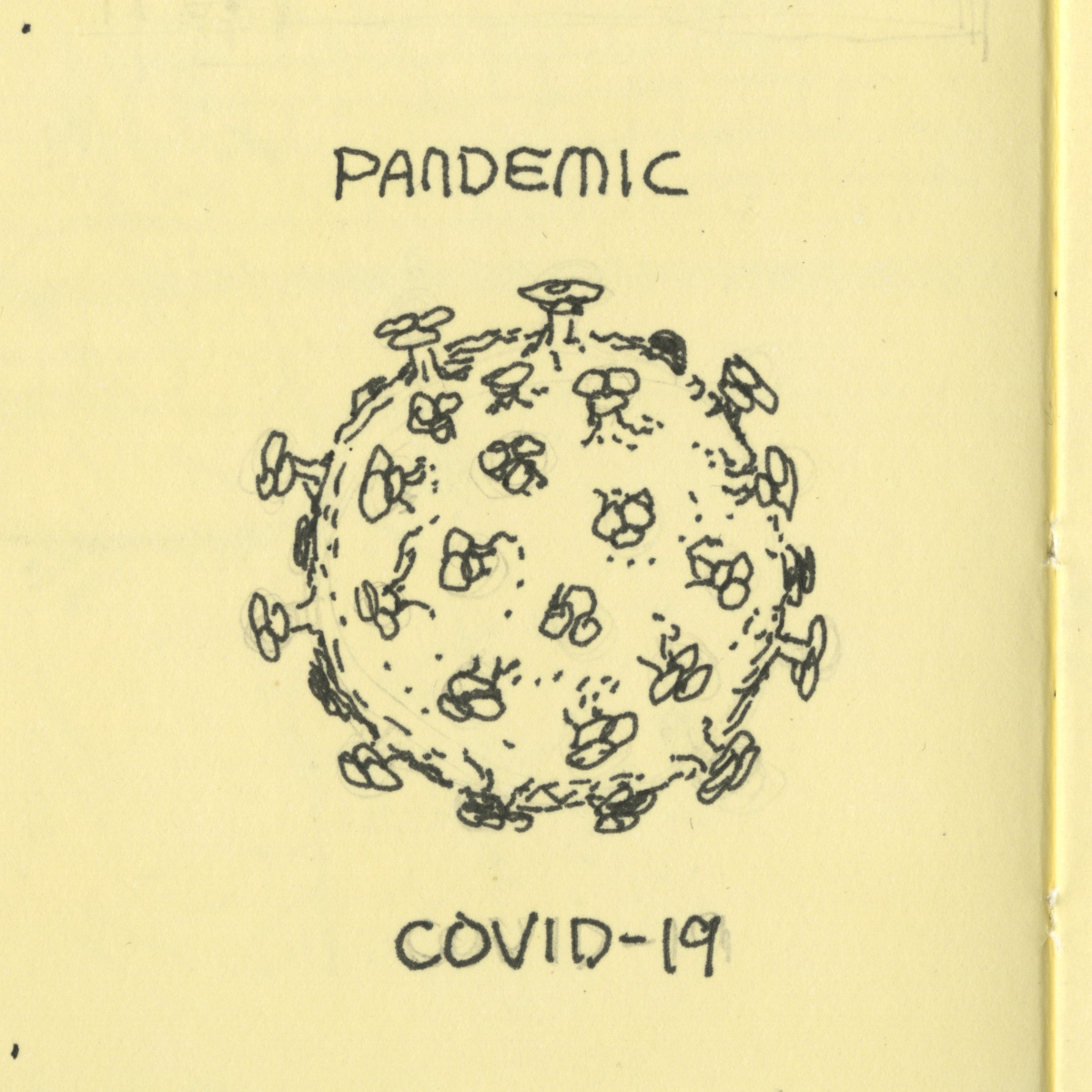
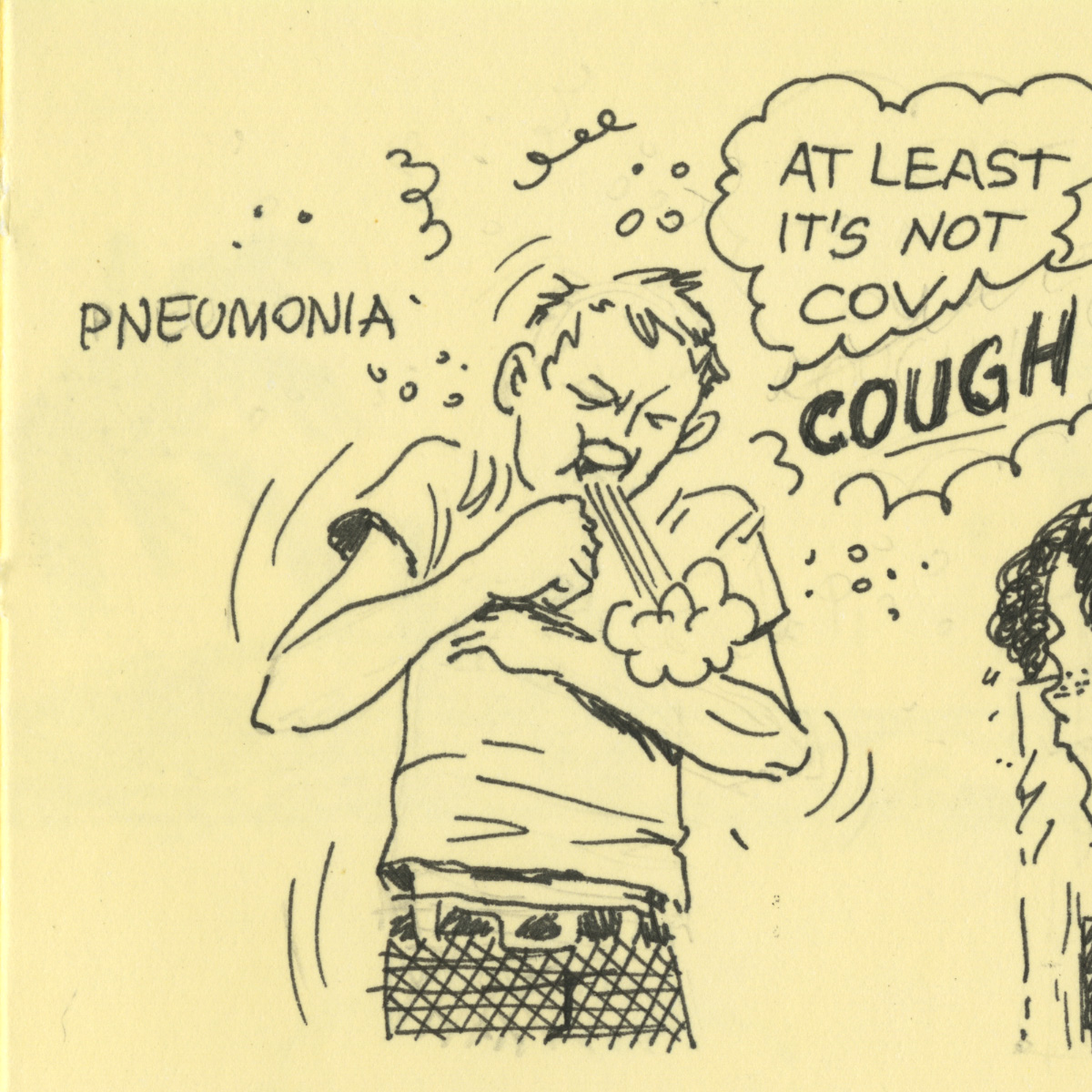
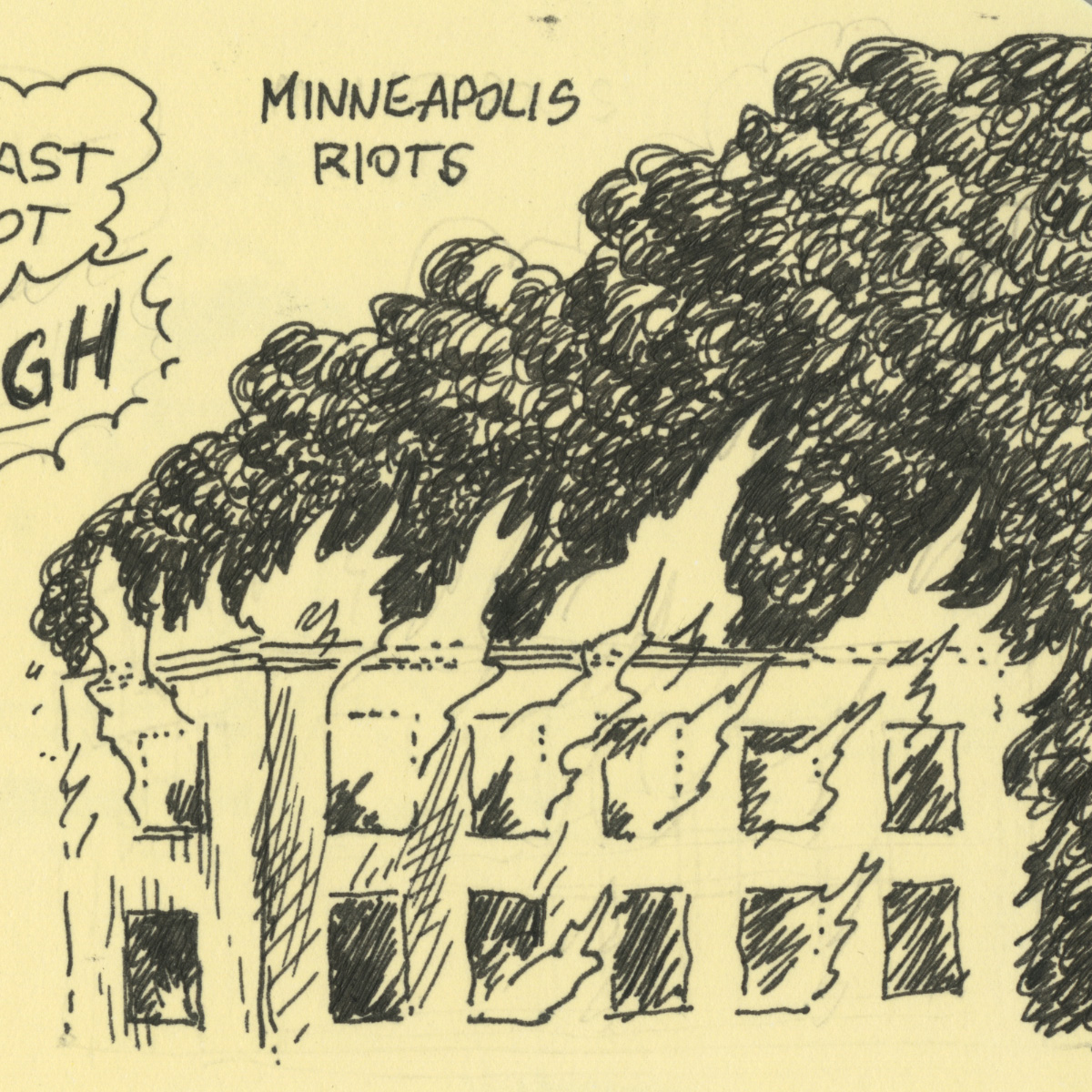
How’s your 2020 going so far? Pandemic, unexpected relocation, pinched nerve, Minneapolis Riots, RIP Ruby, Pneumonia… what else you got 2020?
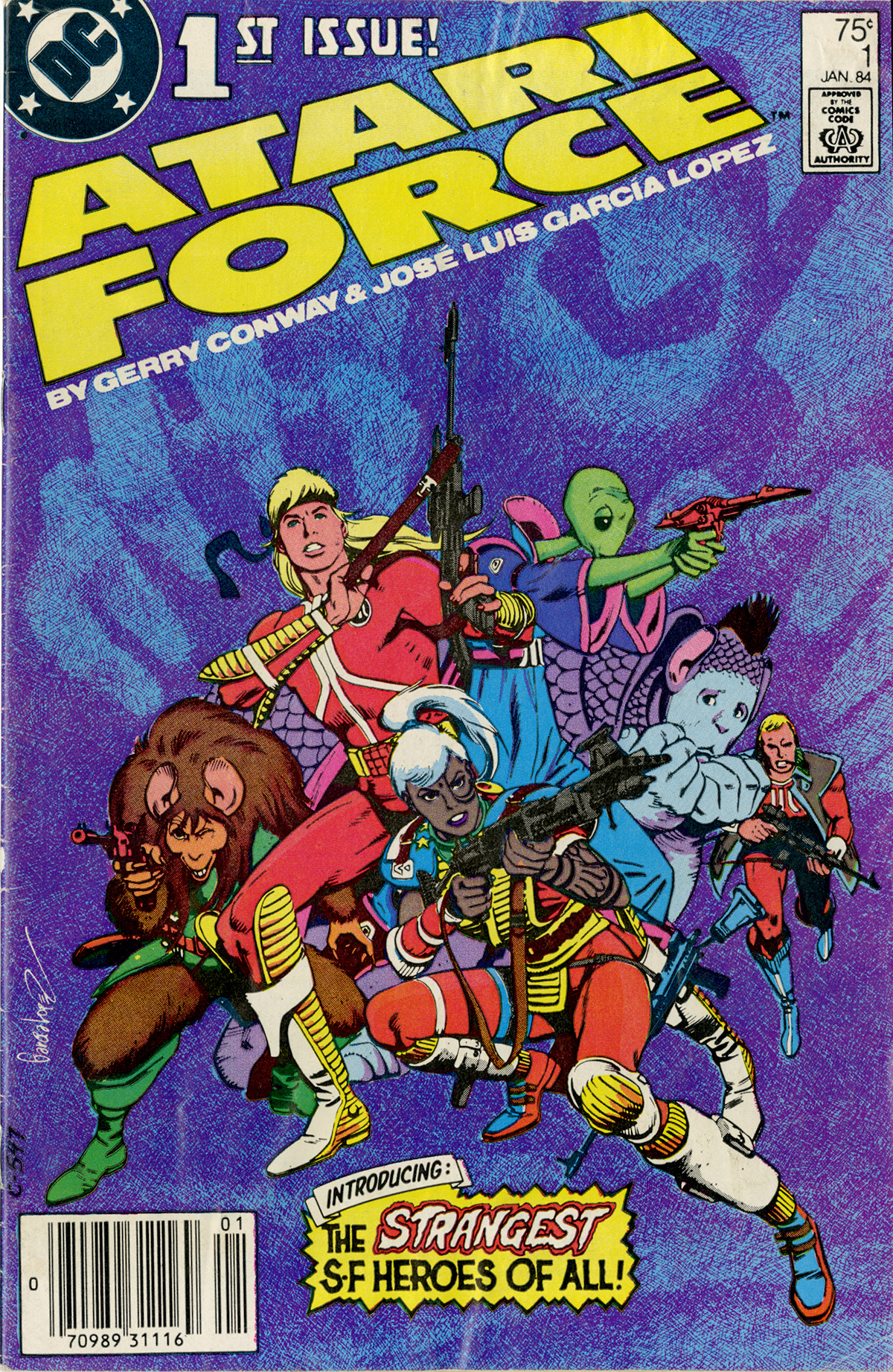
Atari Force is a title I admired from afar. I always loved the Jose Garcia Lopez art, and the fact that it was Science Fiction (S-F). With Gerry Conway writing, it always looked like it’d be a solid title by two creators at the top of their game. I had a few random issues, but I never read any.
After acquiring issues 1-13 in a quarter bin not too long ago, I finally got around to reading them. It’s written by Gerry Conway (one of the great Bronze Age comics writers whose credits are too numerous to list), most of the art by José Luis Garcia-Lopez, with a few fill-in issues drawn by Ross Andru (and inked by Lopez), and Eduardo Barretto. The lettering was done by Bob Lappan—a delightful surprise—as he is one of my favorite letterers. Colors by Tom Ziuko.
I’m also currently re-reading and researching Crisis on Infinite Earths for another TCJ Event Horizon column (more on Even Horizon here). As I read through Atari Force, it became clear there were some interesting similarities to DC’s huge event series that came out only a few months later.
Lopez’s art is crisp and light. He makes that classic bronze-era comic-book realism look so easy. His choreography of fights is always complicated but clear. He’s able to take difficult movements and postures and render them with a grounded lightness. He never skimps on environments either.
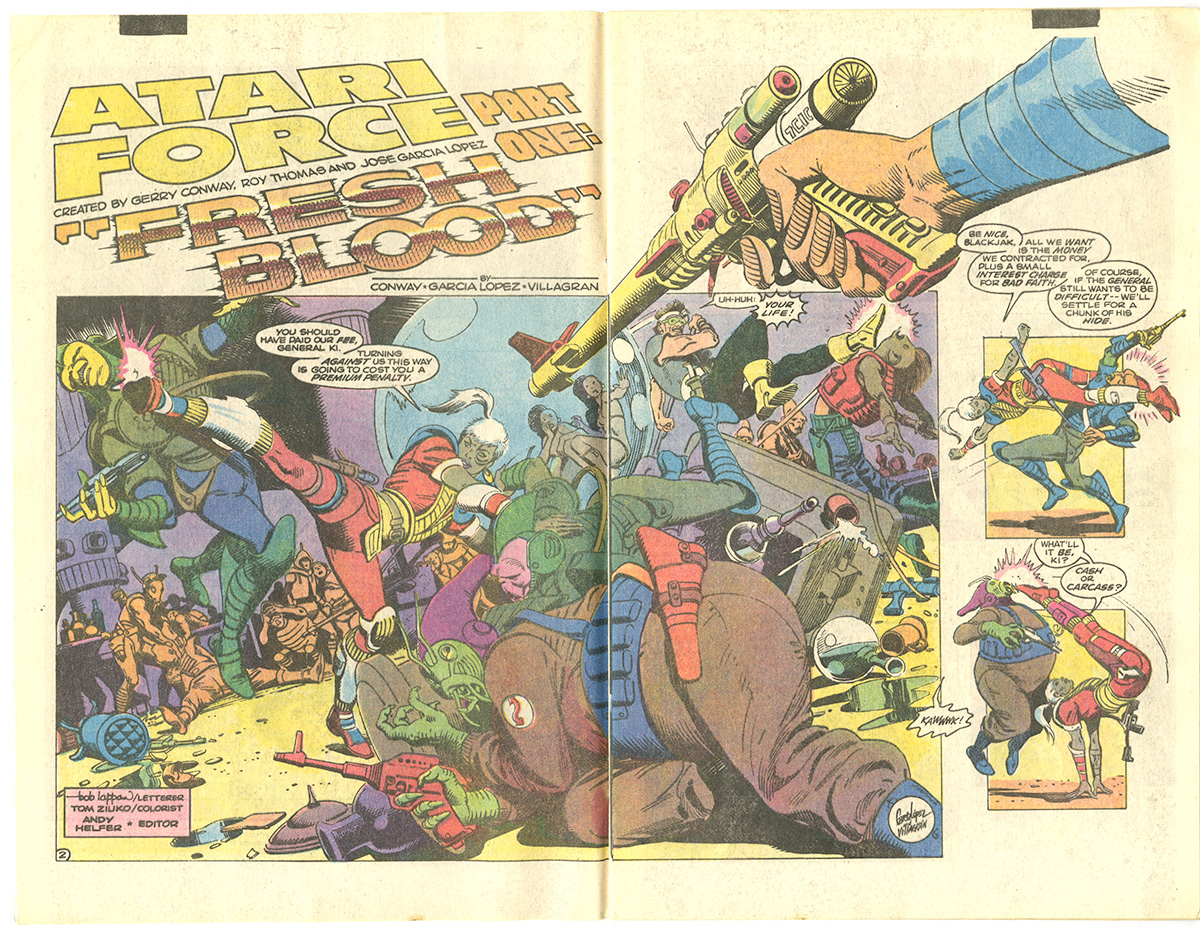
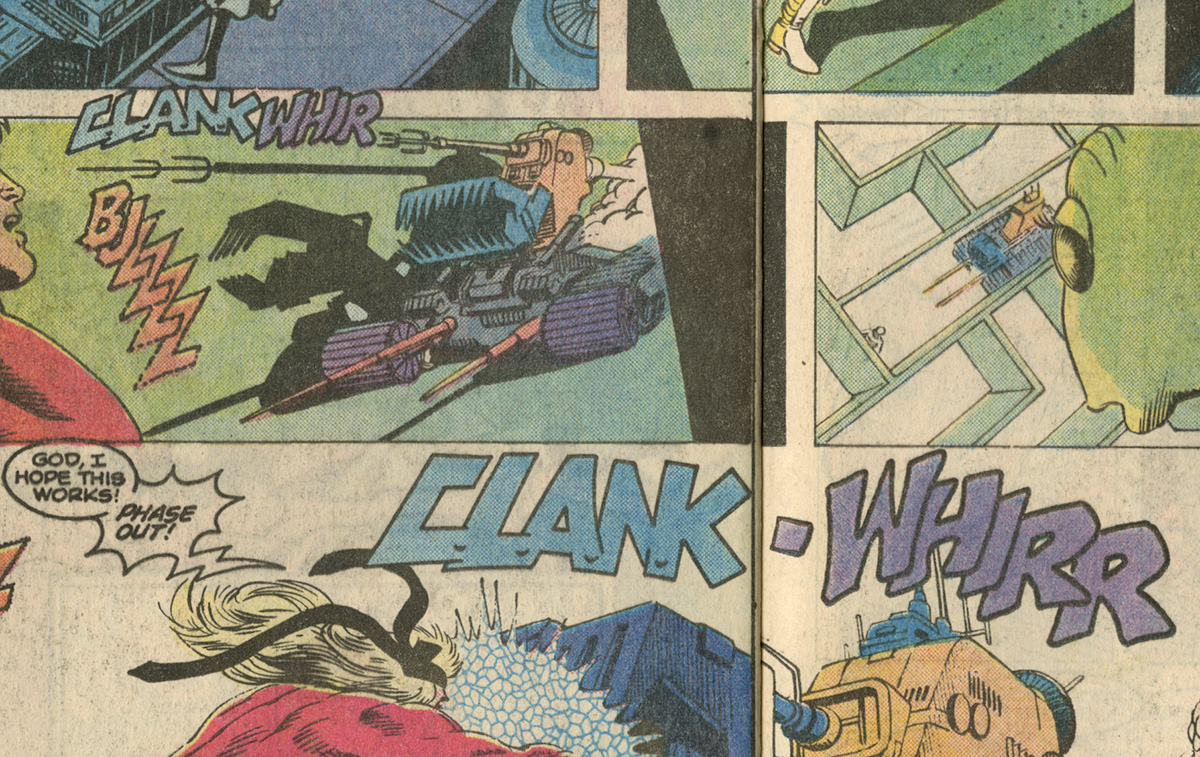
Bob Lappan’s sound effects typography reaches sublime and absurd heights. Quirky, bizarre, odd, and awesome. Is there any other mainstream letterer that takes this much pleasure in rendering sound effects?
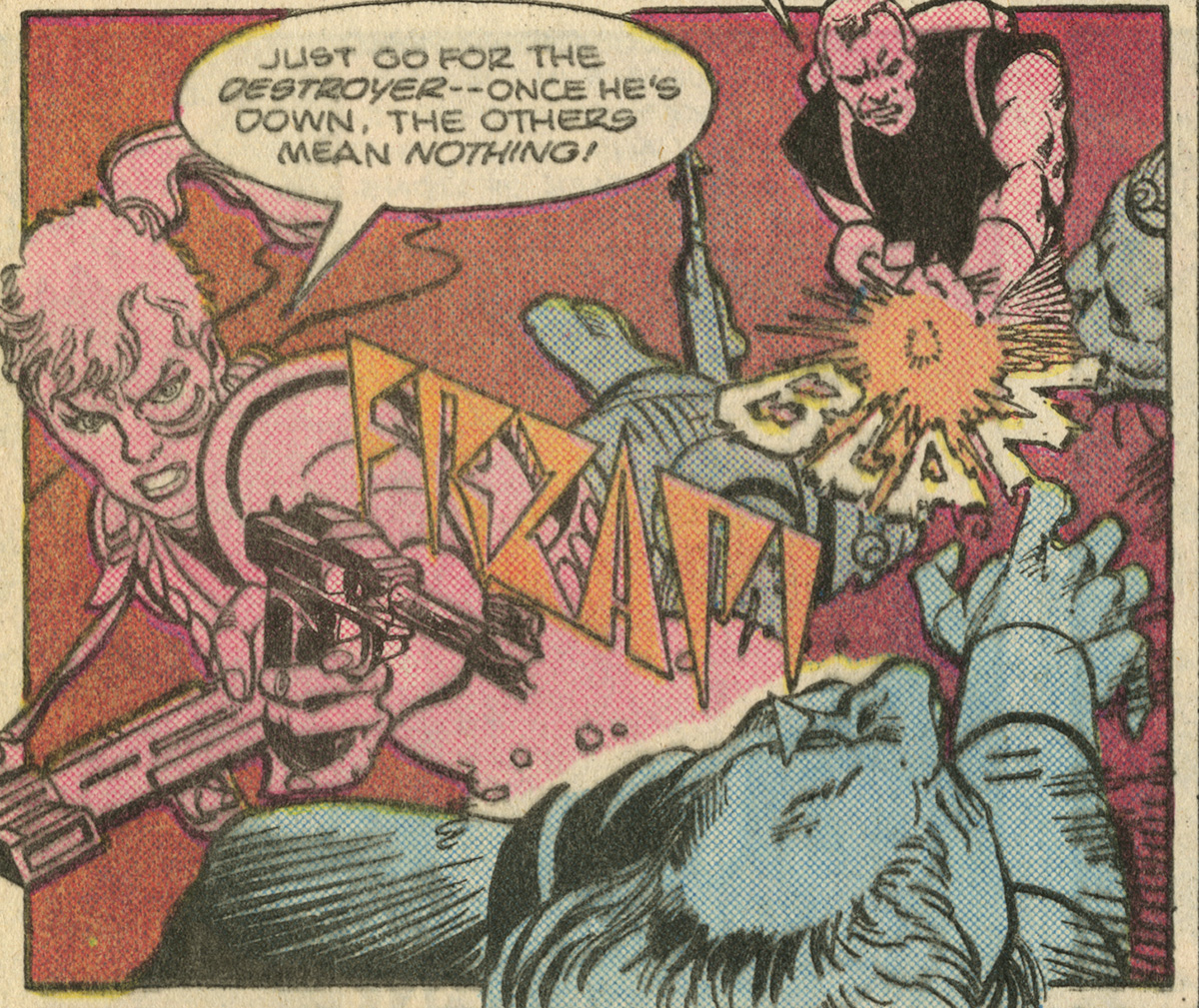
The narrative follows the Star Wars formula. A collection of ‘broken’ individuals has to come together as a team to defend the Multiverse against the Dark Destroyer, a Darth Vader-like menacing figure. A lot of Star Wars-like tropes abound. Alien planets, bounty hunters, an ‘force’ that seems to be undermining the lives of the heroes, etc.
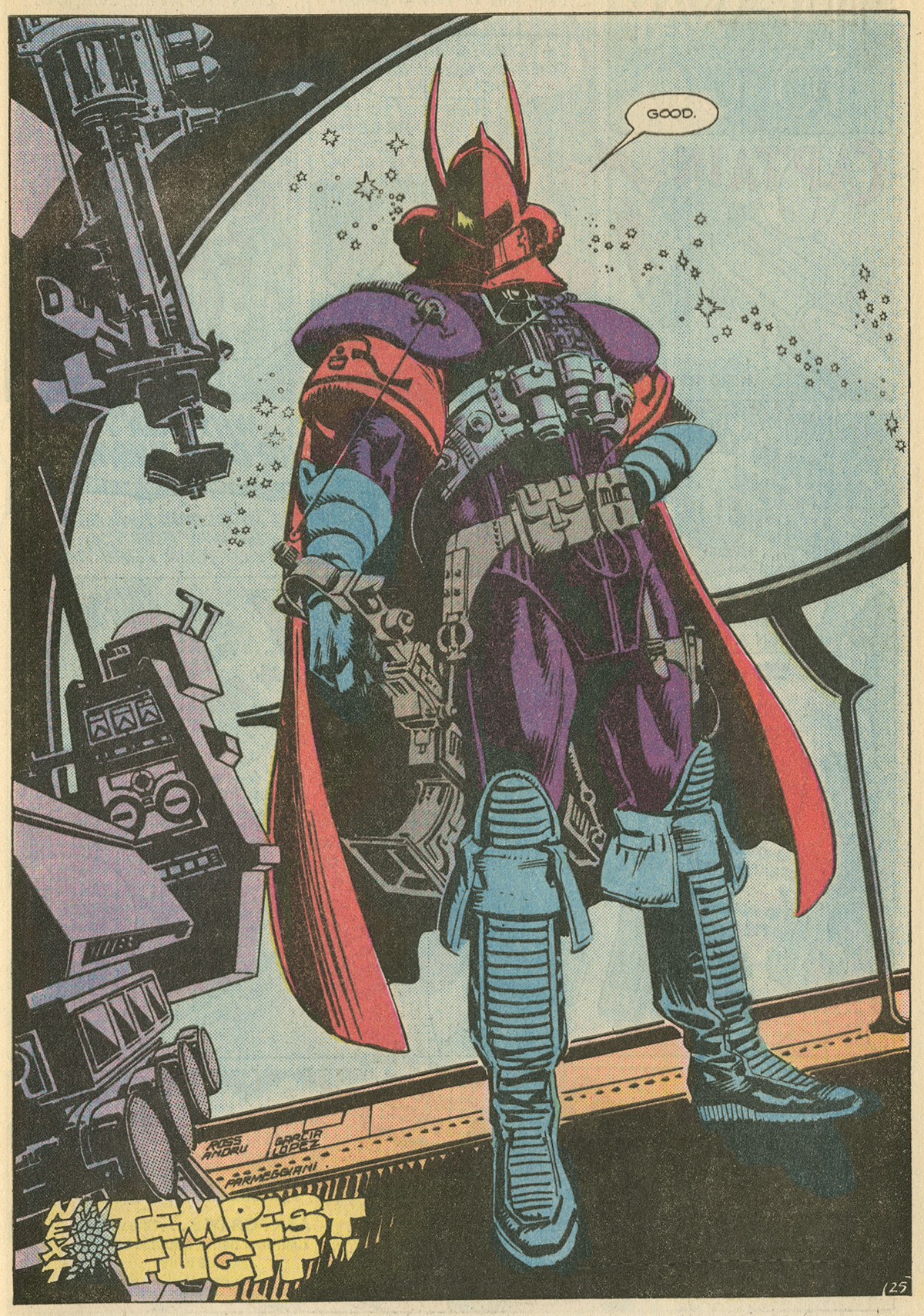
One interesting aside is the use of the Multiverse as one of the driving engines of the story. In Atari Force, Humans have gained the ability to travel between universes, and one of the characters inherits the ability when exposed in the womb. Conway uses the idea as part of the universe… the multiverse increasingly became an important concept at both Marvel & DC. At DC it was at the core of the mythos since “Flash of Two Worlds” (Flash #123) established parallel Earth-2… and would become a key concept to revamp the DC line during the Crisis on Infinite Earths event.
There are other curious correspondences to Crisis on Infinite Earths. SPOILER WARNING: For example, it turns out that The Dark Destroyer is a double of the leader of Atari Force, Martin Champion. They are almost mirror images from disparate parts of the Multiverse. Destroyer’s goal is to annihilate Martin’s universe via an Anti-Matter bomb. These are obvious parallels to Monitor and Anti-Monitor and the matter vs. ant-matter struggle that propels the story of Crisis. Conway was one of the early architects of the multiverse concept that became increasingly deployed by both Marvel and DC throughout the 70’s and 80’s. As early as in 1972, Conway and writers Steve Englehart and Len Wein crafted an unofficial metafictional crossover spanning titles from both companies.
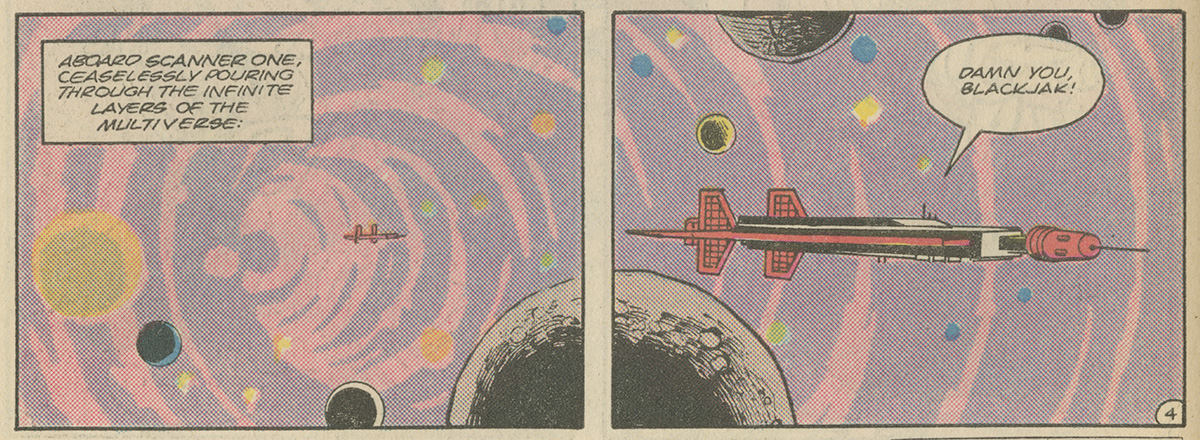
The 80’s were a good decade for ‘S-F hero team’ comics. They seemed to multiply everywhere. Besides Atari Force, there was also Omega Men and The Wanderers. I suppose the popularity of the S-F tinged Legion of Superheroes had something to do with it, as well as the popularity of Star Wars and S-F cinema. Marvel (via Epic) had Dreadstar and Alien Legion. Inside of the Marvel Universe were the Swashbucklers and Guardians of the Galaxy (though their heyday would come later). On the indie side there was Nexus and American Flagg! could be included, at least for its S-F nature, though it was much more ambitious thematically and artistically than most of the others. I’m sure I’m blanking on others.
Atari is very much aimed at young readers, but in an interesting way. There are characters like Babe and Hukka which are very much aimed at very young readers. Babe is literally a big baby (albeit very powerful one) and speaks with a limited vocabulary. Babe’s spotlight issue (#?) takes full advantage of this by limiting the words and action. Babe and Hukka riff off each other as they bumble and help revenge against (and genocide!!!) an invading force. Future issues feature Hukka back-up stories that use limited vocabulary, pantomime, onomatopoeia, and Bob Lappan’s lettering mastery, to maximum effect.
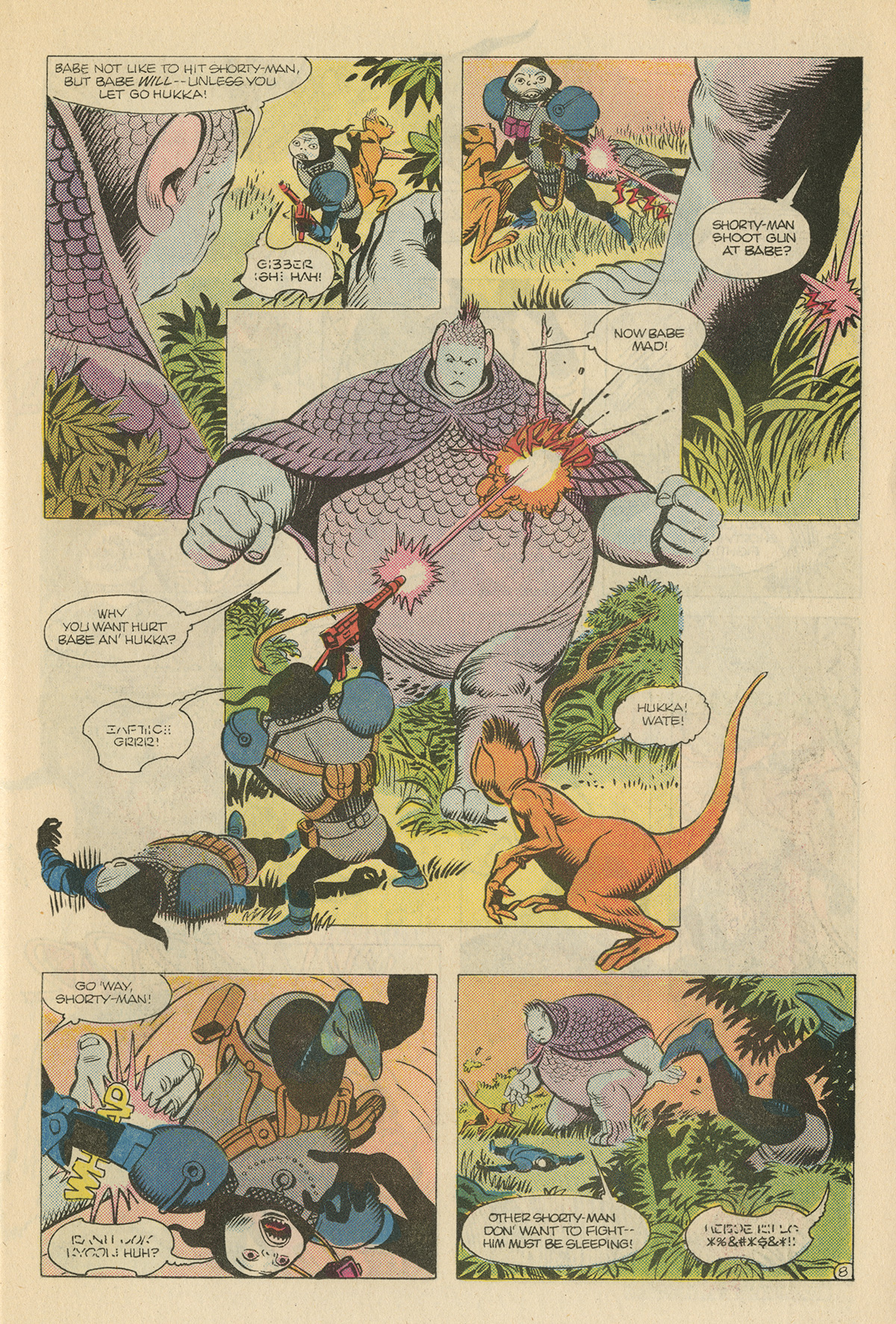
All this is paired with a more traditional comic book fare: heroic characters, adult situations — but told from the POV of young adults, interesting S-F concepts like the Multiverse, villains with mysterious motivations, etc. The younger readers can come for the ‘baby’ characters, but grow with the rest of the book as they master new skills and language. This is pretty rare in comics and books these days. This kind of formula is more often deployed in blockbuster movies, which are designed to appeal to the ‘family’ audience. Comics have become a much more niche product catering to specific demographics. It’s rare these days that the family would read comics together.
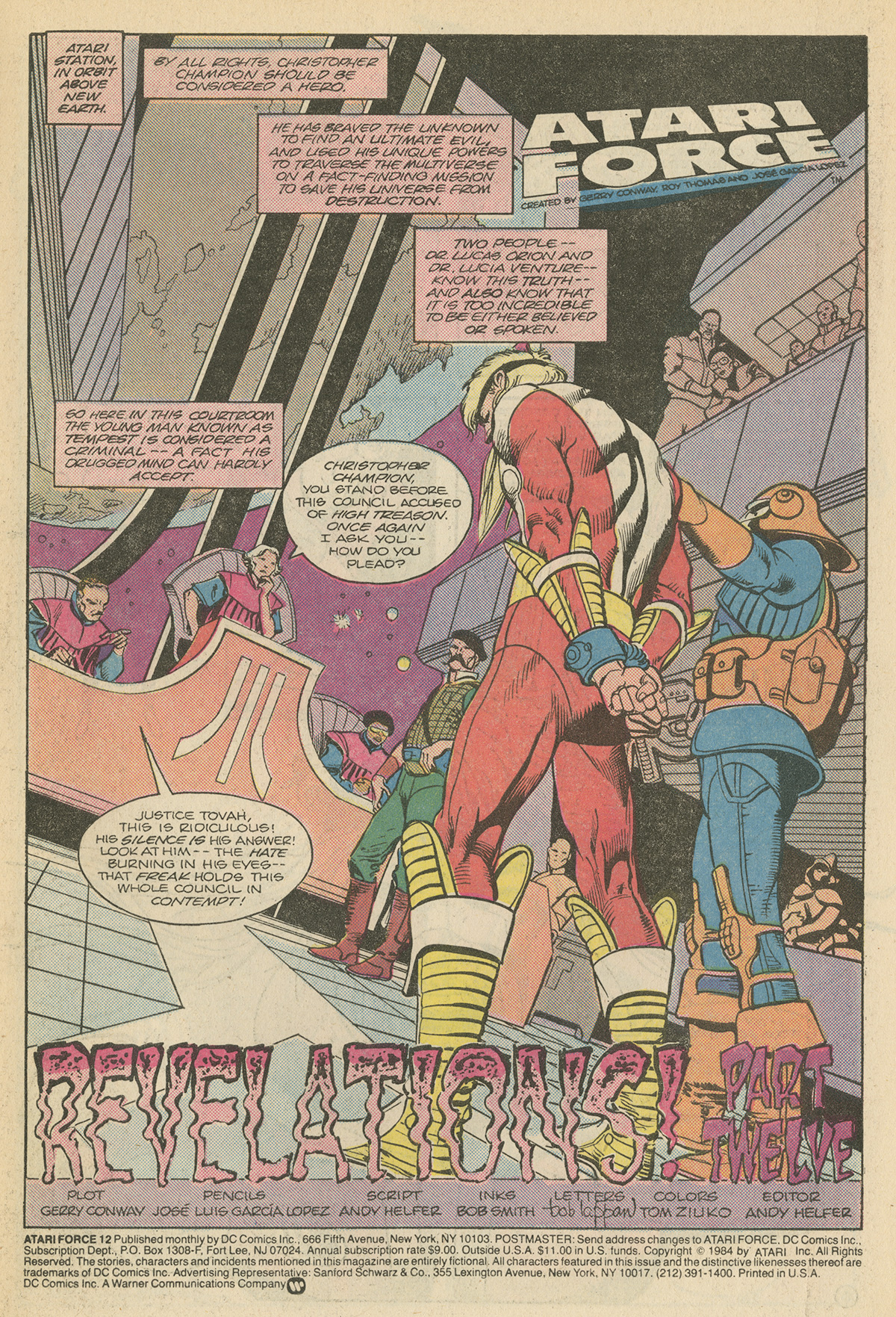
The story is only loosely based on the Atari Force video game (and accompanying comics). It takes the concepts into uncharted new territory. Visually, it’s designed to capitalize on the Atari brand name. It’s jarring to see a comic book that was effectively a big Atari branding exercise. On every page some form of the Atari logo appears; as a patch, as a word, as a costume design flourish, etc.
Still, the creators don’t hold back. The characters are well rounded and interesting, the story is fun and propulsive, and the art is beautifully realized. It’s a pleasure to see top talent at the height of their powers. It’s a gorgeous comic book. It’s worth seeking this out in the original comic books… since it’ll probably never get reprinted due to licensing issues.
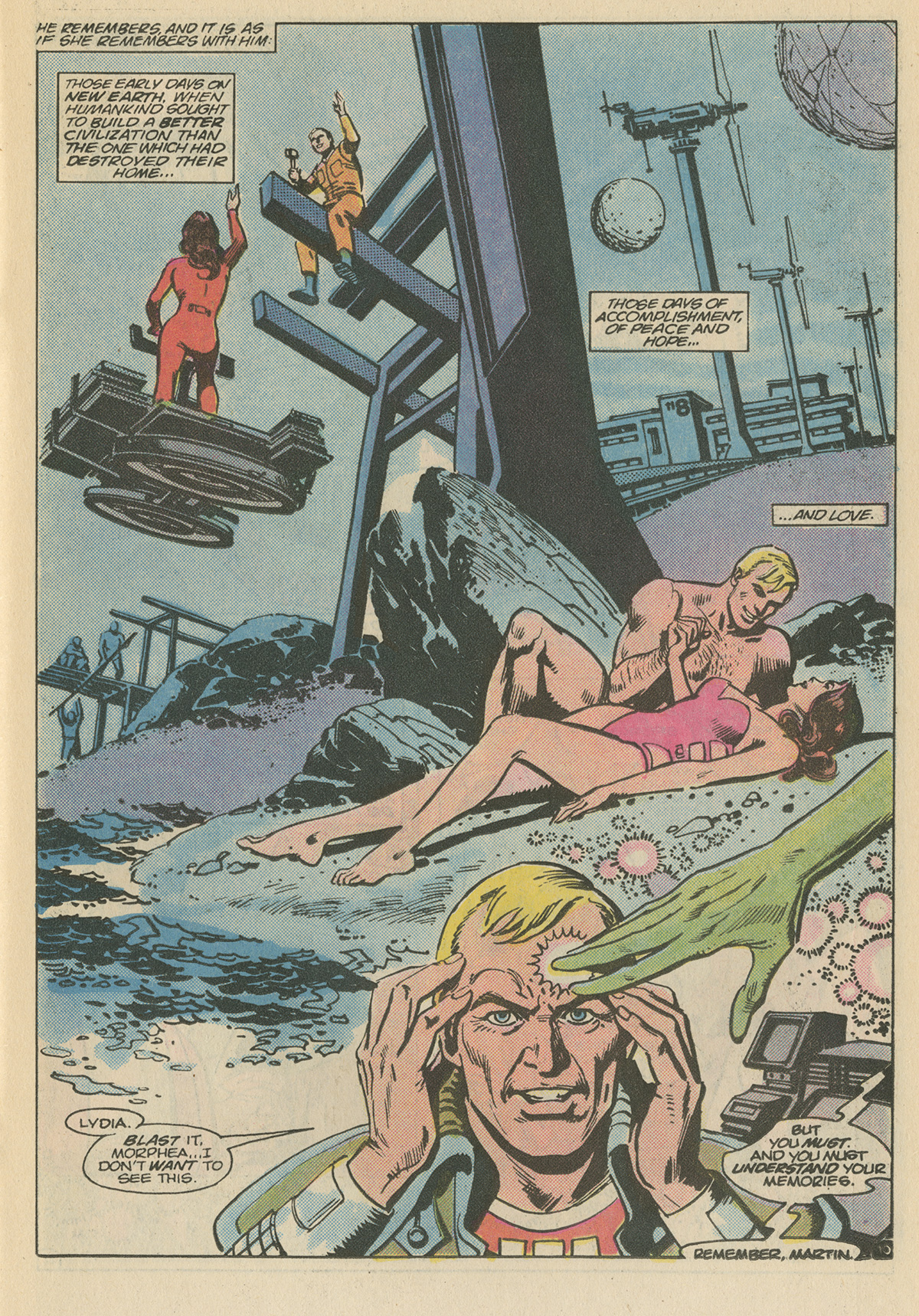
Explore more posts related to my Event Horizon column about the comics from 1985-87.
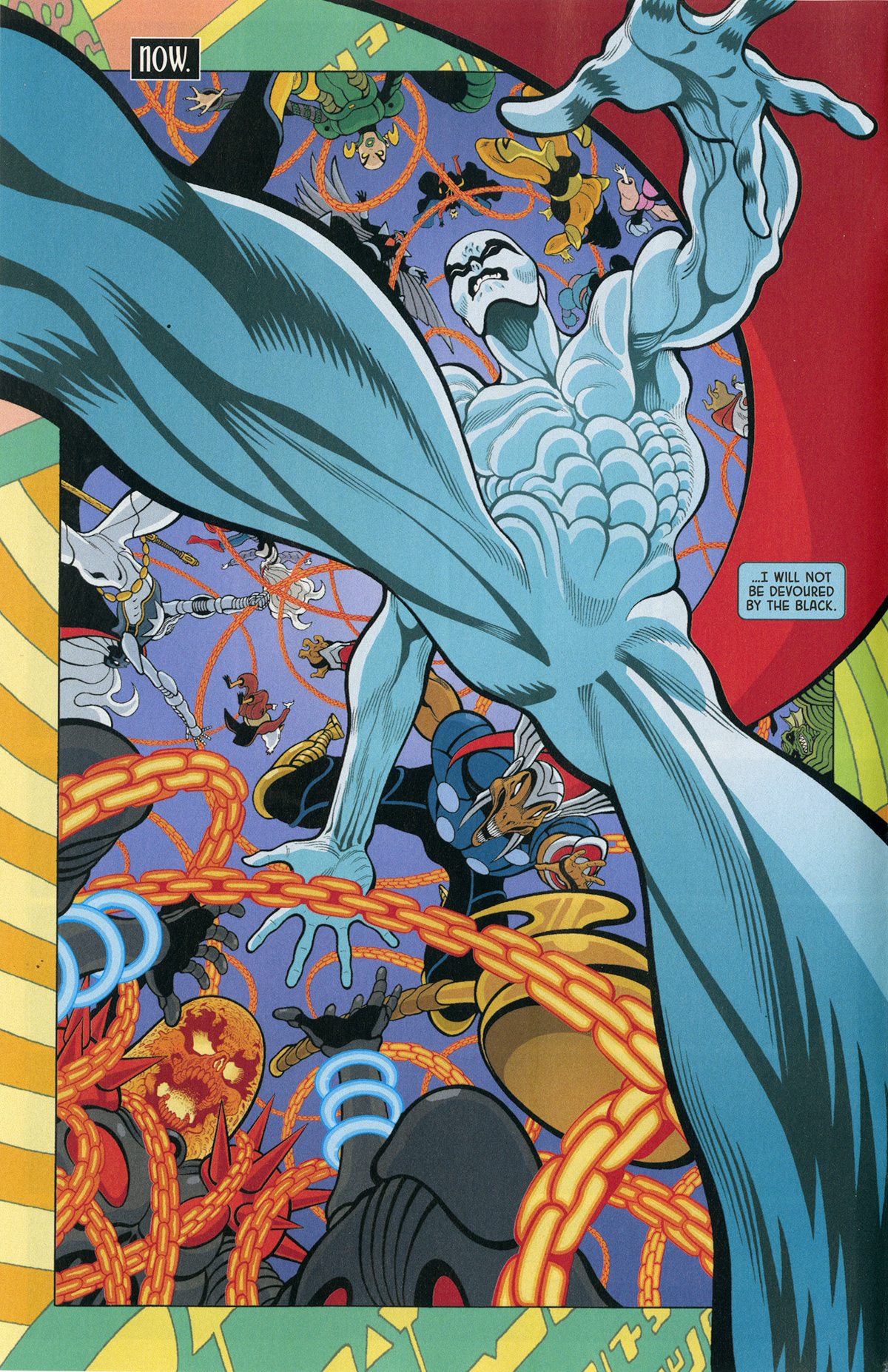
Over on Ink Logging, I’ve written a short review of the great looking new Silver Surfer Black series from Marvel. It’s drawn by Tradd Moore. Here’s a taste:
There’s a barely restrained surrealist/trippy component to his drawings. The Silver Surfer series seems designed bring that element out in force. There are a lot of psychedelic flourishes, unusual angles, expressionistic renderings, complex layouts, etc. Moore seems to be really having fun here. There’s a surreal fluidity to everything. Everything is flows, undulates, and bubbles like… a lava lamp. There’s not much to the story… at least so far…
I’m writing a lot more. Here a a few places you can find my writing:
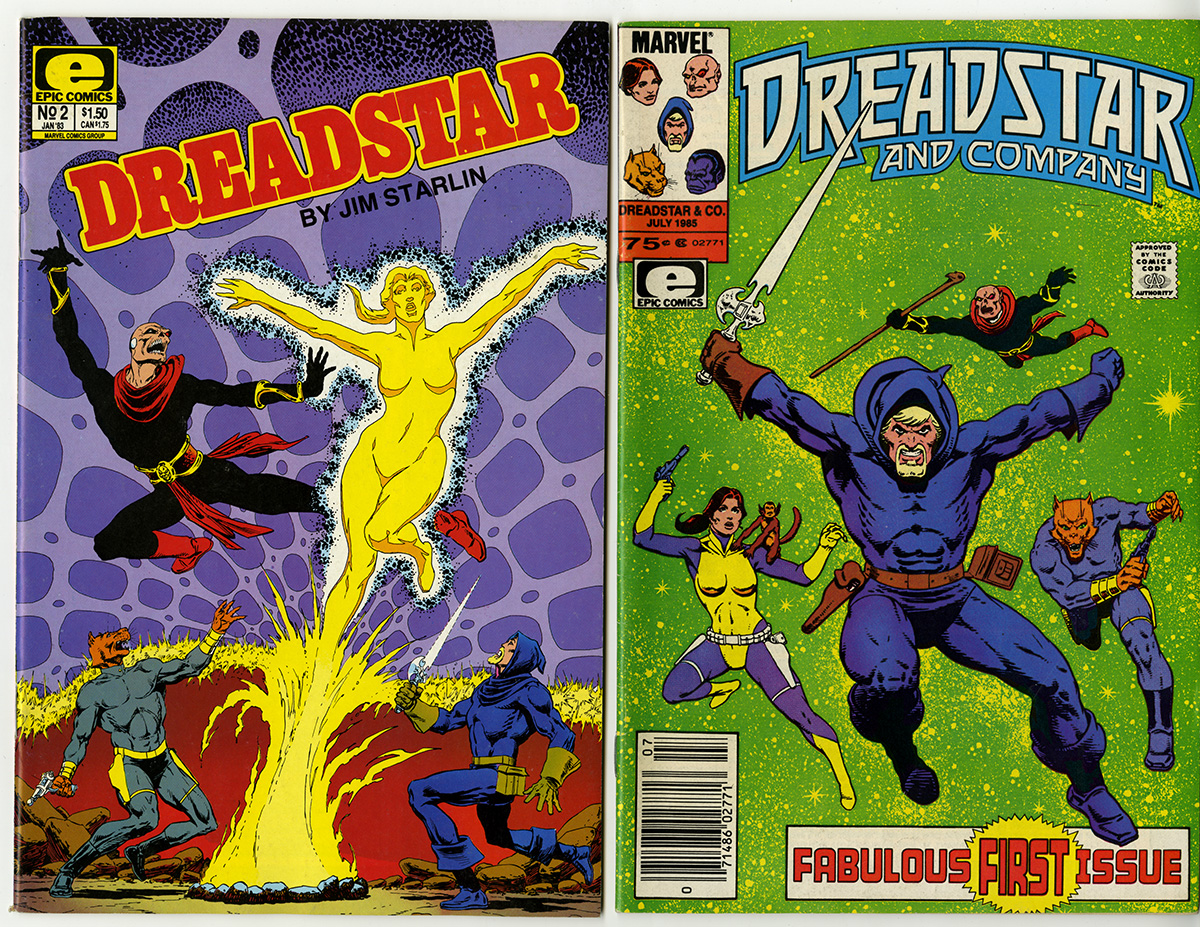
Starlin draws the crap out of this issue. The environments are fully realized, and the crew fight hundreds of robots, all rendered on the page without too many shortcuts. I’ve always liked the way Stalin plays around with the grid. He’s unafraid to chop the grid into small slivers, to give the action an added urgency. He really likes density on a page. All the pages have either a lot of panels, or are rendered with a lot of detail. He also doesn’t skimp on text. He really wants to pack a lot of information into the comic. The result is a pretty satisfying read. Even if the intro info dump is a little much, you come away immersed into a huge story. It made me pretty excited for issue 2.
But I’ve also written on Doctor Zero:
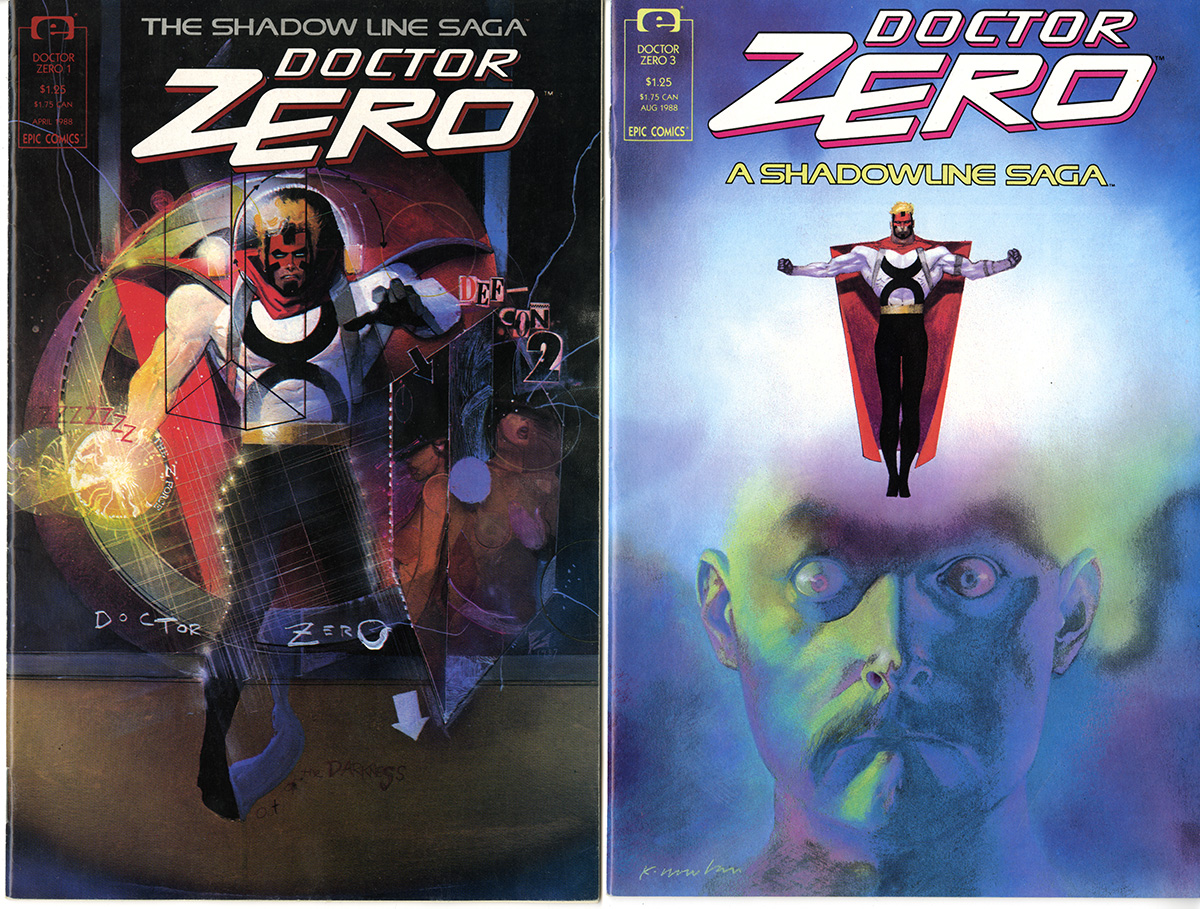
As the series continues, Doc Zero is revealed to be an immortal (or at least very ancient) who has been around the planet since before humanity evolved. In fact in one caption, he says he walked on Gondwana, which would make him several hundred million years old(!!!). Maybe ‘zero’ means he’s the oldest of the Shadowline beings? His Machiavellian machinations are some kind of god-like need to intervene in human affairs. We need saving, and we know not what we do. These kinds of proclamations are frequent with Doc Zero. He clearly has a god-complex.
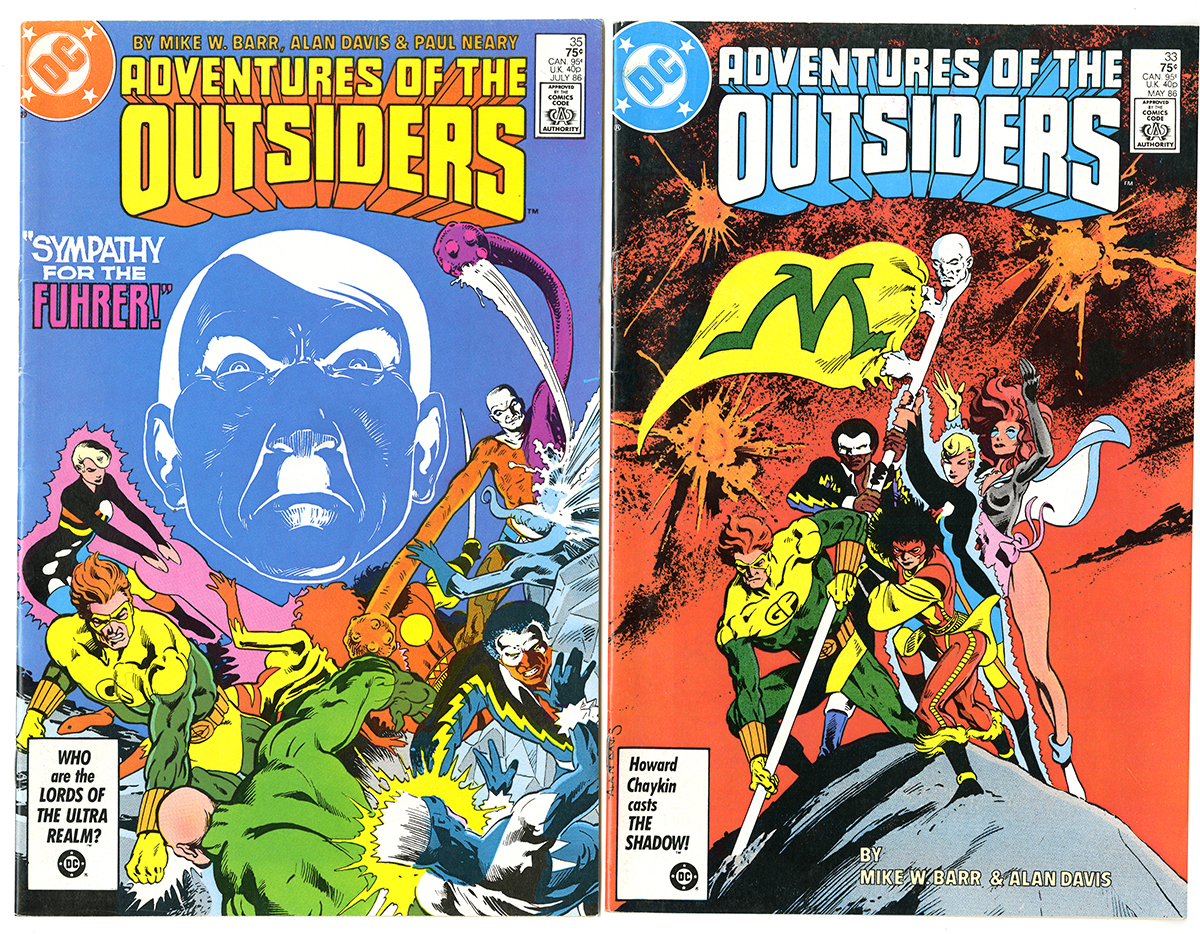
The story involves yet another invasion of Markovia. Baron Bedlam returns, takes over Markovia, and proceeds to clone… Hitler! Unfortunately for Bedlam, Clone-Hitler is appalled by the actions of his original and takes his own life. An interesting and rare case of nurture-over-nature in comics. Generally speaking genetics are presented as unalterable law, at least in my experience.
Check out the whole Dreadstar post on Tumblr. Maybe I should turn this into a Dreadstar book club? Let me know if anyone out there is interested. Haha!
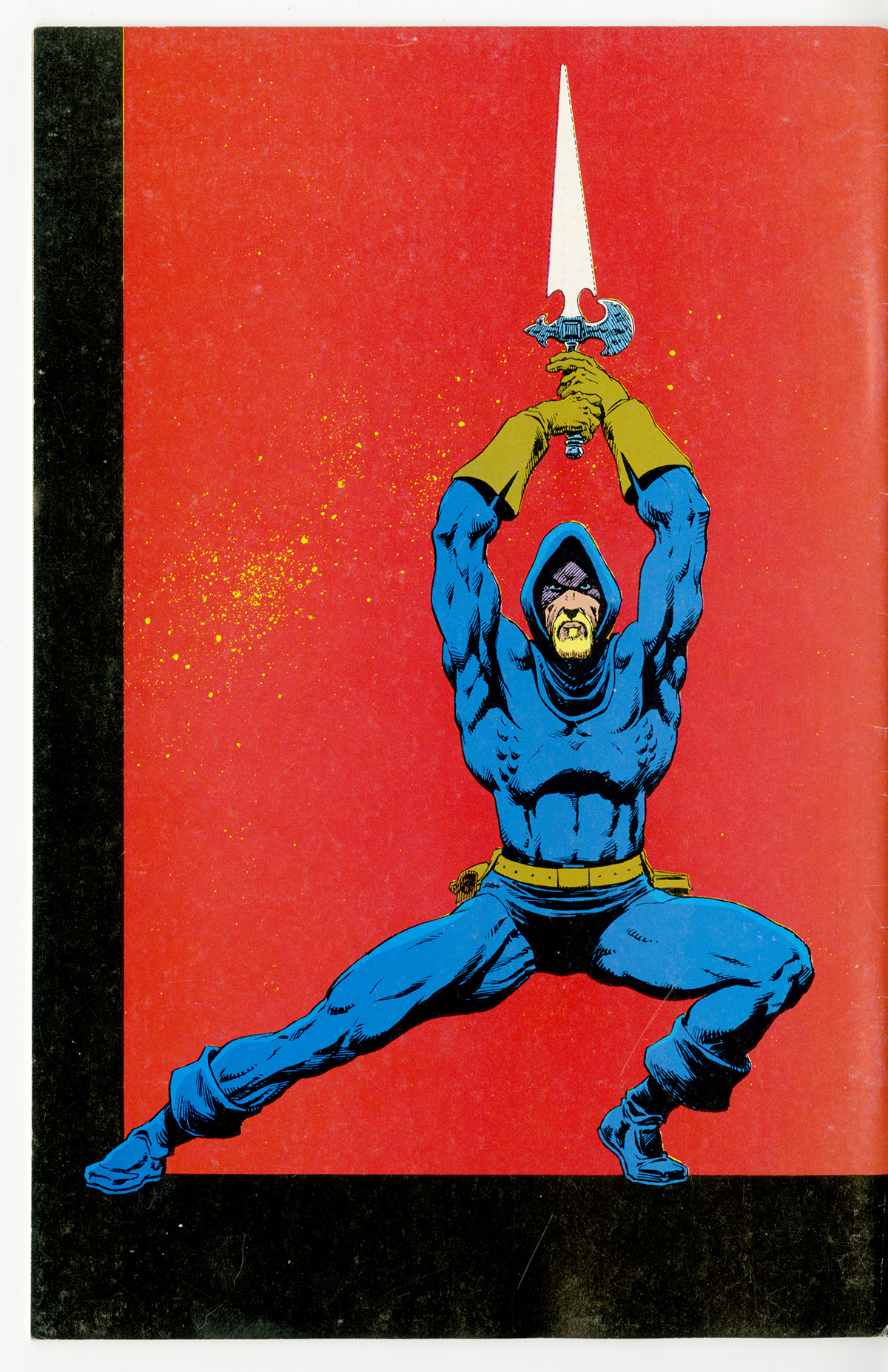
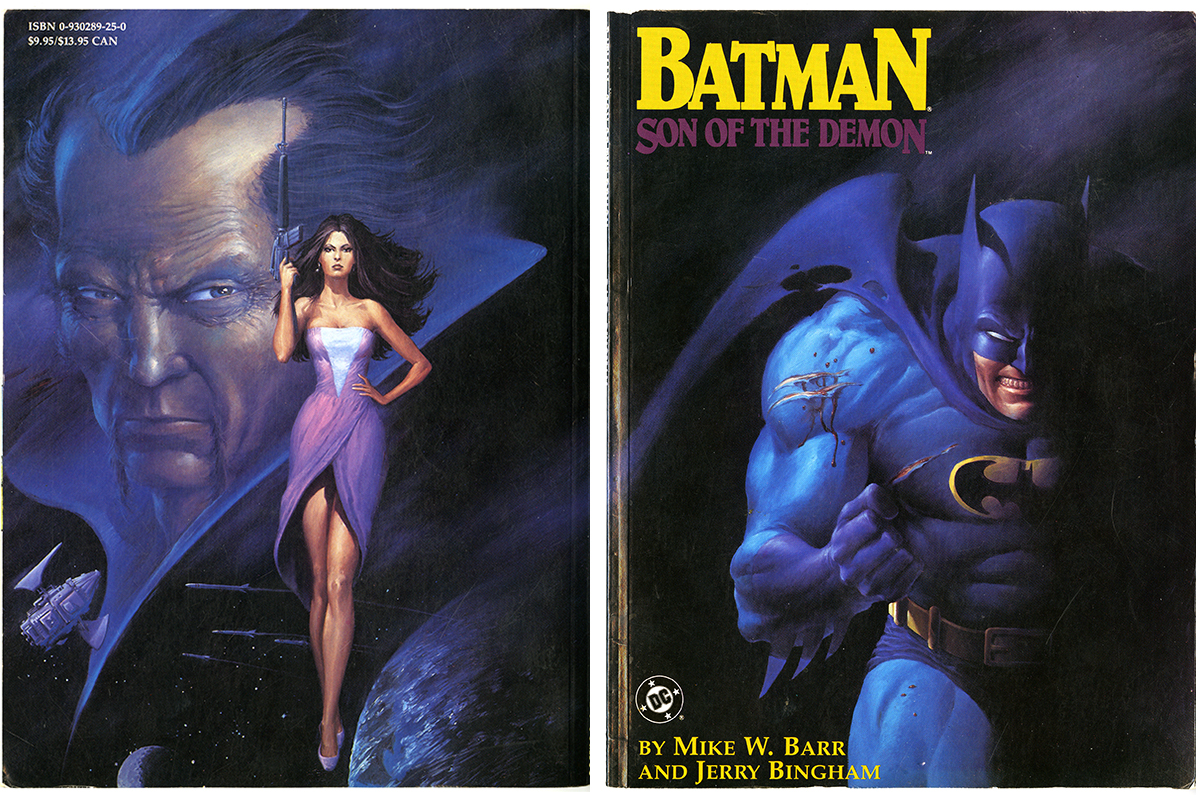
I’ve got a new entry in my Event Horizon column over at The Comics Journal. This on is about Batman: Son of the Demon (BSOTD) by Mike W. Barr and Jerry Bingham. I did a lot of writing around this episode, much of which didn’t make the final cut. Here’s a bit that got left on the cutting room floor. One thing I found myself struggling with is the large body of Batman literature. Much of this literature is very similar to itself, with small differences. The more I thought about it, the more it resembled a fractal structure. And when zooming out on this fractal, Batman and superheroes in general acquire a fractal self-similarity. But I get ahead of myself.
How do you write about Batman? How do you write about a property like Batman? Specifically, how do you write about a single episode of one of the longest running comics properties in the world? How do you write about something like Batman: Son Of the Demon ?
After 80 years of continuous publication — after countless issues, series, specials, graphic novels, novelizations, TV & film adaptions — what is Batman? Which Batman do you write about? Batman the character or Ba(TM)an the franchise? When you write about BSOTD, which Batman do you compare him to? Is it possible to evaluate BSOTD on its own merits? How can you evaluate Batman’s behavior and story arc in this book? If you don’t know the history between Ra’s al Ghul & Batman will this make any sense? If you know it only in-part, is that enough?
If you’re critical of a work like this, is it because you don’t ‘get it’? Is it because you’re not a fan, and haven’t taken the time to become more familiar with Batman mythos? Is it not for you? Or, is it possible to consider BSOTD out of the general Batman context and say something meaningful about it? This doesn’t even begin to tackle Batman in the context of the broader DC Multiverse; all of his guest appearances, his relationships with Superman, Wonder Woman, The Justice League, and many of the other DC superheroes. Does any of that matter? Or, can you just write about BSOTD?
I have read many Batman comics, seen most of the ’66 TV show and all the Batman films since Tim Burton’s. Even with all this, I have not read more Batman, than I have read. This of course is true of just about anything. During our lifetime we will have not read more than we will have read.
One way is to just not worry about it too much. Each Batman incarnation fits the era in which it was created. Each Batman era owes as much to the general cultural context, as to the writer/artist/editor team that worked on the comics.
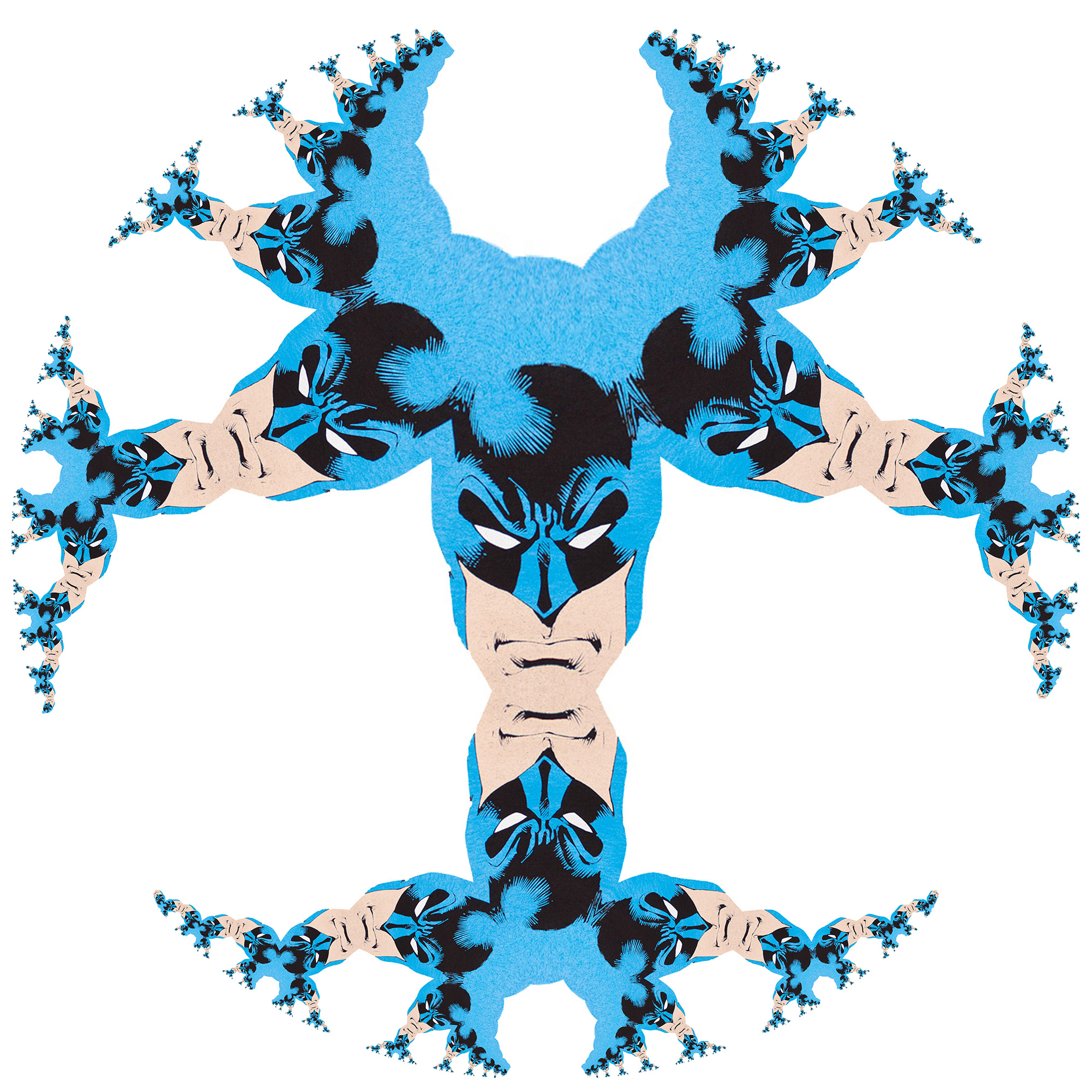
All that said, when you read a Batman comic, no matter how out of continuity, and how random, if you have read other Batman comics, and other superhero comics, most likely it’ll have a quality similar to those other comics.
There’s a self-similarity to superhero stories in general. A self-similar object “is exactly or approximately similar to a part of itself (i.e. the whole has the same shape as one or more of the parts).” [Wikipedia] Batman is like that. On transcendental level, Batman is a set of characteristics and story tropes. When looked at from a distance each part of the Batman canon is like another part. As you zoom in there are differences of course. But the differences circle around repetitions; like a fractal.
Anyway, back to the column. In this episode I start to zero-in on some of the general qualities of comics of the Event. (What is the Event? Read the introduction) This time I read Batman: Son of the Demon (BSOTD) by Mike W. Barr and Jerry Bingham. It’s a more traditional entry into the Event Horizon narrative.
I created a handy little chart that maps various Event titles onto art-narrative axes and with an experimental-to-traditional scale for each.
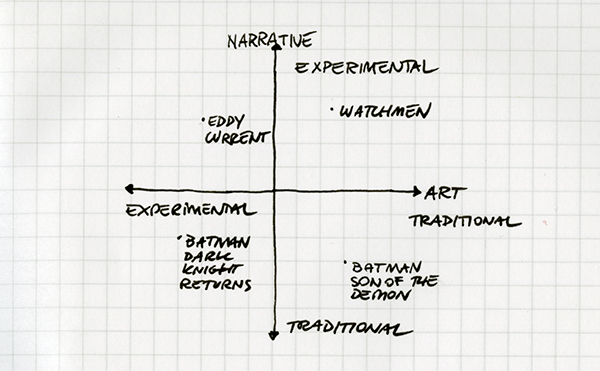
Comics of the Event can be mapped onto a fourfold structure of two intersecting axes. On the horizontal axis, we have the ‘art’ continuum, which ranges from experimental (or innovative) on one end, to traditional on the other. The vertical axis is ‘narrative,’ which has a similar range.
Because comics are a unique melding of narrative and image, the intersections between these two continuums can result in unusual juxtapositions. Traditional narratives can be executed in experimental art styles, and experimental narratives might be assigned a traditional artist. These discrepancies were intensified during the Event, especially in commercial comics published by Marvel, DC, and other publishers where writer and artist are distinct figures.
At some point in the future I’ll probably come back to the fractal self-similarity of superheroes. But for now, read the new Even Horizon column here.
Explore more posts related to my Event Horizon column about the comics from 1985-87.

The distance between the present and utopia is measured in centuries. We locate utopian societies in the future, and prefigure them with premonitions of apocalypse; the dysfunctional order of the present must be swept aside by some vaguely grasped apocalyptic event to allow a new and better world to emerge. Every generation faces their own unique brand of the end of the world: religious rapture, nuclear annihilation, natural disasters, clash of civilizations, Malthusian overpopulation, and so on. Ecological collapse caused by industrial pollution fuels the horror in Kazuo Umezu’s inventive, eleven-volume manga horror epic, The Drifting Classroom.
The titular classroom is actually Yamato Elementary School, which due to unknown circumstances finds itself ripped out of time and flung into a devastated future. The school, housing 863 students and teachers, becomes an ark adrift on the sea of toxic sand that covers the remains of Tokyo and the rest of the world. The school’s temporal realignment brings the kids and adults face to face with the deadly consequences of Japan’s famed “economic miracle.” They become the last remnants of civilization and, at the same time, the last hope for humanity’s survival.
It’s clear that Umezu perceives adults as part of the problem, for he dispenses with the teachers early on. One by one the grown-ups succumb to madness and die off quickly. They can’t process what is happening to them—the idea that the school might be in the future is utterly impossible—and unable to imagine the impossible they have to die off, like dinosaurs. The children, not yet saddled with dogmas of adulthood, are able to imagine the possibility of time travel and thus grasp the reality of their predicament. Their capacity to imagine the impossible becomes their salvation, but also the source of the horrors to come.
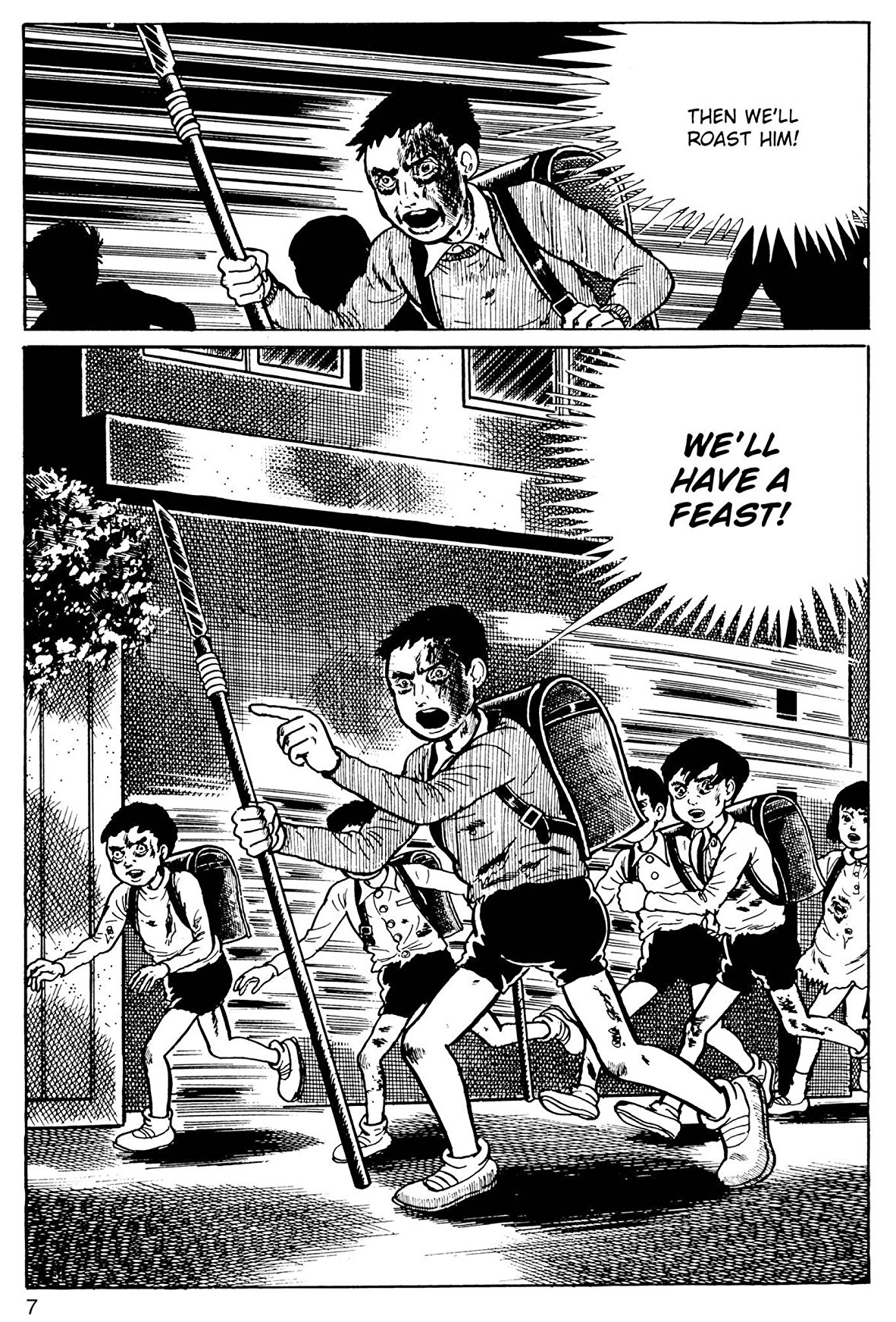
By the third volume the kids are on their own, allowing Umezu to present a kind of post-apocalyptic Lord of The Flies, with several hundred Piggies. Led by the idealistic sixth grader Sho and a few of his friends, the children try to survive both the inhospitable environment and themselves. The body count grows rapidly as they face toxic mushrooms, vicious plagues, freak floods, mutated spider-humans, mummies, bizarre starfish, gigantic sand worms, and starvation. This degraded future sharpens the children’s connection to the environment in several ways; for example, they can no longer take things like clean water for granted, and they have to conserve what meager supplies they have (a swimming pool with water, lunch room food, etc.).
These are just the more obvious lessons of ecology, however—Umezu’s genius is that he broadens ecology to include the social. To survive, the kids form the Nation of Yamato Elementary and elect Sho as the Prime Minister. But, like its counterparts in the present (their past), the nascent nation quickly succumbs to infighting and breaks into rival factions. Their society devolves from an idealistic democracy through various stages of feudalism to a band of starving nomads. For Umezu, the Nation of Yamato Elementary becomes a stand-in for the present world and shows the fate of civil society deprived of its ecological base.
Working in the tradition of H.P. Lovecraft, the horror of The Drifting Classroom is purely material—it isn’t mystical, as it tends to be in earlier Umezu works like Cat-Eyed Boy. He dispenses with ghosts, spirits and unexplained monsters, locating the real sources of “evil” in our ignorance of the workings of the world and the hubris of technological progress. And buried under the desert wasteland around the school are the remnants of human civilization; Umezu thus turns our own world into something akin to Lovecraft’s cyclopean ruins of some ancient antediluvian civilization (like the corpse-city of R’lyeh). Seen through the prism of the destroyed future, the industrialized world we live in seems like an apocalypse in slow motion. The skeletons of our cities seem bizarre and alien, the fossilized bones of a civilization choking on its own success.
Umezu does break with Lovecraft in some ways. Lovecraft’s universe is completely indifferent to the fate of humanity. His gods are cosmic entities that have crossed into our world from unknowable dimensions. The destruction they wreak is almost accidental. In Umezu’s universe, the fate of humans and the planet is more intertwined and symbiotic; a poisoned planet leads to a toxic society and vice-versa. In one revealing sequence, the children decide to create a religion, and the image of Sho’s mother becomes a benevolent Goddess designed to give the kids hope in a hopeless world. Meanwhile, a small group of children slowly mutating from having ingested toxic mushrooms (!) create their own god: a one-eyed devil. Religion is not something divine and eternal—it’s a product of the environment and our imagination, and it offers both comfort and destruction. But neither can be our salvation. One leads to a debased existence as mutant spider-humans, the other only offers temporary relief. Ultimately, we have to listen to the planet and use our imagination to avoid the kind of future The Drifting Classroom posits.
Unfortunately, according to Umezu, the imaginative powers of the present are tainted by our “miraculous” industrial society. When we first meet Sho, he’s a typical kid. He covets toys, especially a “future car”—a sleek UFO-like automobile. And he has a conflicted relationship with adults; he tries to be nice to his mother, but ends up having a childish argument with her about some thrown-out marbles. Enraged, Sho runs off to school discarding an unwrapped present his mother gave him (it contains, of course, the “future car”). For both of them, futurity is embodied by the toy, a shining symbol of Japan’s relentless economic progress and technological prowess. Yet later in the series, after the children are forced to evacuate the school ahead of a toxic cloud and have been wandering through the lifeless desert, the starving kids end up in a UFO-domed amusement park—an impressive, automated relic from Japan’s industrial peak. At first it appears like paradise to the famished children, but the techno-Eden isn’t as benign as it seems. Everything is artificial—there is nothing that the kids can eat—and the park’s helpful robots, damaged by the ravages of time, have turned into deadly Terminator-like killers.
In fact, both the UFO-domed park and car had real world counterparts at the 1970 Osaka World’s Fair Expo. Housed in part under a space-age dome by architect Kenzo Tange, the Expo presented Japan with an airbrushed techno-utopian vision that was becoming increasingly preposterous to the visitors. The Drifting Classroom was serialized in 1972-74. Japan at that time saw the emergence of its nascent environmental movement. Up until then, a single-minded pursuit of economic strength, characterized Japan’s post-war years. The “Japanese Miracle,” as it came to be known, saw a decades-long increase in the industrial output of the nation and a corresponding increase in the wealth of its citizens.
But the counterpoint to the economic miracle was a high level of environmental degradation. Japan’s industrial might was tainted by ecological disasters, increasing occurrences of birth defects, and a string of incurable disease outbreaks: Morinaga Milk Powder Poisoning (arsenic), Yokkaichi Asthma (sulphur dioxide), Minamata Disease (mercury), Itai-itai Disease (cadmium). All this led to a greater ecological consciousness, the emergence of the environmental movement, and eventually, the creation of the Japanese Environmental Protection Agency in 1971.
Until the disappearance of the school, both Sho and his mother are oblivious to the ultimate fate of the planet. They haven’t realized the damage their way of life was doing to the Earth. Paradoxically, when they become separated by centuries their relationship grows stronger. Through a handicapped girl, Nishi, who appears to have unexplained powers, Sho is able to communicate with his mother. Several times she is able to help her son, by strategically placing valuable objects (a knife, vaccine, etc.) in the past for Sho to excavate and use in the future.
Once the future cataclysm is made concrete by Sho’s time travel, his mother can finally take steps to try to avert that catastrophe. Her love for Sho enables her to overcome adult skepticism, bear the ridicule of others, and put her mind to work. If she can’t bring Sho back, at least she can change the present to make his future a better place.
If this makes the book sound didactic and preachy, it’s not. The themes and ideas outlined above simmer beneath a shimmering surface of a fast-paced and slickly drawn comics narrative. Since The Drifting Classroom was serialized in weekly episodes, it’s chock-full of cliffhangers and surprise twists and turns. It’s a compelling page-turner designed to move the reader efficiently through the narrative. Umezu’s detailed art skillfully builds tension in series of cinematic sequences. He uses darkness very effectively: sequences comprised entirely of panicked dark silhouettes can go on for page after suspenseful page.
Finally, when he unveils the bizarre mutant monsters of the future, they’re lovingly embellished with detailed renditions of blood, bone, and peeling skin. Also, the 863 inhabitants of Yamato Elementary give Umezu ample opportunity to rack up a high body count, and he doesn’t flinch; the students die off quickly, dispatched in new and inventive ways. He often lingers on a violent scene with sadistic glee, just to make us feel a little queasier. With a few deft pen strokes he can change an innocent child into one possessed by some unknown menace.
Often called the “Stephen King of Japan,” Kazuo Umezu is a giant of Japanese horror. A steady trickle of his comics has begun appearing in the US since the 2002 publication of Orochi: Blood, yet The Drifting Classroom remains his best-known work. Regardless, this is an opportune time for its appearance on American shores. It’s an artifact of a fertile period in Japan. The eco-awareness of the Japanese was mirrored by a growing sophistication of their manga.
Umezu’s sprawling epic dates from the same period that saw the rise of mature comics known as Gekiga (see the work of Yoshihiro Tatsumi). Around the same time, Osamu Tezuka, the “god of manga” and creator of Astro Boy, serialized Ode to Kirihito, his first mature work. As American comic books make their steady climb into respectability and the specter of global ecological collapse appears imminent again, the horrors of Kazuo Umezu’s The Drifting Classroom are a useful glimpse of a strange parallel world not that different from the one we encounter today.
The Drifting Classroom
Volumes 1-11
Kazuo Umezu
VIZ Media ($9.99 each)
by Tom Kaczynski
I wrote this review a decade ago, but only a small snippet ever appeared online.
I’m not a professional comics reviewer, so this list is simply based on personal preferences. I’m not looking for objective metrics of quality, I’m much more interested in how a specific work makes me feel or think, or if it surprises me. There are a LOT of 2018 comics I haven’t been able to read, so this also isn’t comprehensive. This list also doesn’t contain any Uncivilized Books titles (all of which I loved, naturally, but I’m biased), for obvious reasons. This list originally appeared as part of a massive round-up on The Comics Journal. There a some spoilers below. Here are my 10 favorite comics of 2018, in no particular order:
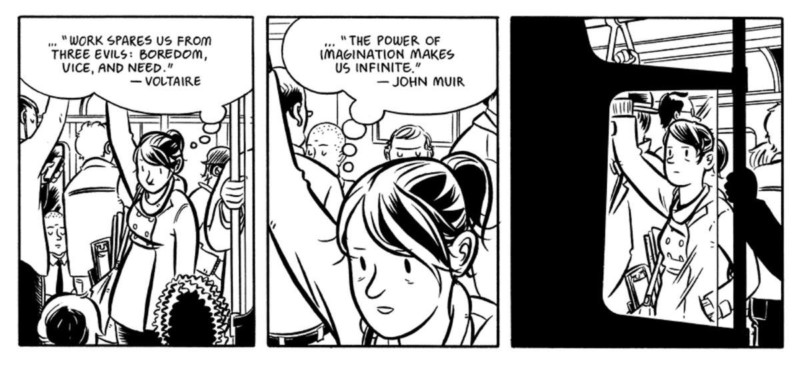
Hartley Lin created a stunning graphic novel. The cartooning is flawless, with incredible attention to detail. The story is about Frances, a young legal clerk pulled into the orbit of the menacingly charismatic executive Castonguay. It has some familiar beats about trying to hold on to an authentic self without getting lost in a messy corporate world of petty power struggles. But the execution elevates the story. Hartley’s precise drawings, his framing, sly references (Castonguay as Daddy Warbucks), surreal touches, and great propulsive editing kept things alive and a pleasure to read.
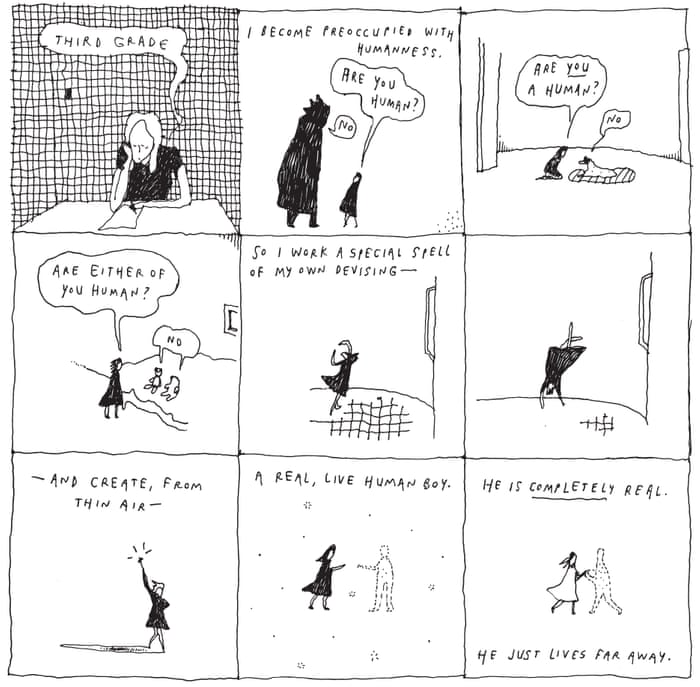
I was already a fan on Liana’s Instagram feed and her New Yorker cartoons. Passing for Human is beautifully told, via a series of re-starting narratives. One thing that stood out is Liana’s drawing ability. Her drawing style is raw and resembles doodles, but she is fearless and can draw anything with it. A complete world emerges: tiny houses, animals, humans and their lost shadows. Mythical, magical, and absorbing.
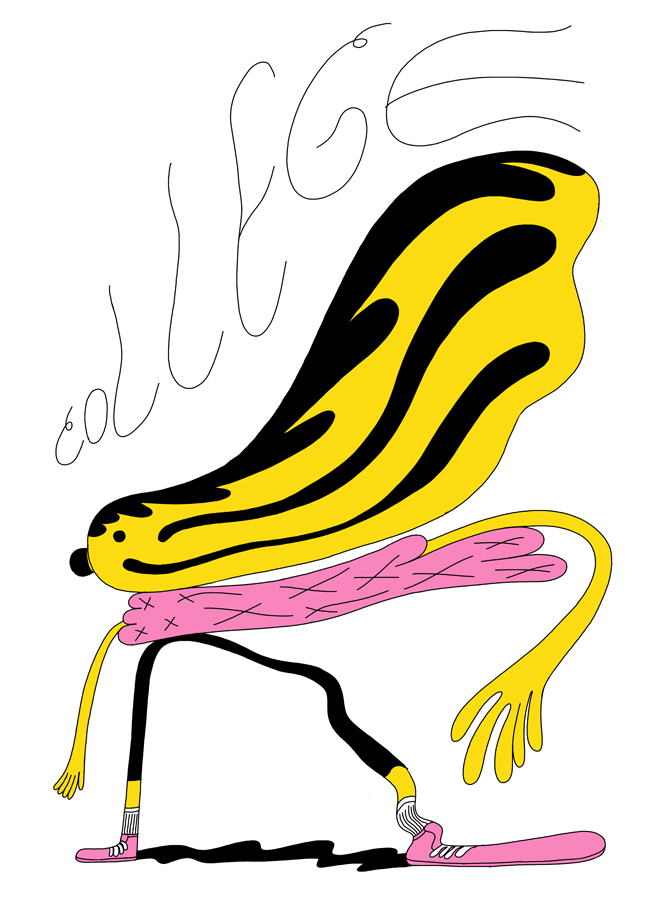
Brat contains the word art. One way to read DeForge’s Brat is to substitute Art for Brat; art performance for prank; critical cynicism for temper tantrum; artistic calling for juvenile delinquency. Brats are artists. The titular brat, Ms. D, is an juvenile delinquent/artist struggling with relevance. Once the hero of all brats, Ms. D finds herself older, and no longer a ‘juvenile’. Is she still relevant?
Ms. D embarks on a new project, that, at first glance, appears as a mysterious terrorist plot. Finally, her big performance turns the audience, an entire town, everyone, to become brats! The entire population of the city loses it’s collective mind. The results are at first predictable: graffiti, property damage, zoo animals on the loose, and at least one death (the Mayor gets eaten by a lion). But then, the loss of collective control produces a kind of utopia. In the aftermath, the town rids itself of instruments of control that turned out to be unnecessary. Banks and police? No longer necessary. Hunger? Gone. These things were just accrued, stratified historical layers of a society weighing us down. Once you release the brat, it all falls away. We don’t need these things.
What happens day after brat Armageddon? DeForge alludes to it. But things don’t seem to have changed much. Our hero remains rich, so even if some banks are gone, wealth remains. The world didn’t change all that much. Her former intern, Citrus, is now a star delinquent. Delinquency still exists. Maybe we need a bigger temper tantrum? Or the more things change, the more they remain the same.
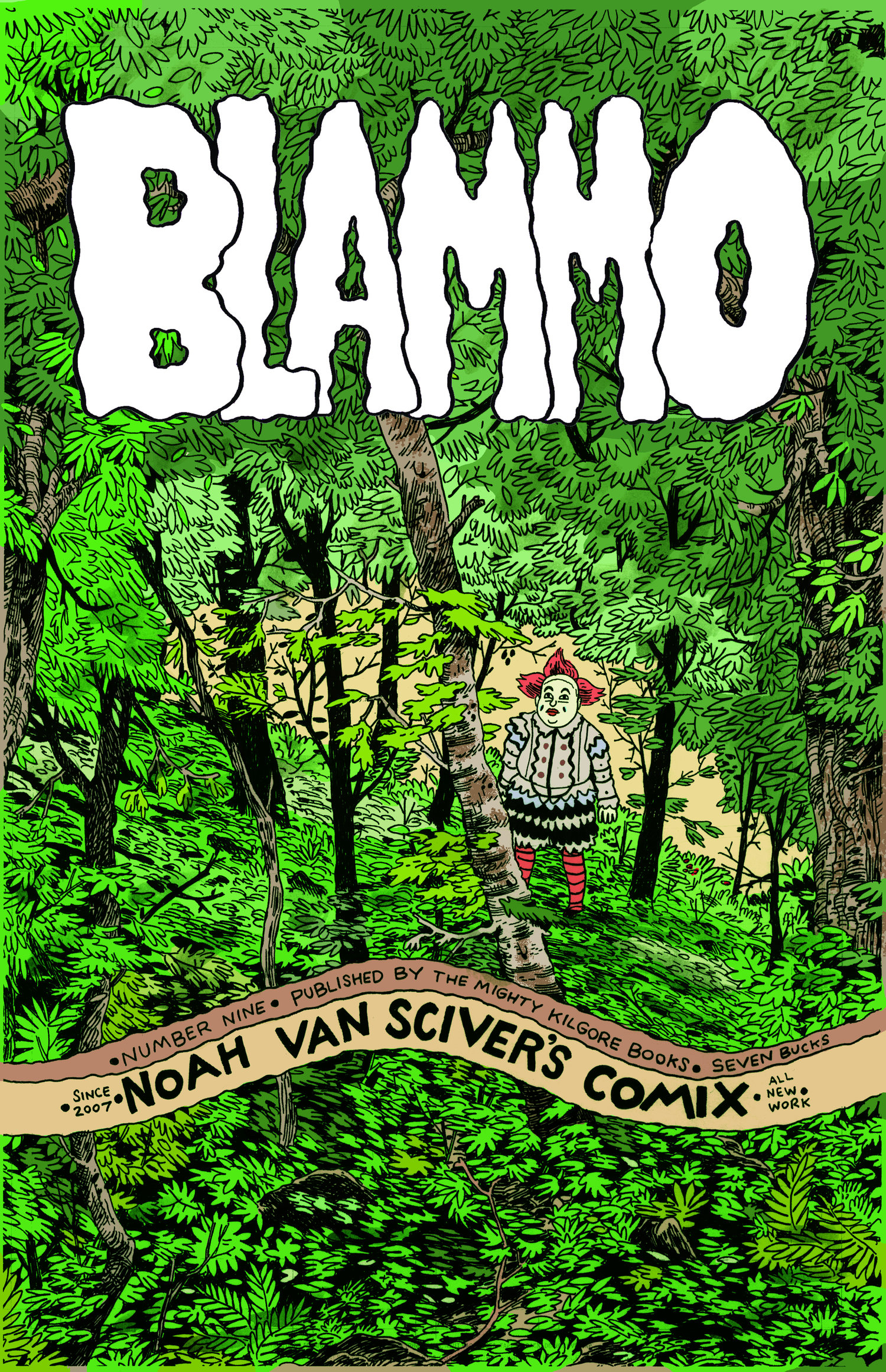
No one does the one-artist anthology like Noah Van Sciver. Blammo is the heir of the 80-90’s single artist anthology comics like Eightball, Optic Nerve, or Dirty Plotte. Every issue fills me with joy and nostalgic pangs for that time.
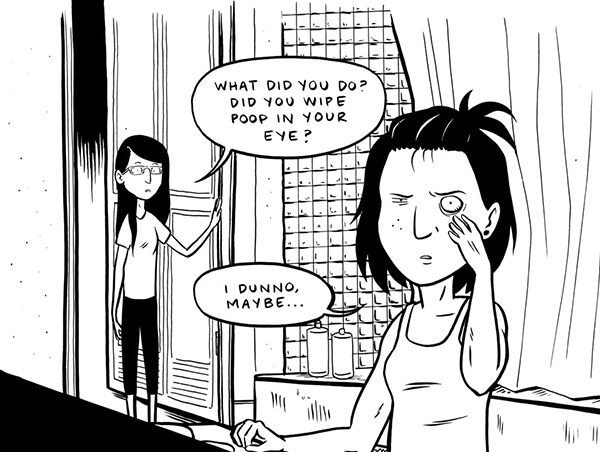
MS Harkness has emerged as a vital member of the Minneapolis comics scene. Her incredible work ethic has already yielded many mini-comics and her first graphic novel, Tinderella. Self-deprecating, self-abasing, fearless and fun, there are few books out the like it. It’s not a perfect book by any means, but it’s a promising foreshadowing of things to come.
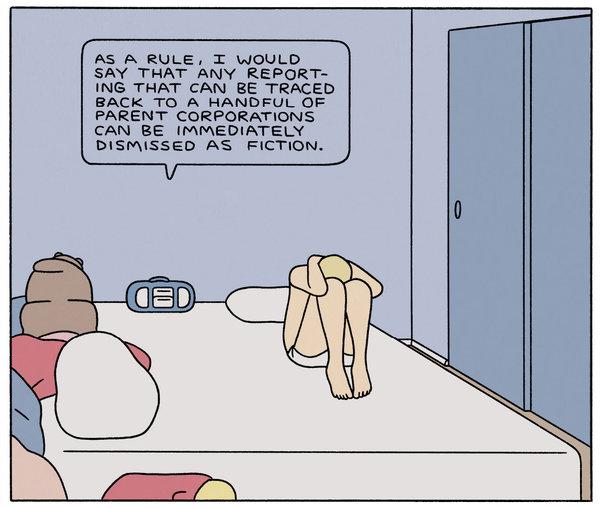
I didn’t know what to think of first when I to started read Sabrina. I was repelled by it’s quiet abandon, it’s cold artwork, and it’s meandering repetitions. But half way through, something flipped in my brain. I did a 180 and absolutely fell for this book. It reminded me of Tom McCarthy’s Remainder. Both books revolve around damaged characters trying to recapture something utterly lost and unrecoverable. It’s an impossible task. We’re placed in an uncomfortable voyeuristic position – watching the characters grasp at memories and fragments as they slowly evaporate – and we can’t look away.
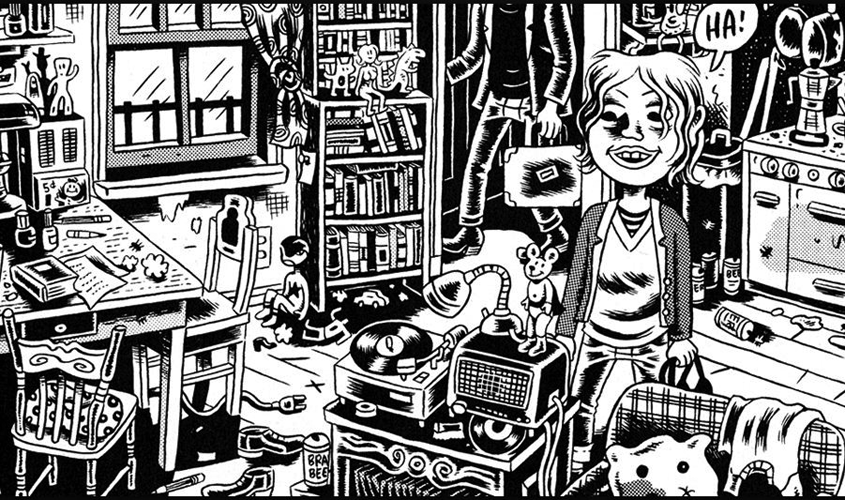
While working on Sweet Little Cunt: The Graphic Work of Julie Doucet with Anne Elizabeth Moore, I re-immersed myself in Julie Doucet’s comics of the 80’s and 90’s. It was another reminder of the incredible versatility of the one-artist anthology format. It enabled the artist to experiment, take detours, and continue on a primary narrative at the same time, while producing regular work, on a (somewhat) regular schedule. Julie filled every page of Dirty Plotte with incredible one-page bizarre experiments, ongoing stories (My New York Diary), and small one-off masterpieces of short comics. It’s really great D&Q brought this important work back into print.
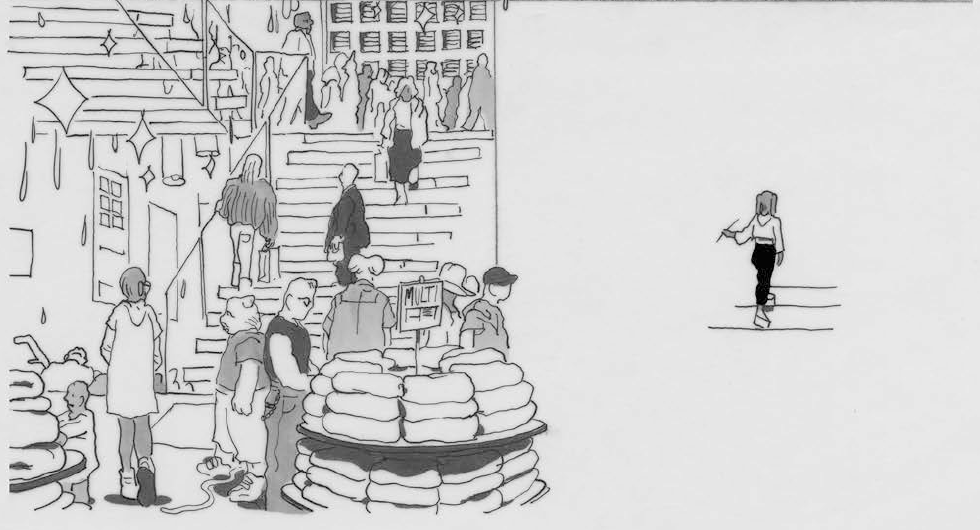
It took me a while to finally read this book. It was very much hyped after it’s release last year. When something is hyped, I tend to tune it out. I’m glad I finally read it. Connor’s minimalist cartooning is the perfect match for the absurd vacuous characters literally floating around a dystopic post apocalyptic world. It hits close to home. We are these characters. We are empty beings, getting stoned, floating easy as the world burns. Beautifully executed. Near perfect graphic novel.

Olivier Schrawen has an incredible ability for the absurd. Arsene, ostensibly a Schrauwen ancestor – gets involved in an absurd folly – a Utopian city in the middle of a tropical jungle. The book comes with explicit instructions to pause reading between certain chapters: a week, two weeks. I followed the directions to the letter, and I must say it enhanced the reading enormously. By the time I’d return to read the next chapter, the previous chapter had receded in my mind, like a dream. It perfectly suited the book. Finally, when Arsene and crew reach the jungle site of the utopian city, the absurd world had wormed itself into my unconscious, providing the perfect imaginative fuel for the finale to come.
I wrote about Eddy Current in my column and here on this blog. It remains one of the best comics I read in 2018.
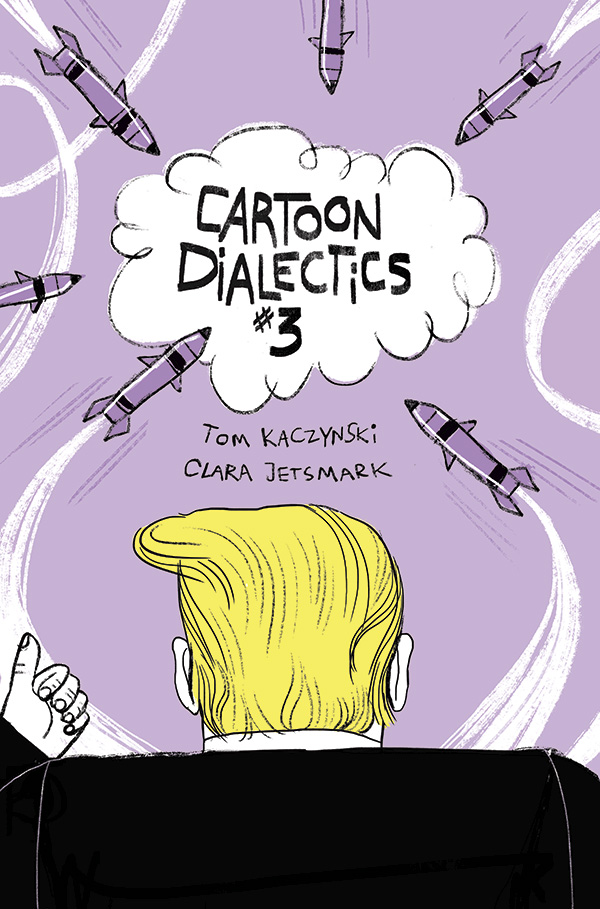
It’s difficult to hype your own work. I should know, I started a whole publishing company just to avoid hyping my own work! But, it’s very gratifying to see your own work on any best of list. When the list written by a writer you admire, well that’s even better! Cartoon Dialectics Vol. 3 makes it on the Best of 2018 list at Your Chicken Enemy. Here’s what they have to say:
Cartoon Dialectics #3 looks like a humble, unobtrusive work– it’s packaged like a zine, printed in purple, black and white with an occasional splash of yellow on somewhat thick, matte paper. But what Tom Kaczynski and Clara Jetsmark provide between its covers is powerful, invigorating stuff, connecting the dots between our society’s retromania and the rise of neo-fascism, while also acknowledging how easy it is for anyone to fall prey to the dangerous allure of nostalgia.
[…]
Bold in its aesthetic and literal simplicity and paradoxically educational and surreal, Cartoon Dialectics #3 did a far better job investigating where we are now and why in its few pages than the entirety of the New York Times this year.
Nick Hanover
A big thank you goes to The Nib for commissioning the piece in the first place. Another big thank you goes to Clara Jetsmark who bravely agreed to draw it on a very tight deadline when I ended swamped with other work.
Here’s a short few page preview of this comic for those who haven’t seen it yet:

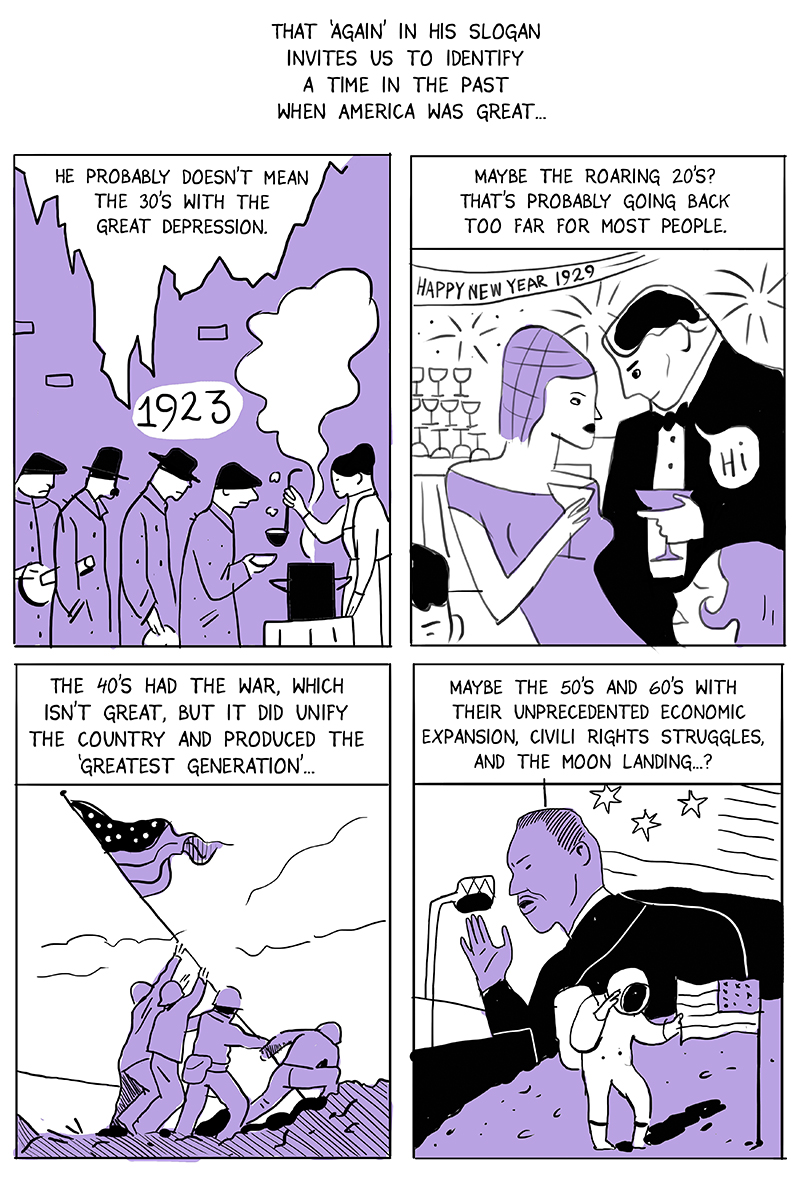
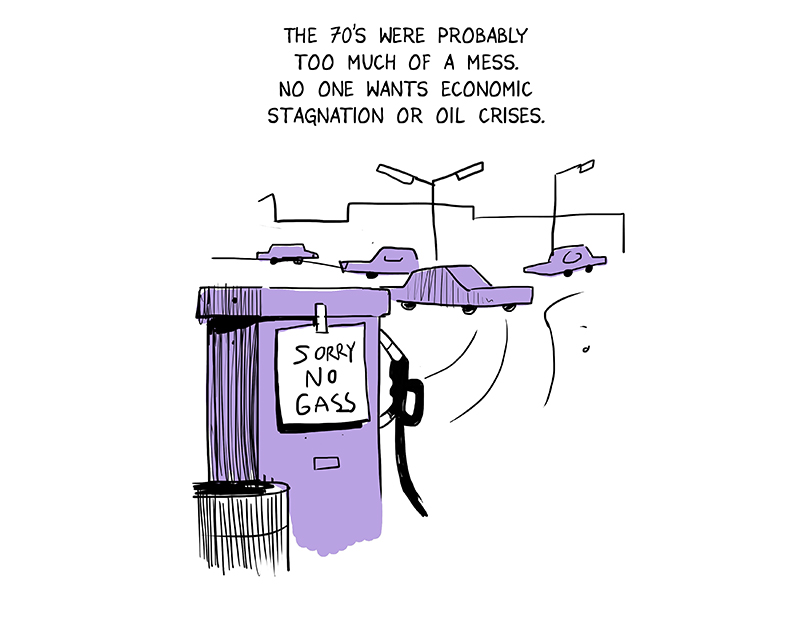
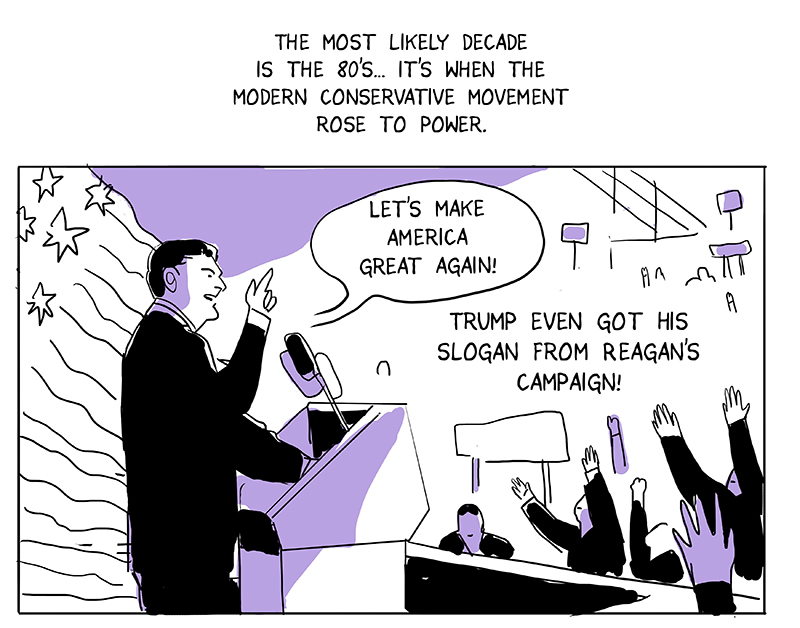
You can order a copy here:
Order Cartoon Dialectics Vol. 3I stumbled on the following a while ago on Blissblog:
“Along with the many cross-contaminations between rock-etc and s.f., one thing that Heller’s book reminded me of was that many of the very earliest rock criticism publications were started by people who had previously done science fiction fanzines.
Simon Reynolds | Blissblog
Intensely self-reflexive fields, rock criticism and science fiction share a strange mix of inferiority and superiority complexes. Painfully aware of their marginal position vis-à-vis “proper” journalism and “respectable” literature, they nonetheless believe that they are doing the Most Crucial Writing of Our Time. I can remember from my own days as an adolescent s.f. fanatic being struck by the s.f. writer’s culture of workshops and conventions – by how the writers loved to write essays defining s.f. as a genre, proclaiming its unique contribution to literature. There were even a few volumes of essays by s.f. writers debating s.f. that I remember reading.
This. This exactly describes me during High School. Except replace music with comics. I took pains to let everyone know that comics were the most important thing. I’m sure it was very annoying. Whenever I had to write essays about books in English class, I tried to convince my teachers to let me write about X-Men, Spider-Man, Fantastic Four, and whatever else I was reading at that time. Most of the time I was shut down, but a few teachers indulged as long as I could ‘prove’ to them that comics weren’t just kid’s stuff. Actually that was crucial. It challenged me to look at comics somewhat differently, and probably led to my actively seeking out better comics to impress my teachers.
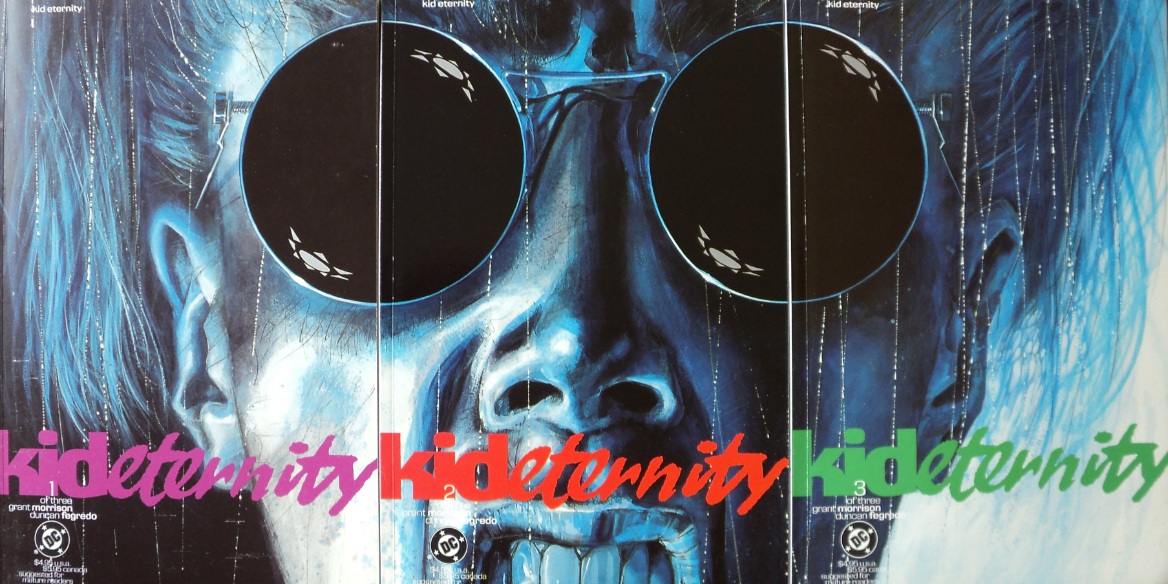
I have a pretty intense memory of showing Kid Eternity to my teacher. This is the Grant Morrison & Duncan Fegredo 90’s revamp with fully painted art. I remember challenging my teacher to look closely at the art. “It’s all painted” I’d say. “EVERY page is a full painting! Imagine if Michaelangelo had to paint the Sistine Chapel, over and over again, and tell the whole story in that famous painting.” I was definitely already a Science Fiction fan at this point. In Poland, I’d collected the magazine Fantasyka, which serialized sci-fi novels and comics. In the US, I read whatever sci-fi my library had on hand. Harry Harrison, Asimov, Pohl, Piers Anthony, David Eddings, Heinlein, Lem, etc.
To speculate wildly here… if we follow Fredrick Jameson’s assertion from Archaeologies of the Future, and think of Science Fiction as a sub-genre of the utopian novel (not the other way around), then sci-fi retains a utopian imaginary somewhere underneath all of the technological dress up. Sci-fi at it’s core imagines and extrapolates different worlds/futures based on different customs, different technologies, different environments (planets), etc. It’s easy to imagine young brains blown to bits by science fictional speculations.
I don’t think that I was consciously doing this at the time, but in retrospect, I must have been thinking about comics as some kind of major human innovation. The comics I was reading were not perfect, but I imagined a different future, where comics were the dominant literature. It’s a science fictional extrapolation. Take something small and insignificant from today, and imagine it as a dominant form in the future. Or at least, as something that has the capacity to become that.
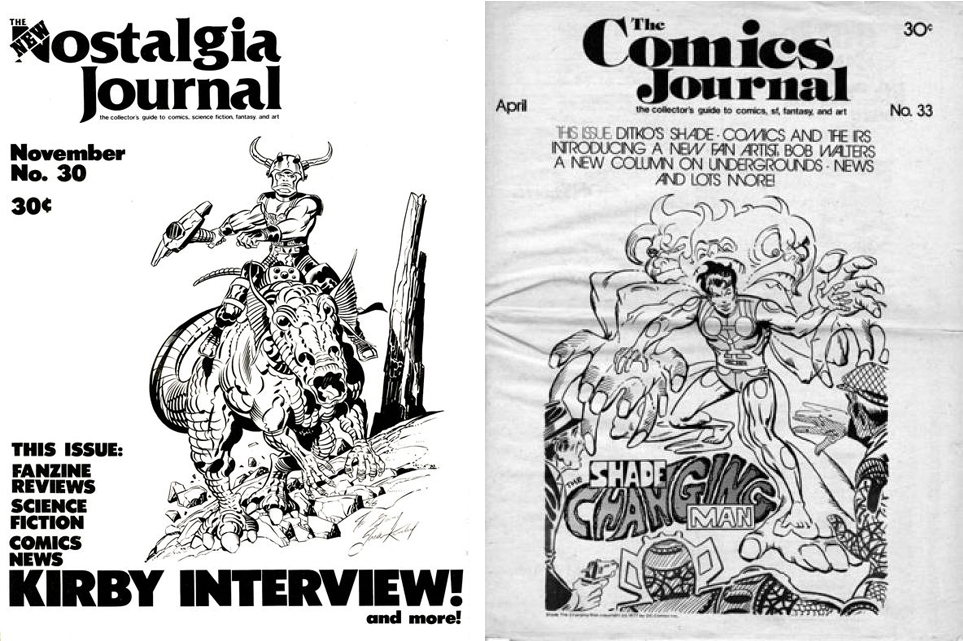
I imagine young Gary Groth in a similar mode. He takes over The Nostalgia Journal, a fantasy, sci-fi, comics, fanzine, and turns it into The Comics Journal, the most important magazine in the world. There was an inkling there already, a belligerent insistence on the importance of the medium. And all this without clear evidence for that importance, as The Comics Journal kept reminding us, while frequently berating the industry for failing to make great comics. It comes out of that same era. Sci-fi fanzines, pop/rock fan-zines, comics fanzines – popping up everywhere – creating new critical appreciation for debased art forms; art forms that were new and vital and popular. There was no rule book on how to write about these things. They had to invent it in real time. They were inventing the future in real time.
If you’ve read my Comics Journal column on Ted McKeever’s Eddy Current (and the outtakes here), you probably saw a brief detour I took to discuss the relationship between superheroes and cities. I’ve expanded that topic a little more on my twitter account. Check out this thread:
Explore more posts related to my Event Horizon column about the comics from 1985-87.