A few additions to my initial post before I forget them.
An anonymous reader pointed out (via comments) a couple of other institutions where cartoonists got training. Both Disney and Fleisher Brothers trained artists for animation. This type training followed the specialization model typical of the other schools I mentioned before. In this case the specialization was even more pronounced. These companies were growing very quickly at one point and had a huge demand for animation talent. The fact that they set up corporate schools to satisfy their own demand for animators, speaks to the fact that there weren’t many other places for this kind of education. Some of this training obviously could translate to comics and cartooning. At least one great comic-book artist, Jesse Marsh, came out of that system.
The other school (named by the same anonymous reader) was The John Buscema School. It was set up in the 1970’s by one of Marvel Comics’ most prolific artists, John Buscema. I know that Stan Lee lectured there, but I don’t know much else about it. The work that went into that school was the source material for the legendary How To Draw Comics the Marvel Way. I confess that I have created hundreds of pages of comics during my high-school days based on the exercises in that book. If the book is indicative of the curriculum of the Buscema School, then the school probably functioned in a way similar to the training done by the animation studios. It was a way to quickly train talent for a fast growing business.
Even though How To Draw Comics… contains a lot of work by Jack Kirby, it’s probably safe to assume he didn’t teach at the Buscema School. By 1971 he had left Marver for DC. Also, I think by then he had already moved to California(?). In an interesting side note, Kirby briefly worked for the Fleischer Studios as an inbetweener. But he hated the work:
From Fleischer I had to get out in a hurry because I couldn’t take that kind of thing,” describing it as “a factory in a sense, like my father’s factory. They were manufacturing pictures. (Via Wikipedia)
This is coming from a famously fast artist who was capable of turning in several issues of a standard comic-book per month. I wonder if this in any way could be a clue as to the conditions & pace present at the animation studio schools.
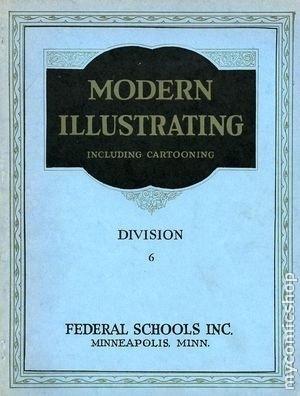
Modern Illustrating Including Cartooning (1935 edition) An interesting nugget about the state of comics education before the WWII can be found a the end of volume one the D&Q edition of Gasoline Alley (published as Walt & Skeezix). I just finished reading the volume and I can’t resist mentioning it. The book reprints seven pages from the fifth volume of Modern Illustrating and Cartooning. The book was published by Federal Schools, from Minneapolis, Minnesota. Federal Schools was the original name for the Art Instruction School which I already mentioned. Frank King wrote and illustrated the material reproduced. The piece is called “Lesson 3. Part 1. The Cartoon Page”. Here are a few subheaders to give you an idea of the material King’s writing about:
The Cartoon Page a Symposium on Timely Topics
Ideas
Arrangement
Making the Drawings
The content of the piece is a reminder why comics are called ‘comics’. Almost all of the advice is geared to creating humorous pieces on timely topics. King also encourage students to keep sketchbooks and to draw from life; sound advice for any era.
The material dates from 1931, but as Chris Ware notes in the explanatory text that accompanies the reprinted pages, most of the drawings that accompany King’s text dates to 1917 & 1918. Federal Schools was founded in 1914, so it’s certainly possible that earlier editions of the work exist.
Chris Ware also raises the tantalizing possibility “that [Charles] Schulz worked his way through King’s exercises as part of his correspondence training”. Schulz is the star alumni of the Art Instruction School, and had famously taught there as well. Incidentally the school is still around. A few of my friends were instructors there. It’s still a correspondence school, and the instructors still hand-correct (with red ink) sent in student drawings.
In my last post I briefly outlined the how comics education worked in the early years of the form. Today I want to start getting into what I think is the next phase of development of the comics medium and comics education.
The initial bursts of energy that created newspaper comic strips (at the turn of the century) and comic-books (in the 1930’s) had dissipated. Since the 1950s newspapers started to systematically reduce the size of comic-strips and sunday sections (as well as more aggressively censor the strips). The formation of the Comics Code Authority after the Senate Subcommittee hearings strangled creativity on the comic-book world. The comics Roy Lichtenstein was appropriating (as mentioned last time) were lowly commercial junk for kids; largely anonymously produced.
Around the same time Lichtenstein was making his comics-based paintings, the art form was rapidly transforming. DC & Marvel were reviving the superhero genre. Marvel’s fresh take on the stale genre was especially instrumental in raising the profile of comics among a young literate college educated audience. A few years later the Undergrounds would emerge and take comics into the taboo breaking territory of sex, drugs and rock ‘n roll. The undergrounds established a link between comics and counterculture which would prove a fertile ground for future innovation. This was followed by increasingly literate and arty comics anthologies, the invention of the Graphic Novel (the term and format), and the independent comics boom of the 80’s (and the great bust in the 90’s). Throughout this time the status of comic-books (and newspaper strips) as a mass medium was slowly eroding. But as the health of the medium faltered, the the health of the art form was undergoing a creative renaissance.
The whole 20 year period from the late 70’s to the late 90’s saw an aggressive effort by cartoonists, writers and publishers to make the case for comics as an art form. Will Eisner’s A Contract With God popularized a whole new book store category: the graphic novel. Hated or loved, this coinage is largely responsible for opening the door for the medium into a whole new market. In the late 70’s and early 80’s Gary Groth’s Comics Journal transformed itself from a fan publication, into a hard hitting magazine with journalistic standards and a much needed critical voice. RAW dragged comics into the art world, and Weirdo tried to keep it low brow. But, both insisted that comics are an art form that needed to be recognized. To list all the great comics from that period would take too long. I listed some of them in the timeline below.
I don’t know much about the state of comics education during that period. I have more questions than answers. I know that Eisner was teaching and lectured on the art form at SVA during the 70’s and 80’s. Eisner’s two books on the medium Comics and Sequential Art and Graphic Storytelling and Visual Narrative were born from his academic career. Eisner coined the term Sequential Art, a broad category of combining images with words in a sequence, that includes not only comics, but storyboards, instructional manuals, and others. Eisner:
In general terms we can divide the functions of Sequential Art into two broad applications; instruction and entertainment. Periodical comics, graphic novels, instructional manuals and storyboards are the most familiar vehicles. in the main, periodical comics and graphic novels are devoted to entertainment while manuals and storyboards are used to instruct or sell. But there is an overlap because art in sequence tends to be expository.
Another instructional function of this medium is conditioning an attitude toward a task. The relationship or the identification evoked by the acting out or dramatization in a sequence of pictures is in itself instructional. People learn by imitation and the reader in this instance can easily supply the intermediate or connecting action from his or her own experience. Here too there is no pressure of time as as there would be in a live action motion picture or animated film. The amount of time allowed to the reader of a printed comic to examine, digest and imagine the process of acting out or assuming the role or attitude demonstrated is unlimited. There is room for approximation and opportunity for specific performances which the reader can examine without pressure. Unlike the rigidity of photographs, the broad generalizations of artwork permits exaggeration which can more quickly make the point and influence the reader.
Kent pointed out that:
It’s not difficult to imagine Eisner making this same pitch to Proctor and Gamble or Pan Am execs, trying to sell them on instructional comics as the way to reach consumers and employees alike. His long career as a visual propagandist – for a certain conception of comics as well as for specific companies and causes – remains an underappreciated aspect of his life and work as a whole. There is definitely a sense in this chapter that he is trying to seal the deal, both intellectually and commercially.
Kent continued on to gently chide Eisner for his narrow vision for the use of Sequential Art. However, if the book is looked at from the point of view of how comics were taught at the time Eisner’s point of view makes more sense. It reads much like a text book which tries to sell students on the usefulness of the skills whey will learn… which are the very skills being taught at SVA and the Kubert School at the time. I assume the curriculum at these institutions still largely focused on turning out technically proficient workers for the commercial print industry. But I wonder what kind of discussions were going on in the classrooms at the time. All the ferment going on in comics at the time must have kicked up some dust at the schools… Some alumni from that time:
SVA: Peter Bagge, Kaz, Mark Newgarden
Kubert School: Rick Veitch, Stephen R. Bissette
It’s also no surprise that Eisner himself has built his career by created the very items (periodical comics, graphic novels and instructional manuals) he names as examples of Sequential Art. The book was published in 1985, and already felt like an anachronism… an artifact form an earlier era. Despite some of the commercial trappings of Eisner’s book, there is a sense of respect for comics and a clear attempt to define the art form as such. This formalization and the coinage of term Sequential Art would become an important milestone. It gave artists, academics, and publishers a term they could rally behind. The term ‘freed’ comics from… well the comics, and all the negative connotations that came with it.
Next up: Scott McCloud, Art School Confidential, and more.
Timeline:
1952. Mad Magazine founded
1954. United States Senate Subcommittee on Juvenile Delinquency hearings take place
Comics Code Authority (CCA) founded
1961. “Look Mickey” painted by Roy Lichtenstein
Stan Lee and Jack Kirby’s Fantastic Four #1 published
1968. Zap Comix published
1970. Philip Guston’s cartoon paintings first exhibited
1972. Justin Green’s Binky Brown Meets the Holy Virgin Mary published
1975. Art Spiegelman & Bill Griffith’s Arcade published
1976. Harvey Pekar publishes American Splendor
1977. The Nostalgia Journal becomes The Comics Journal (issue #37)
1978. A Contract With God by Will Eisner published (popularized the ‘Graphic Novel’ nomencalture)
SCAD founded
1980. RAW published by Françoise Mouly (edited by Art Spiegelman and Mouly)
1981. Weirdo published
The Hernandez Brothers publish Love And Rockets
1985. Will Eisner’s Comics and Sequential Art published
1986. Batman: The Dark Knight Returns by Frank Miller Watchmen by Alan Moore & Dave Gibbons
1992. Art Spiegelman’s Maus awarded the Pulitzer, the Eisner and the Harvey
1993. Scott McCloud’s Understanding Comics published
1996. Will Eisner’s Graphic Storytelling and Visual Narrative published
The date of MIX is approaching soon! I’m excited that Minneapolis has the potential to become the site of a regular indie comics convention. I understand that the table space went really fast, which is indicative of the demand for such an event. But, more on MIX in the future. I mention it only in passing because, during MIX, I’m moderating a panel on Comics Education . I’m pretty new to teaching (I taught my first class at MCAD this Spring), but the topic of comics and education is something that I’ve thought about a lot over the years. I’m going to post some notes over the next couple of weeks to in an attempt to clarify my ideas on the subject. Most of this will be US centric. I don’t know much about how/if comics are taught elsewhere. I also realize that some of this may include inaccuracies and generalizations. I hope to correct these over time. Anyone please feel free to chime in.
First, a little history. Comics or cartooning have been taught for a long time. Historically comics and cartooning schools were mostly designed as technical colleges that taught the skills necessary to get work in the fast paced commercial environment of newspapers, pulps, magazines and comic-books. Some key institutions that embodied that approach were:
The Art Instruction School was founded in 1914, and is famous for the ubiquitous Tippy the Turtle ads and Charles Schulz. It’s purely a correspondence school and was founded to (in their own words) “train illustrators for the growing printing industry.”
Cartoonists and Illustrators School was founded in 1947 by Burne Hogarth to educate returning WWII GI’s. It was originally known as The Manhattan Academy of Newspaper Art and eventually became The School of Visual Arts (in 1956). This is the only school on this list that transformed itself from a primarily technical art school, to a ‘proper’ art school as we understand them today.
The Joe Kubert School of Cartoon and Graphic Art was founded in 1976 by Joe Kubert. Their mission is stated as: “The school is dedicated to aspiring cartoonists who are dedicated to becoming professionals in cartooning, comic book, and the general field of commercial art.”
In all of these schools comics and illustration went hand in hand and on some level were interchangable. The focus was on representational drawing and painting, perspective, pen and ink, drafting, lettering etc. These were the exact skills a student needed to master to create camera ready artwork for commercial printing and publication. As such these institutions were tied to a cheap mass medium: print. Students were encouraged to specialize. The speed of publication required separate people to write, draw (penciller), ink (inker), letter and color a single story. Artists from that era created countless pages of comics for huge & small corporations (many of them unsigned) under strict deadlines, in an assembly line system. It’s a wonder that any great comics managed to be made despite the brutal, fast-paced system.
The commercial quality of the comics is why ‘real’ artist like Roy Lichtenstein could paint panels from a comic-book in a gesture similar to Andy Warhol’s later Campbell’s Soup Can. Comic-book art was generally seen (with some exceptions of course) as anonymous commercial junk for kids. Lichtenstein’s comic-book based paintings became an important defining moment (myth?) for the future of Comics Art in education and it’s relationship with Art and Art Schools. This is something I’ll tackle in the next post.
A partial timeline. Some of these items will not become significant for comics education until later:
1914. Art Instruction School Founded
1947. Cartoonists and Illustrators School founded
1958. Dynamic Anatomy by Burne Hogarth published
1961. “Look Mickey” painted by Roy Lichtenstein
1970. Dynamic Figure Drawing by Burne Hogarth published
1976. The Joe Kubert School of Cartoon and Graphic Art founded
1978. How To Draw Comics the Marvel Way by Stan Lee and others published
Er… maybe the title is an overstatement. In any case, Kevin Huizenga will be in Minneapolis to give a lecture at MCAD. For those who follow comics, Kevin needs no introduction. For those of you who don’t know his work, he’s easily one of the best and most interesting cartoonists working today. But don’t take my word for it, come see for yourself! Kevin will speak at MCAD during the student mini-comic Expo on Thursday (Mar. 24th) at 1:00 pm.
I wrote about this 15 page collaboration with Dash Shawsome time ago. The story is called ‘Resolution’ and it is published in the current issue of MOME. That very issue (vol. 17) has just made it onto the shelves of comic-book stores. More information, video & PDF previews and the option to buy the book courtesy of Fantagraphics.
Frank Santoro recently posted a note about ‘fusion cartoonists.’ He sees the work of Paul Pope and Scott McCloud’s Zot as progenitors of a new stylistic movement (a loose term – perhaps a better word is sensibility?). Other, younger cartoonists mentioned in the same breath are Brandon Graham, Brian Lee O’Malley, and Dash Shaw. Their work (according to Frank – and I concur) is a new kind of fusion of contemporary and international influences. Their works draw on art from all the major comic-book producing regions: America, Japan, and Europe. This international miscegenation is key.
Frank likes Jazz metaphors and I think ‘fusion’ generally fits… though it’s perhaps a little broad. I’ve been thinking recently along similar lines, but aligning these artists with a recent art-world concept of Altermodernism. The term & concept was coined by Nicolas Bourriaud in 2005. Bourriaud asserts that post-modernism has exhausted itself and it must be replaced by a new concept. His candiate is Altermodernism. Here’s his explanation:
“Artists are looking for a new modernity that would be based on translation: What matters today is to translate the cultural values of cultural groups and to connect them to the world network. This “reloading process” of modernism according to the twenty-first-century issues could be called altermodernism, a movement connected to the creolisation of cultures and the fight for autonomy, but also the possibility of producing singularities in a more and more standardized world.”
To my eyes this really fits what Frank is describing.
Altermodernism itself is still rather vague and ill-defined… it’s very new after all… but at least it’s meaning is not yet so overstuffed like it’s predecessors post-modernism and modernism. I for one would be thrilled to see comics at the head of an artistic vanguard, embracing and extending the meaning of the zeitgeist with the same kind of determination seen in the art world. Down with Alternative. Long live Altermodern!
I was asked to contribute an essay on the work of Will Eisner as part of this year’s (2010) Will Eisner Week celebrations. I decided to take a closer look at Eisner’s Contract With God Trilogy. The essay (well… really a series of notes) just got posted. Here’s a short excerpt:
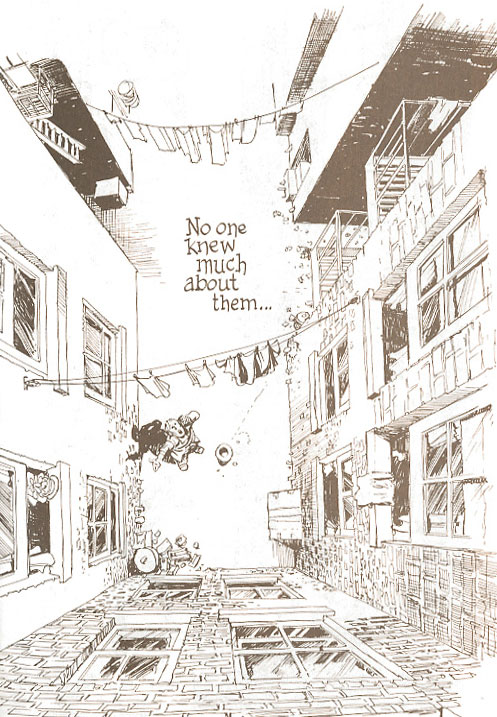
All the stories in A Contract with God take place on Dropsie Avenue. Eisner fills this fictional Bronx street with multiethnic (especially Jewish) immigrants, desperate criminals and ragged tramps. Sudden wealth is as possible as instant ruin. Throughout the book it becomes obvious that the real protagonist of the book is the street itself. Eisner lavishes attention on its dilapidated buildings, rain drenched stoops and moody street-scapes. He’s clearly enamored of the urban patina of the place. With each subsequent story, Eisner increasingly begins to use the architecture of the street as a substitute for the panel border. In effect he trades the comic-book gutters for the gutters of the street.